HMG Australia — Menotropin Gonadotropin Reference Material
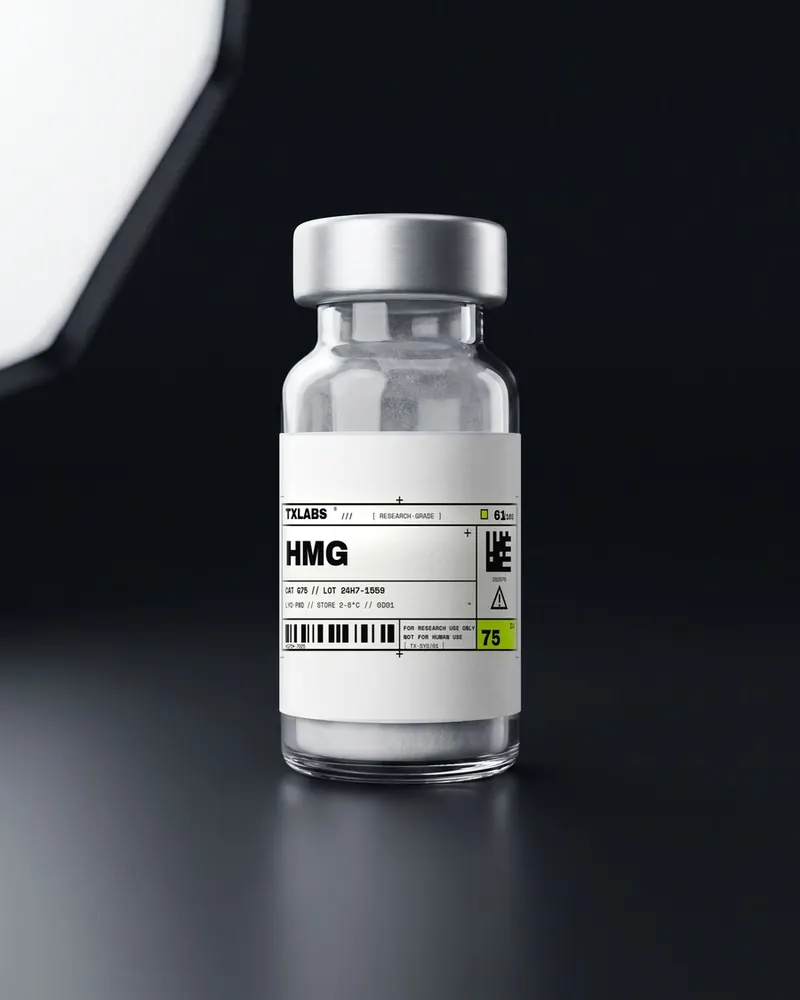
From $199 AUD · ≥98% HPLC purity · third-party COA · ships Australia-wide
What is HMG?
HMG (human menopausal gonadotropin, menotropin) is a gonadotropin preparation with follicle-stimulating (FSH) and luteinising (LH) hormone activity. Derived from the urine of postmenopausal donors, it is studied in reproductive endocrinology research on folliculogenesis, ovulation and gonadal function.
Specifications
- From: $199 AUD
- Category: Hormones & Sexual Health
- Form: Lyophilised powder
- Purity: ≥98% HPLC
- Testing: Third-party Certificate of Analysis
- Classification: Research reference material · For Research Use Only
What the research covers
HMG stands for human menopausal gonadotropin, also called menotropin. It is a prescription-only medicine in Australia and registered prescription products containing menotropin exist on the Australian Register of Therapeutic Goods. TXLABS supplies it strictly as an analytical reference material for laboratory work. It is not supplied for human or veterinary administration, and no clinical indication is described on this page.
The central fact about this material is that it is not a single molecule. Menotropin is a purified preparation derived from human urine that carries both follicle-stimulating hormone and luteinising hormone activity, conventionally in an approximately equal ratio, and it is standardised by biological assay in international units of each activity rather than by mass. Its content is therefore defined functionally. That makes it categorically different from the synthetic peptides that dominate this catalogue, where a stated milligram figure and an observed mass define the product.
The underlying hormones are heterodimeric glycoproteins. Follicle-stimulating hormone, luteinising hormone, thyroid-stimulating hormone and chorionic gonadotropin all share a common alpha subunit, encoded by CGA, and are distinguished by a hormone-specific beta subunit. The two subunits associate non-covalently, each carries N-linked glycans, and neither subunit alone reproduces the activity of the assembled dimer. Because the beta subunits differ and the alpha subunit does not, immunoassays and identity methods for these hormones are designed around beta subunit epitopes. Urinary-derived preparations additionally carry a background of other urinary proteins, and the degree to which those are removed is a defining characteristic of a given manufacturing process.
The published research relevant here is largely reproductive endocrinology and analytical chemistry: gonadotropin receptor pharmacology, glycoform characterisation, comparisons of urinary-derived and recombinant gonadotropin preparations, and immunoassay standardisation against international reference preparations. In each case the value of a reference material lies in the traceability of its unit definition.
TXLABS supplies HMG as an analytical reference material for laboratory research only. It is a prescription medicine in Australia, it is not supplied for human or veterinary administration, and it is not offered for any therapeutic purpose.
Reading the certificate
The useful certificate for a urinary-derived gonadotropin preparation is a bioassay and impurity document rather than a purity percentage. Ask which activities are stated and how each was assayed, and against which international reference preparation the assay was calibrated, since traceability of the unit is the whole basis of the figure. Ask about total protein against stated gonadotropin activity, because the ratio is a direct measure of how much co-purified urinary protein remains and it varies widely between processes. Ask about the isoform or glycoform profile by isoelectric focusing, since sialylation differences change behaviour without changing sequence. A single reversed-phase HPLC percentage says almost nothing here. TXLABS publishes third-party certificates for tested lots in the CoA library; no certificate is currently published for HMG. The certificate for the lot supplied is available on request to support@txlabs.bio.
Storage and handling
Glycoprotein heterodimers fail in ways that short peptides do not. The alpha and beta subunits are held together non-covalently, so anything that destabilises the association, heat, extremes of pH, chaotropic conditions or repeated freezing and thawing, dissociates the dimer and removes the activity while leaving both polypeptides present and detectable. A preparation can therefore be intact by protein content and depleted by bioassay. Sialic acid residues on the glycans are labile to acid and to microbial sialidase, and desialylation alters clearance behaviour and the isoelectric profile without any change to the protein backbone.
Store the lyophilised material frozen, desiccated and protected from light, and equilibrate the sealed vial to room temperature before opening. Reconstitute by adding diluent slowly down the vial wall and swirling gently; do not vortex or shake, since interfacial stress drives aggregation of glycoproteins at low concentration. Hold solutions cold, use them promptly and aliquot rather than cycle them through the freezer. Australian summer transit routinely exceeds 40 C, and for a bioassay-defined preparation the risk is that potency falls silently with no visible change to the cake or the solution.
Working out concentration
Menotropin is presented by activity. The TXLABS vial is nominally 75 IU. Taken into 1 mL that gives 75 IU/mL; into 2 mL, 37.5 IU/mL; into 5 mL, 15 IU/mL. Conventionally the figure refers to 75 IU of follicle-stimulating hormone activity together with 75 IU of luteinising hormone activity, so a record that states only a single unit figure is ambiguous and should specify which activity it describes. There is no general conversion from international units to milligrams for this material, because the unit is defined by bioassay and specific activity depends on the preparation. The calculator handles ordinary mass and volume conversions. Unit arithmetic only, not a protocol.
How it relates to adjacent compounds
HMG belongs to the gonadotropin group of this catalogue and is best understood alongside its immediate relatives. hCG shares the same alpha subunit and differs in its beta subunit, and is likewise standardised in international units by bioassay; the two are frequently discussed together in reproductive endocrinology and are frequently confused in supply chains, which is a reason to read the analyte name carefully on any certificate. Gonadorelin sits upstream of both in the endocrine axis as the hypothalamic decapeptide, and is by contrast a small, fully defined synthetic peptide whose certificate answers completely different questions. Kisspeptin-10 occupies a related position in that axis. These are subject-matter and axis adjacencies only, and imply nothing about comparable activity or interchangeable use.