Kisspeptin-10 Australia — KISS1R Reference Decapeptide
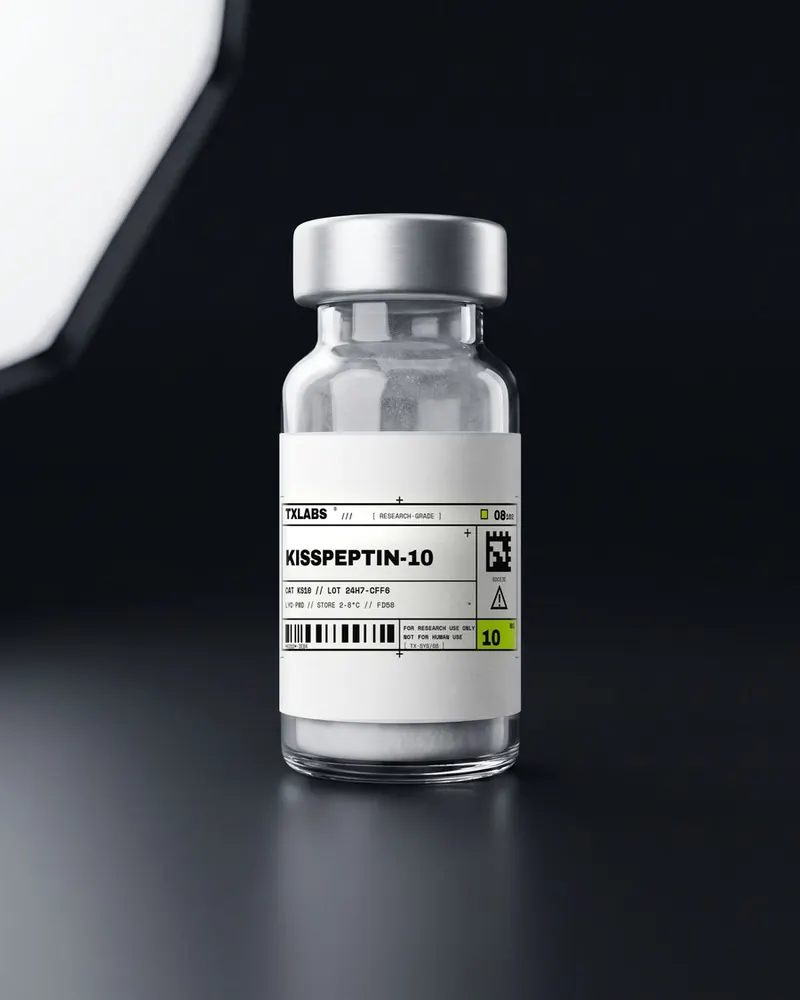
From $69 AUD · ≥98% HPLC purity · third-party COA · ships Australia-wide
What is KissPeptin-10?
KissPeptin-10 (kisspeptin-10, metastin fragment) is a decapeptide that stimulates gonadotropin-releasing hormone (GnRH) neurons. It is studied in reproductive endocrinology research on the hypothalamic-pituitary-gonadal axis and LH and FSH secretion.
Specifications
- From: $69 AUD
- Category: Hormones & Sexual Health
- Form: Lyophilised powder
- Purity: ≥98% HPLC
- Testing: Third-party Certificate of Analysis
- Classification: Research reference material · For Research Use Only
What the research covers
Kisspeptin-10 is the C-terminal decapeptide of the KISS1 gene product and the shortest fragment that retains full agonist activity at its receptor. PubChem lists the formula C63H83N17O14 and a molecular weight of 1302.4 Da for the sequence YNWNSFGLRF with a C-terminal amide. That amide is not decorative: the kisspeptins belong to the RFamide peptide family, defined by a C-terminal arginine-phenylalanine-amide motif, and the amidation is required for receptor recognition. Loss of it produces a substantially less active molecule of nearly identical mass.
The naming in this family is a genuine source of confusion. The KISS1 gene encodes a 145-residue precursor that is processed to a 54-residue peptide, originally called metastin, and to shorter forms of 14, 13 and 10 residues. All of them share the same C-terminal decapeptide sequence, which is why kisspeptin-10 is the fragment most often used as a research tool, and why literature referring to kisspeptin without a number may concern any of them. The receptor is KISS1R, also and interchangeably called GPR54, a Gq-coupled G-protein-coupled receptor.
The research literature places KISS1R signalling upstream of gonadotropin-releasing hormone neurons in the hypothalamus, and published work has examined that hierarchical relationship in animal models, along with receptor pharmacology, beta-arrestin recruitment and receptor desensitisation on continuous exposure. A separate and earlier strand concerns the KISS1 gene product's original identification in the context of tumour metastasis suppression, which is where the metastin name came from and which remains an active field in its own right.
TXLABS supplies kisspeptin-10 as an analytical reference material for laboratory research only. It is not an approved therapeutic good in Australia and is not supplied for human or veterinary administration.
Reading the certificate
The first check for a kisspeptin product is which kisspeptin it is. Kisspeptin-54, -14, -13 and -10 all share the same C-terminal decapeptide, so the name alone does not identify the molecule and the masses differ substantially; confirm the analyte name and the observed mass against 1302.4 Da. The second check is the C-terminal amide, which is required for RFamide receptor recognition; the free acid is one dalton heavier and chromatographically similar, so mass resolution matters. Oxidised tryptophan, sixteen daltons above the parent, is the expected acquired impurity. TXLABS publishes third-party certificates for tested lots in the CoA library; no certificate is currently published for kisspeptin-10. The lot certificate is available on request to support@txlabs.bio.
Storage and handling
Kisspeptin-10 has two chemically vulnerable residues in ten positions: a tryptophan, which is photosensitive and oxidation-prone, and a tyrosine at the N-terminus, which is also oxidisable. Light protection is therefore a chemical requirement rather than a general precaution, and amber or foil packaging matters. The peptide is also relatively hydrophobic for its length, with tryptophan, two phenylalanines and a leucine, so aqueous solubility is more limited than the mass alone would suggest and a solution that does not clear immediately is not necessarily faulty. Store the lyophilised material at -20 °C, desiccated and in the dark, and equilibrate the vial to room temperature before opening so that condensation does not wet a hygroscopic cake. Reconstituted solution is held at 2-8 °C, shielded from light, and aliquoted before freezing. Australian ambient light is intense and summer transit routinely exceeds 40 °C in vehicles and letterboxes, both of which accelerate tryptophan degradation. Collect promptly, unpack indoors and refrigerate.
Working out concentration
The TXLABS kisspeptin-10 vial is 10 mg. Reconstituted with 2 mL of bacteriostatic water it gives 5 mg/mL; with 1 mL, 10 mg/mL; with 5 mL, 2 mg/mL. At 1302.4 Da a 5 mg/mL solution corresponds to approximately 3.8 mM. Published receptor pharmacology on KISS1R is normally specified in the nanomolar range, so the serial dilution from any practical stock is long and the mass-to-molar conversion is the step most often mishandled. Because the peptide is comparatively hydrophobic, a lower stock concentration is sometimes the more practical starting point. The reconstitution calculator resolves vial mass against volume. Concentration examples only, not a protocol.
How it relates to adjacent compounds
Gonadorelin is kisspeptin-10's most meaningful catalogue neighbour, and the relationship is genuinely hierarchical rather than merely categorical: the published literature places KISS1R signalling upstream of the gonadotropin-releasing hormone neurons that gonadorelin's receptor serves, so the two act at different points in the same hypothalamic pathway. HCG sits further downstream still, at the gonadotropin receptor level, and is a glycoprotein rather than a peptide. Oxytocin is another small hypothalamic-origin peptide with an unrelated receptor and structure. Kisspeptin-10 is also the only RFamide-family peptide stocked here, so the C-terminal amide requirement that governs its identity checks has no parallel elsewhere in this catalogue. Pathway and structural relationships only.