Gonadorelin Acetate Australia — Synthetic GnRH Decapeptide
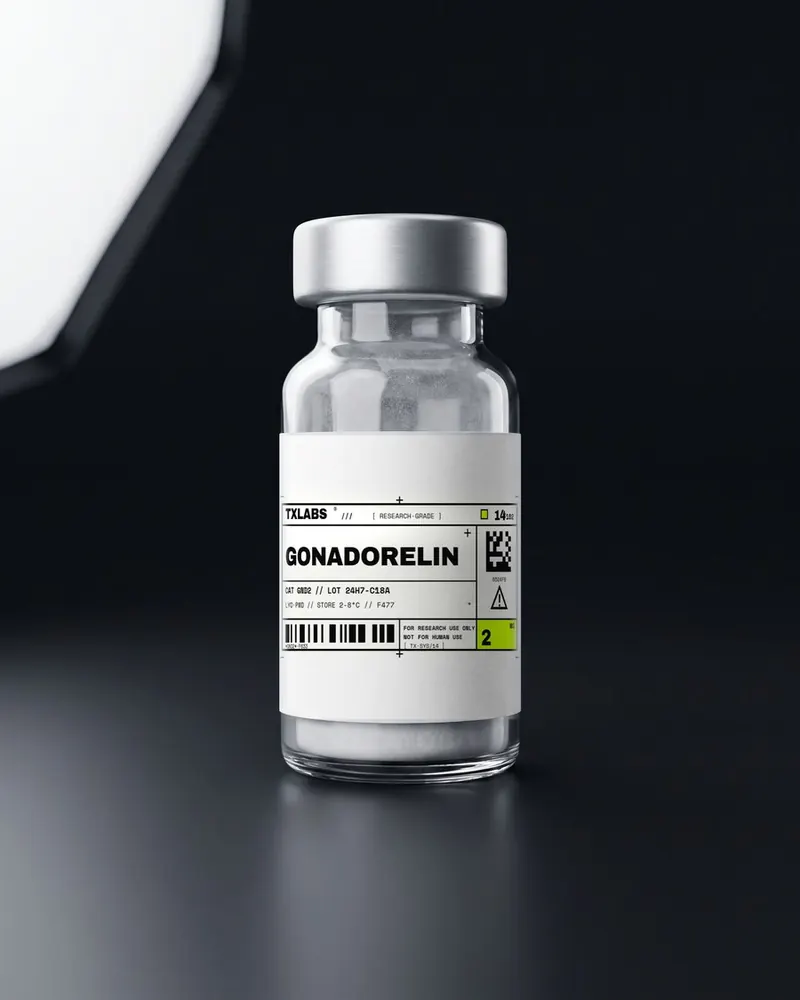
From $149 AUD · ≥98% HPLC purity · third-party COA · ships Australia-wide
What is Gonadorelin Acetate?
Gonadorelin acetate (GnRH, LHRH) is a synthetic decapeptide that stimulates the pituitary release of LH and FSH. Identical to endogenous gonadotropin-releasing hormone, it is used as a reference material in research on the hypothalamic-pituitary-gonadal axis.
Specifications
- From: $149 AUD
- Category: Longevity & Bioregulators
- Form: Lyophilised powder
- Purity: ≥98% HPLC
- Testing: Third-party Certificate of Analysis
- Classification: Research reference material · For Research Use Only
What the research covers
Gonadorelin is synthetic gonadotropin-releasing hormone, also called luteinising hormone-releasing hormone, and unlike almost everything else in this catalogue it is the native sequence rather than an analogue of one. PubChem lists the formula C55H75N17O13 and a molecular weight of 1182.3 Da. The sequence is pGlu-His-Trp-Ser-Tyr-Gly-Leu-Arg-Pro-Gly-NH2, and both ends are chemically unusual: the N-terminus is a pyroglutamate, a glutamine or glutamate residue cyclised into a lactam ring, and the C-terminus is a glycinamide. Both modifications occur naturally in the hormone, and both have practical consequences, since a pyroglutamate cannot be sequenced by standard N-terminal Edman degradation and its formation during synthesis has to be controlled deliberately.
GnRH is released in pulses from hypothalamic neurons and acts at the GnRH receptor, a Gq-coupled G-protein-coupled receptor on pituitary gonadotrophs, where it governs the secretion of luteinising hormone and follicle-stimulating hormone. Its native reported half-life is very short, a few minutes, because the sequence is cleaved rapidly by peptidases. That fragility is exactly why every clinically developed GnRH analogue, leuprorelin, triptorelin and goserelin among them, carries substitutions at position 6 and often a modified C-terminus that gonadorelin lacks. Read alongside those analogues, gonadorelin is the unmodified baseline that shows what the modifications were for.
A central and much-studied feature of this receptor is that pulsatile and continuous exposure produce opposite outcomes: brief pulses maintain gonadotropin secretion, while continuous receptor occupancy leads to desensitisation and downregulation. Published research on gonadorelin covers that pulsatility relationship, receptor pharmacology and its historical use as a diagnostic stimulation agent in endocrine assessment.
TXLABS supplies gonadorelin acetate as an analytical reference material for laboratory research only. It is not supplied for human or veterinary administration.
Reading the certificate
Both termini are where the checks concentrate. The pyroglutamate N-terminus must actually be cyclised: an uncyclised glutamine or glutamate form is eighteen daltons heavier and is a recognised synthesis-related impurity in pyroglutamyl peptides, and it blocks nothing, so the molecule behaves differently. The C-terminal glycinamide should likewise be reflected in the observed mass rather than the free acid one dalton above. Confirm the mass against 1182.3 Da. Oxidised tryptophan sixteen daltons higher is the expected acquired impurity, and the acetate counterion means net peptide assay in milligrams is the meaningful content figure. TXLABS publishes third-party certificates for tested lots in the CoA library; none is currently published for gonadorelin. The lot certificate is available on request to support@txlabs.bio.
Storage and handling
Gonadorelin contains a tryptophan and a tyrosine in ten residues, both oxidation-prone and the tryptophan additionally photosensitive, so dark storage and light-protected packaging are chemically motivated. The pyroglutamate N-terminus is stable in itself but the peptide is otherwise unprotected, and its serine-tyrosine and glycine-containing regions leave it exposed to the ordinary aqueous degradation routes. Store the lyophilised acetate at -20 °C, desiccated and protected from light, and equilibrate the vial to room temperature before opening so that a hygroscopic cake does not take up condensation. Reconstituted solution is held at 2-8 °C in the dark and used within a short window rather than stored for weeks; aliquot before freezing rather than cycling. The 2 mg vial means a single handling error costs proportionally more material than it would in a 10 mg vial. Australian summer transit above 40 °C accelerates both oxidation and hydrolysis, so prompt collection and refrigeration are worthwhile.
Working out concentration
Gonadorelin is supplied in a 2 mg vial, one of the smallest in the TXLABS catalogue, so diluent volumes carried across from a 10 mg product will give a fifth of the intended concentration. Reconstituted with 1 mL of bacteriostatic water a 2 mg vial gives 2 mg/mL; with 2 mL, 1 mg/mL; with 0.5 mL, 4 mg/mL. At 1182.3 Da a 2 mg/mL solution is approximately 1.7 mM. Because the total mass is small, residual hold-up volume in the vial and adsorptive losses to container walls represent a larger fraction of the material than they would at 10 mg. The reconstitution calculator handles vial mass against volume. Concentration arithmetic only, not a protocol.
How it relates to adjacent compounds
Kisspeptin-10 is the catalogue's nearest neighbour and sits one step upstream, since published work places KISS1R signalling above the GnRH neurons that gonadorelin's receptor pathway begins with. HCG is downstream again and structurally unrelated, being a glycoprotein hormone acting at the LH/hCG receptor rather than a decapeptide acting at the pituitary. HMG occupies a similar downstream position as a gonadotropin preparation. Gonadorelin is also the only compound stocked here that is an unmodified native human hormone sequence rather than an analogue of one, which is exactly what makes it a baseline rather than a tool built for durability. Read together these four map different levels of one axis, which is a pathway relationship and says nothing about comparable activity.