PT-141 Australia — Bremelanotide, Batch-Verified
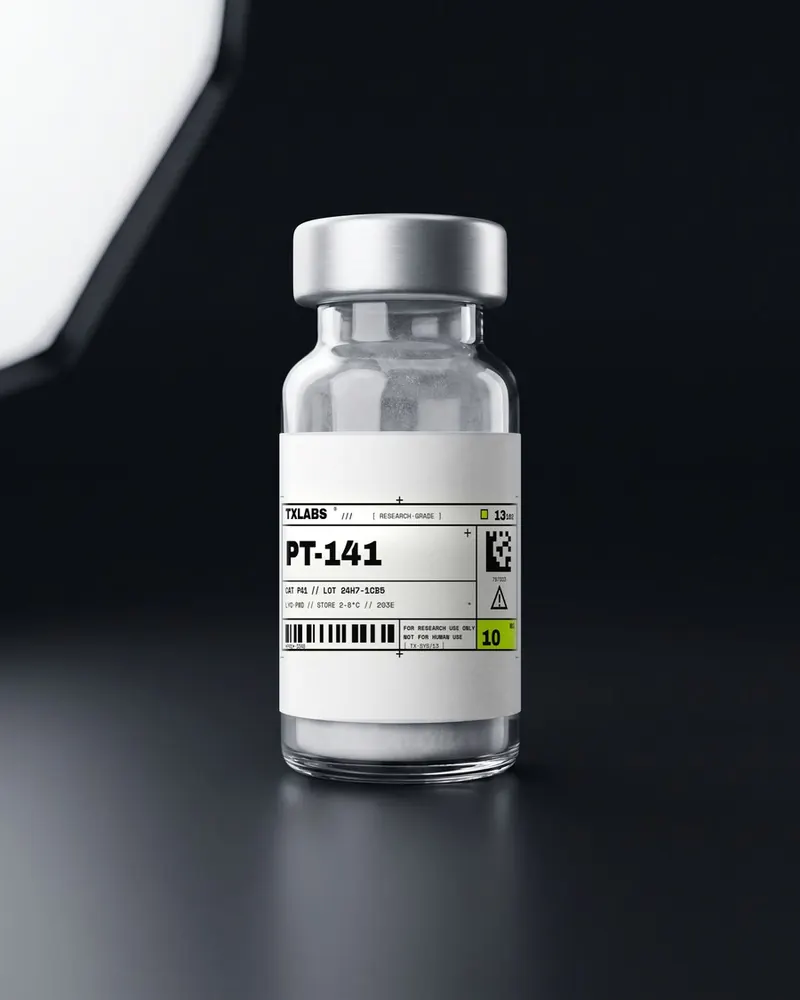
From $69 AUD · ≥98% HPLC purity · third-party COA · ships Australia-wide
What is PT-141?
PT-141 (bremelanotide) is a melanocortin receptor agonist peptide derived from Melanotan 2 that acts on MC4 receptors in the nervous system. It is studied in research on melanocortin signalling and neurobehavioural pathways.
Specifications
- From: $69 AUD
- Category: Hormones & Sexual Health
- Form: Lyophilised powder
- Purity: ≥98% HPLC
- Testing: Third-party Certificate of Analysis
- Classification: Research reference material · For Research Use Only
 View full report ↗
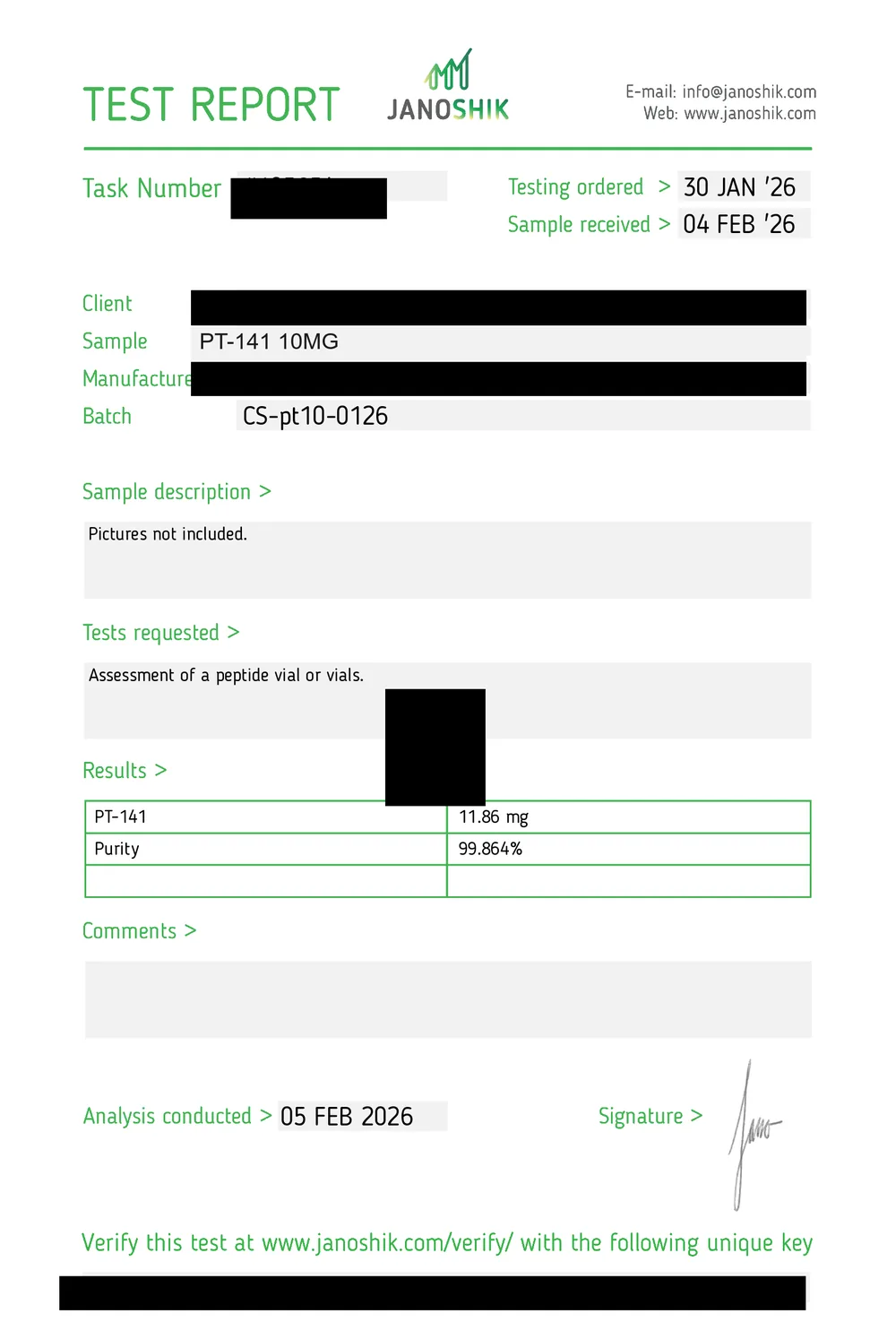
Report ID and verification key are redacted on our copy of this certificate. Request the unredacted report, or see the full CoA library.
What the research covers
PT-141, generic name bremelanotide, is a cyclic heptapeptide analogue of alpha-melanocyte-stimulating hormone with molecular formula C50H68N14O10 and molecular weight 1025.2 Da. Its structure is a lactam-bridged macrocycle, Ac-Nle-cyclo[Asp-His-D-Phe-Arg-Trp-Lys]-OH, in which a side-chain amide bond between aspartate and lysine constrains the peptide into a rigid ring. That constraint locks the His-D-Phe-Arg-Trp core message sequence, common to the melanocortin peptide family, into a receptor-favourable conformation and confers substantial resistance to peptidase degradation. Chemically, bremelanotide is the C-terminal acid corresponding to the amide melanotan II, and it was identified as a metabolite of that compound, which is the historical reason the two are so often discussed together.
Pharmacologically PT-141 is described in the literature as an agonist at melanocortin receptors with reported preference for the melanocortin-4 receptor, MC4R, a G-protein-coupled receptor expressed in the central nervous system, particularly in hypothalamic nuclei. Because MC4R signalling is also central to energy homeostasis, the receptor appears across two distinct research literatures. Preclinical work on PT-141 has examined receptor binding and selectivity profiles across the five melanocortin receptor subtypes, and central mechanism studies in rodent models. Clinical trial programmes were conducted through the 2000s and 2010s, and the compound was registered in the United States in 2019 under the trade name Vyleesi for a specific indication in a defined patient population. It is not registered in Australia.
TXLABS supplies PT-141 as an analytical reference material for laboratory research only. It is not an approved therapeutic good in Australia and is not supplied for human or veterinary administration.
Reading the certificate
Identity is the sharp issue for this compound. PT-141 is the C-terminal acid form and melanotan II the corresponding amide, and their molecular weights differ by roughly one dalton: 1025.2 against 1024.2. That is a small enough gap that low-resolution mass spectrometry may not cleanly distinguish them, so the analytical method used matters, and the two are readily confused or substituted in the supply chain. Confirm the analyte is named as PT-141 or bremelanotide specifically, look for evidence of adequate mass resolution, and check the chromatographic profile. Oxidised tryptophan is the other expected impurity. TXLABS publishes the Janoshik Analytical report for PT-141 in the CoA library: batch CS-pt10-0126, tested 5 February 2026, 99.864% purity with a 10 mg sample assaying 11.86 mg.
Storage and handling
The lactam macrocycle makes PT-141 structurally rigid and comparatively resistant to the backbone degradation routes that affect linear peptides, but it does contain a tryptophan residue in the core message sequence, and tryptophan is both photosensitive and susceptible to oxidation. Light protection is therefore not a generic precaution here but a specific one: store the lyophilised material at -20 °C, desiccated, in amber or foil-protected packaging, and keep reconstituted solution shielded from light at 2-8 °C. Bring the vial to room temperature before opening so condensation does not settle onto cold glass and wet a hygroscopic cake. Aliquot before freezing rather than freeze-thaw cycling. Australian conditions add a specific consideration: strong ambient light and summer transit temperatures above 40 °C in letterboxes and delivery vehicles both accelerate tryptophan degradation, and the outer packaging is the only light barrier a parcel has. Collect promptly, unpack indoors and refrigerate on arrival rather than leaving a parcel in sun.
Working out concentration
The TXLABS PT-141 vial is 10 mg. Reconstituted with 2 mL of bacteriostatic water it gives 5 mg/mL; with 1 mL, 10 mg/mL; with 5 mL, 2 mg/mL. At 1025.2 Da a 5 mg/mL solution is approximately 4.9 mM, a useful reference point because published receptor pharmacology work on melanocortin ligands is normally specified in nanomolar terms and requires a long dilution series from any practical stock. Note that PT-141 and melanotan II differ by only about one dalton, so labelling stock solutions unambiguously matters if both are on the bench. The reconstitution calculator handles the arithmetic. Concentration examples only, not a protocol.
How it relates to adjacent compounds
PT-141's nearest structural relative in this catalogue is melanotan II, and the relationship is unusually close: the two share the same lactam-bridged macrocyclic scaffold and the same His-D-Phe-Arg-Trp core, differing only in the C-terminus, an acid in PT-141 and an amide in melanotan II. PT-141 was in fact identified as a metabolite of melanotan II. Their reported receptor selectivity profiles across the melanocortin subtypes differ, which is a matter of pharmacological characterisation rather than a comparison of effect. More distantly, KPV is the C-terminal tripeptide of alpha-MSH and contains none of the core message sequence these two are built around. Structural relationships only.