GHRP-2 Acetate Australia — Ghrelin Receptor Reference Peptide
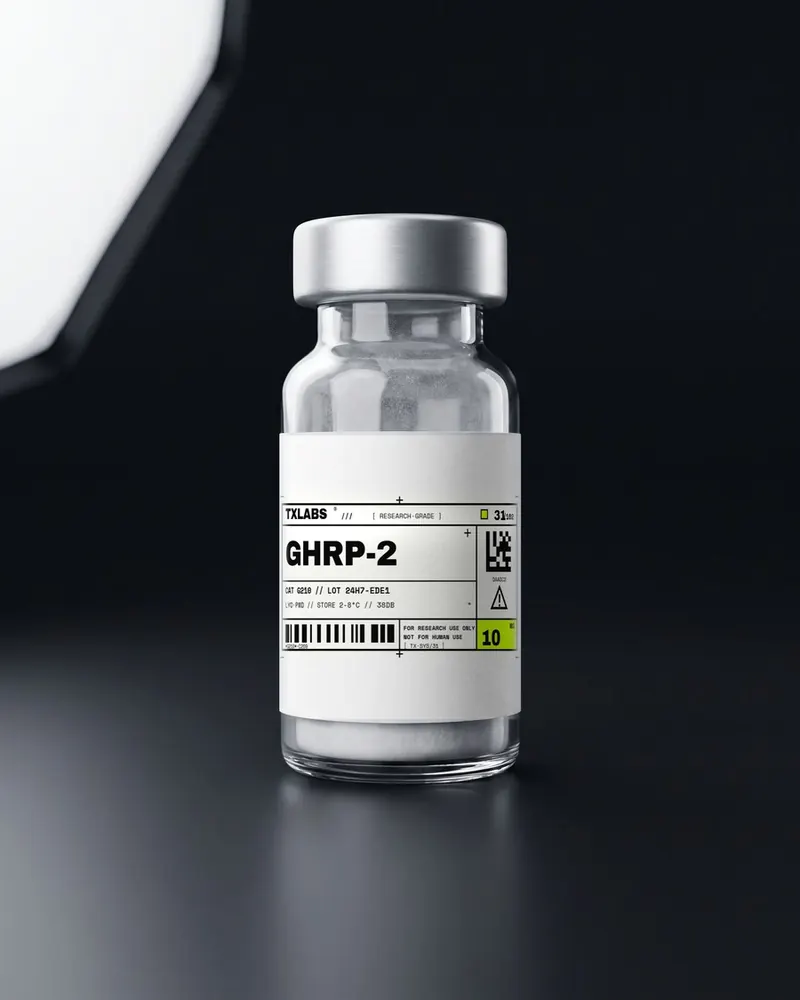
From $49 AUD · ≥98% HPLC purity · third-party COA · ships Australia-wide
What is GHRP-2 Acetate?
GHRP-2 (pralmorelin, Growth Hormone-Releasing Peptide-2) is a synthetic hexapeptide and ghrelin receptor agonist that triggers growth hormone release. It is studied in laboratory research on growth hormone secretagogue pathways and ghrelin/GHS-R receptor signalling as a reference peptide for endocrine studies.
Specifications
- From: $49 AUD
- Category: GH & Secretagogues
- Form: Lyophilised powder
- Purity: ≥98% HPLC
- Testing: Third-party Certificate of Analysis
- Classification: Research reference material · For Research Use Only
What the research covers
GHRP-2, also written as pralmorelin in the international nomenclature, is a synthetic hexapeptide growth hormone secretagogue. PubChem lists the formula C45H55N9O6 and a molecular weight of 818.0 Da. Its sequence is D-Ala-D-2-Nal-Ala-Trp-D-Phe-Lys-NH2, with a C-terminal amide, and three of its six positions are non-proteinogenic or D-configured: D-alanine, D-2-naphthylalanine and D-phenylalanine. That composition is what gives a peptide this small meaningful resistance to exopeptidase degradation, and it is also the source of most of its analytical difficulty.
Mechanistically GHRP-2 is an agonist at the growth hormone secretagogue receptor type 1a, GHS-R1a, the receptor subsequently identified as the ghrelin receptor. The growth hormone-releasing peptide series was developed before the endogenous ligand was known, which is a notable piece of pharmacological history: these compounds were characterised as secretagogues first and were later used as tools to find the receptor and then the hormone. GHS-R1a is a Gq-coupled receptor with unusually high constitutive activity, and the GHRP series has been used extensively in the literature to probe that behaviour, along with beta-arrestin recruitment and receptor internalisation.
Published work using GHRP-2 spans pituitary cell assays of growth hormone release, in vivo endocrine studies in several species, and its use as a comparator in the characterisation of later, more receptor-selective secretagogues. The comparative literature reports that the earlier GHRPs, GHRP-2 among them, produce more effect on adrenocorticotropic hormone, cortisol and prolactin in the models tested than ipamorelin does. GHRP-2 was also investigated as a diagnostic agent for pituitary function testing.
TXLABS supplies GHRP-2 acetate as an analytical reference material for laboratory research only. It is not an approved therapeutic good in Australia and is not supplied for human or veterinary administration.
Reading the certificate
For GHRP-2 the informative measure is chromatographic rather than mass-spectrometric. Three of its six residues are D-configured or non-natural, so epimerisation during synthesis generates diastereomers with exactly the same molecular mass as the target; mass spectrometry sees nothing, and only reversed-phase HPLC resolves them. A single sharp main peak therefore carries real weight here. Confirm the observed mass against 818.0 Da to establish the C-terminal amide and the 2-naphthylalanine are present as expected, and read the assay in milligrams against label weight, since the acetate counterion and residual water contribute to gross powder mass. Oxidised tryptophan is the expected acquired impurity. TXLABS publishes third-party certificates for tested lots in the CoA library; no certificate is currently published for GHRP-2. The lot certificate is available on request to support@txlabs.bio.
Storage and handling
GHRP-2 is compact, amidated and free of cysteine, which makes it one of the more robust peptides in this catalogue, but it contains a tryptophan and a 2-naphthylalanine, both aromatic and both photosensitive. Light protection is therefore chemically motivated rather than routine. Store the lyophilised acetate at -20 °C, desiccated and in light-protected packaging, and bring the vial to room temperature before breaking the seal so condensation does not settle onto a hygroscopic cake. Reconstituted in bacteriostatic water it is held at 2-8 °C and shielded from light; the benzyl alcohol preservative is what permits repeated withdrawal from a vial, whereas plain sterile water offers no antimicrobial margin. Aliquot before freezing rather than cycling a single container. For Australian conditions the small, stable structure gives GHRP-2 more thermal headroom in transit than a long peptide, but intense summer light and letterbox temperatures above 40 °C still favour tryptophan degradation. Collect promptly and refrigerate.
Working out concentration
The TXLABS GHRP-2 vial is 10 mg. Reconstituted with 1 mL of bacteriostatic water it gives 10 mg/mL; with 2 mL, 5 mg/mL; with 5 mL, 2 mg/mL. Because the molecule is only 818.0 Da, molar concentration runs high for a given mass concentration: 5 mg/mL is approximately 6.1 mM. That is the conversion most often mishandled when working from published GHS-R1a pharmacology, which is typically specified in nanomolar terms and demands a long serial dilution from any practical stock. Recording both the vial mass and the diluent volume at the time is what makes the figure reconstructable later. The reconstitution calculator handles the arithmetic. Concentration examples only, not a protocol.
How it relates to adjacent compounds
GHRP-2 sits in the middle of the growth hormone-releasing peptide family in this catalogue. GHRP-6 is the older member of the same series and differs in sequence and mass, 873.0 Da against 818.0 Da, which separates the two without difficulty analytically. Hexarelin is a further hexapeptide in the same family, distinguished by its reported CD36 binding. Ipamorelin is the pentapeptide most often used as the selectivity benchmark in this group. All four act at GHS-R1a, unlike the GHRH analogues such as sermorelin, which bind a separate receptor. All three growth hormone-releasing peptides here are supplied as acetate salts, so net peptide content rather than gross powder weight is the figure that makes them comparable to one another. Structural and receptor relationships only.