GHRP-6 Acetate Australia — Reference Secretagogue Peptide
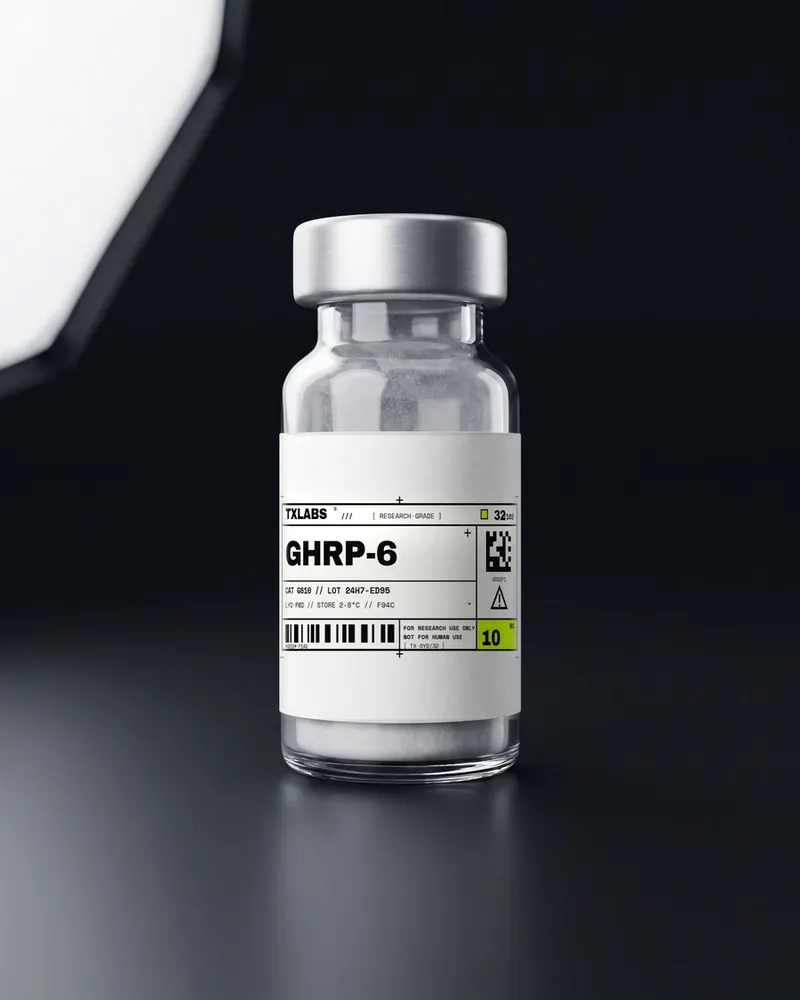
From $49 AUD · ≥98% HPLC purity · third-party COA · ships Australia-wide
What is GHRP-6 Acetate?
GHRP-6 (Growth Hormone-Releasing Peptide-6) is a synthetic hexapeptide ghrelin receptor agonist that stimulates growth hormone release. It is investigated in preclinical research on appetite signalling, the ghrelin/GHS-R axis and pituitary growth hormone secretion.
Specifications
- From: $49 AUD
- Category: GH & Secretagogues
- Form: Lyophilised powder
- Purity: ≥98% HPLC
- Testing: Third-party Certificate of Analysis
- Classification: Research reference material · For Research Use Only
What the research covers
GHRP-6 is a synthetic hexapeptide growth hormone secretagogue and the compound around which much of this pharmacological field was originally built. PubChem lists the formula C46H56N12O6 and a molecular weight of 873.0 Da. Its sequence is His-D-Trp-Ala-Trp-D-Phe-Lys-NH2, with a C-terminal amide. Two features distinguish it structurally from GHRP-2: it carries two tryptophan residues rather than one, and it begins with histidine rather than D-alanine. Those differences account for the 55 Da mass gap between the two and for GHRP-6's markedly greater sensitivity to light and oxidation.
GHRP-6 was derived from earlier work on met-enkephalin-based secretagogues and became the reference ligand used to identify the growth hormone secretagogue receptor, GHS-R1a. Radiolabelled GHRP-6 binding assays were central to the receptor cloning work in the 1990s, and the receptor was later shown to be the ghrelin receptor. That history is why GHRP-6 remains a standard reference agonist in GHS-R1a pharmacology even though more selective compounds now exist.
A distinguishing thread in the GHRP-6 literature concerns appetite signalling. Because GHS-R1a is the ghrelin receptor and ghrelin has a well-documented orexigenic role, GHRP-6 has been studied in rodent food-intake models, and the published comparative work reports a more pronounced effect on feeding behaviour in animals than is described for GHRP-2. Separately, GHRP-6 has been examined in cytoprotection research in cardiac and hepatic injury models, a line of work carried out largely by a small number of groups and with limited independent replication outside them.
TXLABS supplies GHRP-6 acetate as an analytical reference material for laboratory research only. It is not an approved therapeutic good in Australia and is not supplied for human or veterinary administration.
Reading the certificate
GHRP-6 carries a heavier oxidation burden than the rest of its family because of the two tryptophan residues, so oxidised species sixteen and thirty-two daltons above the parent are the acquired impurities to expect, and they appear as earlier-eluting shoulders on reversed-phase HPLC. That also means a high purity figure on freshly synthesised material says nothing about oxidation acquired in storage or transit, which is why the test date deserves as much attention as the number. The D-tryptophan and D-phenylalanine residues add a stereochemical dimension that mass spectrometry cannot assess, so chromatographic resolution matters. Confirm the mass against 873.0 Da and the assay in milligrams against label. TXLABS publishes third-party certificates for tested lots in the CoA library; none is currently published for GHRP-6. The lot certificate is available on request to support@txlabs.bio.
Storage and handling
GHRP-6 has two tryptophan residues in six positions, which makes it the most photolabile of the small secretagogues in this catalogue. Tryptophan absorbs ultraviolet light and its indole ring both photodegrades and oxidises, so amber or foil-protected packaging and dark storage are chemically necessary here rather than a general precaution. Store the lyophilised acetate at -20 °C, desiccated and light-protected, and equilibrate the vial to room temperature before opening so condensation does not wet the cake. Keep reconstituted solution at 2-8 °C in the dark, minimise the time the vial spends open, and aliquot before freezing rather than cycling one container. The histidine imidazole also makes the peptide's solubility and charge state more pH-sensitive than an aliphatic sequence. Australian ambient light is intense and summer transit temperatures above 40 °C are routine; both accelerate tryptophan loss, so prompt collection, indoor unpacking and refrigeration are the meaningful safeguards.
Working out concentration
The TXLABS GHRP-6 vial is 10 mg. Reconstituted with 1 mL of bacteriostatic water it gives 10 mg/mL; with 2 mL, 5 mg/mL; with 4 mL, 2.5 mg/mL. At 873.0 Da a 5 mg/mL solution corresponds to approximately 5.7 mM. Note that GHRP-2 and GHRP-6 vials are both 10 mg and the reconstituted solutions are visually identical, so labelling stock containers with the compound name rather than only a concentration matters if both are on the bench. The 55 Da mass difference is invisible to everything except an instrument. The reconstitution calculator resolves vial mass against volume. Concentration arithmetic only, not a protocol.
How it relates to adjacent compounds
GHRP-6 is the oldest member of the growth hormone-releasing peptide family stocked here and the one against which the others were characterised. GHRP-2 is the closely related hexapeptide with a different N-terminal pair and a single tryptophan. Hexarelin extends the series with a 2-methyl-tryptophan and a reported second target at CD36. Ipamorelin was developed later and is described in the literature as the more receptor-selective compound of the group. All act at GHS-R1a, in contrast to GHRH analogues such as modified GRF(1-29). Read as a series, GHRP-6, GHRP-2, hexarelin and ipamorelin trace roughly two decades of work on keeping secretagogue activity at GHS-R1a while narrowing the reported hormone response profile. Structural and receptor relationships only.