AOD9604 Australia — Tyr-hGH(177-191) Reference Peptide
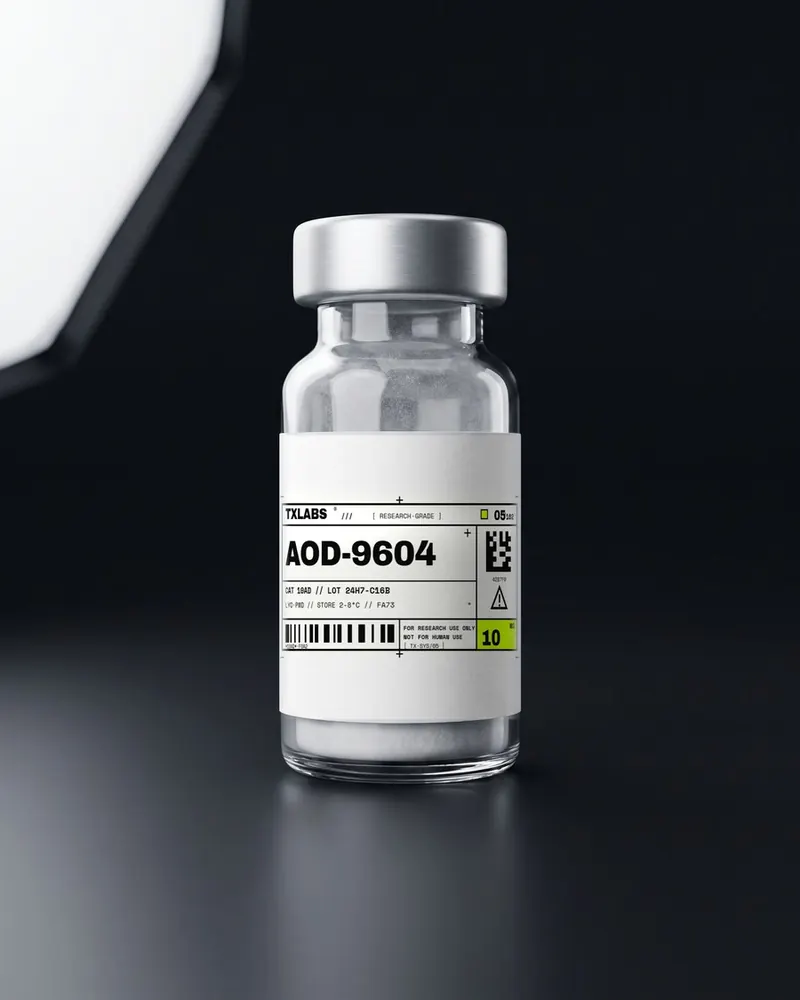
From $149 AUD · ≥98% HPLC purity · third-party COA · ships Australia-wide
What is AOD9604?
AOD9604 is a synthetic peptide fragment of human growth hormone (hGH 176-191) noted for its lipolytic activity. It is investigated in laboratory research on fat metabolism and lipid mobilisation without affecting IGF-1 signalling.
Specifications
- From: $149 AUD
- Category: Metabolic & GLP-1
- Form: Lyophilised powder
- Purity: ≥98% HPLC
- Testing: Third-party Certificate of Analysis
- Classification: Research reference material · For Research Use Only
What the research covers
AOD9604 is a synthetic modified fragment of the C-terminal region of human growth hormone. PubChem lists the formula C78H123N23O23S2 and a molecular weight of 1815.1 Da, and describes a cyclic structure consistent with an intramolecular disulfide bond. It is most accurately written as Tyr-hGH(177-191): the fifteen C-terminal residues of mature human growth hormone with a tyrosine appended at the N-terminus. The added tyrosine is not a native residue in that position, and it was introduced as a synthetic handle, a tyrosine being the standard residue used for radioiodination in this era of peptide chemistry.
The fragment retains the two cysteines that in mature human growth hormone are residues 182 and 189, and these form a small intramolecular disulfide loop. That loop accounts for a two-dalton difference between the closed and reduced forms of the molecule and is a real analytical variable rather than a footnote.
The published research on AOD9604 concerns lipid metabolism in adipose tissue models, arising from earlier work on the C-terminal region of growth hormone and metabolic signalling, and a hypothesis in that literature that the region's activity is separable from the growth-promoting and IGF-1-mediated actions of the intact hormone. Whether a distinct receptor mediates that activity has not been established, and the mechanistic account in the literature remains incomplete. AOD9604 was taken through clinical development in the 2000s, and it has separately been the subject of regulatory assessment as a food ingredient in some jurisdictions, a history that is documented but not one that supports any claim about the material supplied here.
TXLABS supplies AOD9604 as an analytical reference material for laboratory research only. It is not an approved therapeutic good in Australia and is not supplied for human or veterinary administration.
Reading the certificate
Identity against the neighbouring product is the sharp check here. AOD9604 is the tyrosine-leading sequence at 1815.1 Da in its disulfide-closed form, and the reduced free-thiol form is two daltons heavier at approximately 1817 Da; the true native hGH(176-191) fragment, which begins with phenylalanine rather than tyrosine, would be about sixteen daltons lighter again. Those are small gaps, so the resolution of the mass method used matters, and mislabelling between these closely related fragments is a documented supply-chain issue. Confirm the analyte name, the observed mass and whether the disulfide is reported as closed. TXLABS publishes third-party certificates for tested lots in the CoA library; none is currently published for AOD9604. The lot certificate is available on request to support@txlabs.bio.
Storage and handling
The disulfide loop is what makes AOD9604's handling distinctive among short peptides. Disulfide bonds are labile at alkaline pH and in the presence of reducing agents, and free thiols released by reduction can then re-pair incorrectly or form intermolecular dimers, so keep reducing agents such as dithiothreitol and beta-mercaptoethanol out of the diluent and avoid alkaline conditions unless the method calls for them. The tyrosine residues are also mildly oxidation-sensitive and benefit from light protection. Store the lyophilised material at -20 °C, desiccated and protected from light, and equilibrate the vial to room temperature before opening so a hygroscopic cake does not take up condensation. Reconstituted solution is held at 2-8 °C in the dark and aliquoted before freezing rather than cycled. Australian summer transit above 40 °C accelerates disulfide scrambling as well as ordinary degradation, so prompt collection and refrigeration on arrival are the practical safeguards.
Working out concentration
The TXLABS AOD9604 vial is 10 mg. Reconstituted with 2 mL of bacteriostatic water it gives 5 mg/mL; with 1 mL, 10 mg/mL; with 5 mL, 2 mg/mL. At 1815.1 Da a 5 mg/mL solution corresponds to approximately 2.8 mM. Because AOD9604 and the product sold as HGH fragment 176-191 are both stocked here as 10 mg vials and give visually identical solutions, and because their masses are close, stock containers should be labelled with the compound name rather than only a concentration if both are in use. The reconstitution calculator resolves vial mass against volume. Worked concentration arithmetic only, not a protocol.
How it relates to adjacent compounds
HGH fragment 176-191 is the product AOD9604 is most closely related to and most often confused with; the two pages set out the naming and mass relationship from each side, and the observed mass on a lot certificate is what separates them. Somatropin is the intact 191-residue parent hormone from which the C-terminal region is drawn. Further out, tesamorelin and ipamorelin act on the pituitary to influence endogenous growth hormone release rather than being fragments of the hormone itself. These two fragment products are the closest pair in the catalogue by mass, and the only pair where a sixteen-dalton difference carries the entire distinction between them. Structural and lineage relationships only.