Hyaluronic Acid Australia — Research Glycosaminoglycan
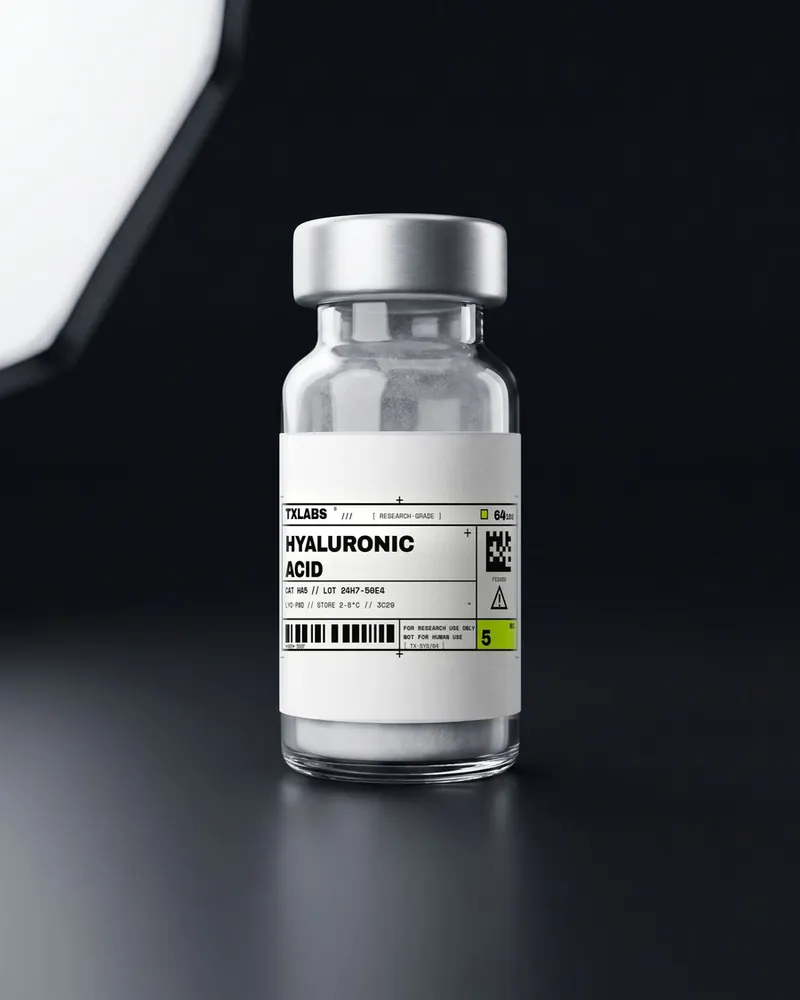
From $419 AUD · ≥98% HPLC purity · third-party COA · ships Australia-wide
What is Hyaluronic Acid?
Hyaluronic Acid — a research-grade peptide reference supplied lyophilized for laboratory use only.
Specifications
- From: $419 AUD
- Category: Aesthetic & Skin
- Form: Lyophilised powder
- Purity: ≥98% HPLC
- Testing: Third-party Certificate of Analysis
- Classification: Research reference material · For Research Use Only
What the research covers
Hyaluronic acid is not a peptide and is not a single molecule with a molecular weight. It is a glycosaminoglycan: a linear, unbranched, non-sulfated polysaccharide built from a repeating disaccharide of D-glucuronic acid and N-acetyl-D-glucosamine, joined alternately by beta-1,3 and beta-1,4 glycosidic bonds. Any given preparation is a population of chains of different lengths, and that polydispersity is the single most important fact about the material.
Because chain length varies, hyaluronic acid is described by a molecular weight distribution rather than by a molecular weight. Preparations are conventionally grouped as low molecular weight, in the tens of kilodaltons, and high molecular weight, running into the megadalton range, with a great deal of ground in between and no universally agreed boundary between the categories. This is not a technicality. The published literature reports that hyaluronan fragments in different size ranges behave differently in biological systems, with high molecular weight polymer and short oligosaccharide fragments described as having distinct and sometimes opposing activities in the same assay. Any experiment that does not specify the size distribution of the material used is therefore difficult to interpret and harder still to replicate.
The research context is broad and long established. Hyaluronan is a major component of the extracellular matrix and of synovial and vitreous fluid, it is the ligand for the cell-surface receptors CD44 and RHAMM, and it is a standard subject in matrix biology, in rheology, where its viscoelastic and shear-thinning behaviour in solution is the property of interest, and in biomaterials work. It is turned over enzymatically by hyaluronidases and non-enzymatically by reactive oxygen species. Sources include bacterial fermentation, most often Streptococcus species, and animal tissue extraction, and the two differ in impurity profile.
TXLABS supplies hyaluronic acid as a research-grade material for laboratory use only. It is not an approved therapeutic good in Australia and is not supplied for human or veterinary administration.
Reading the certificate
A certificate for a polysaccharide answers almost none of the questions a peptide certificate answers. The central figure is the molecular weight distribution, ideally by size exclusion chromatography with multi-angle light scattering, reported as a weight-average and number-average molecular weight together with a polydispersity index. A single molecular weight number without a distribution behind it should be treated as approximate at best. Beyond that, ask for the source, since bacterial fermentation and animal tissue extraction carry different impurity profiles and different regulatory considerations; for protein and nucleic acid content, which are the characteristic fermentation residues; for endotoxin, which matters in any cell-based work; and for glucuronic acid content as an identity and assay measure. TXLABS publishes third-party certificates for tested lots in the CoA library; no certificate is currently published for hyaluronic acid. The lot certificate is available on request to support@txlabs.bio.
Storage and handling
Hyaluronic acid is strongly hygroscopic and will take up atmospheric moisture rapidly, which both increases gross weight and accelerates degradation. Keep it sealed and desiccated, store cold and protected from light, and equilibrate the container to room temperature before opening so that condensation does not wet the powder.
In solution the practical problems are physical. The polymer hydrates slowly and forms extremely viscous solutions at modest concentrations, so material added too quickly clumps and takes hours to disperse; sprinkling into gently stirred diluent rather than adding diluent to a bulk powder is the usual approach. Once hydrated, the chains are vulnerable to depolymerisation by shear, which means vigorous mixing, sonication and repeated passage through narrow bores measurably reduce the molecular weight. They are also vulnerable to free radical scission, to acid and alkali, and to hyaluronidase carried in by microbial contamination.
The critical point is that all of these degrade the material by shortening the chains without changing its chemical identity. A degraded preparation still assays as hyaluronic acid. Only a molecular weight distribution measurement reveals the change. Australian summer transit above 40 C accelerates chain scission, so prompt cool, dry storage on arrival is worthwhile.
Working out concentration
The TXLABS vial is 5 mg. Five milligrams taken into 5 mL gives 1 mg/mL; into 10 mL, 0.5 mg/mL; into 2 mL, 2.5 mg/mL. There is a genuine practical ceiling here that does not apply to peptides: at high molecular weight, solutions above roughly 1 to 2 mg/mL become very viscous and slow to handle, so the useful working concentration is often set by rheology rather than by the experiment. Molar conversion is not meaningful for a polydisperse polymer, since there is no single molecular weight to divide by; concentration is expressed in mass per volume and the size distribution is reported separately. The reconstitution calculator covers the mass and volume arithmetic. Concentration examples only, not a protocol.
How it relates to adjacent compounds
Hyaluronic acid sits in the aesthetic and skin category of this catalogue, where its neighbours are chemically unrelated to it. GHK-Cu is a copper-binding tripeptide complex and Matrixyl is a palmitoylated pentapeptide; both appear in the same body of extracellular matrix and dermal research literature, but neither is a polysaccharide and both are characterised by entirely different methods. The more useful comparison is with glutathione and alprostadil, which like hyaluronic acid are non-peptide materials in a peptide catalogue and therefore need certificates built around their own chemistry rather than around HPLC purity percentages. These are category and analytical adjacencies only, and imply nothing about comparable activity or interchangeable use.