Glutathione Australia — GSH Tripeptide Reference Material
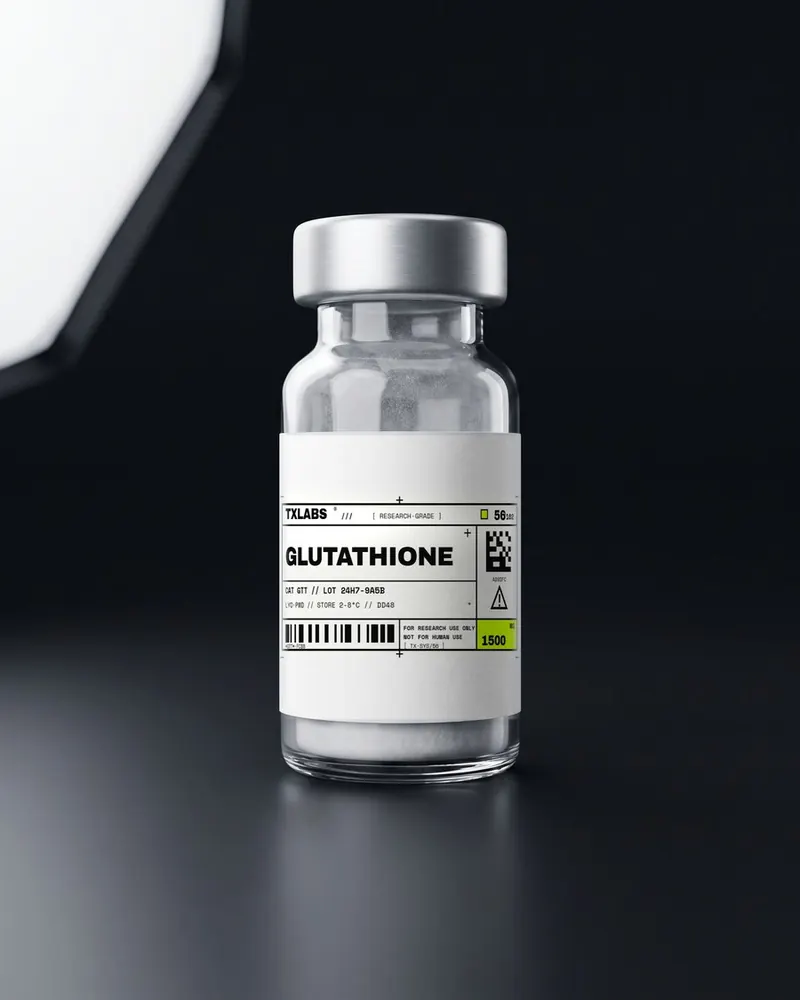
From $29 AUD · ≥98% HPLC purity · third-party COA · ships Australia-wide
What is Glutathione?
Glutathione (GSH) is an endogenous antioxidant tripeptide (glutamate-cysteine-glycine) central to cellular redox balance. It is studied in laboratory research on oxidative stress, detoxification pathways, and thiol-dependent enzyme systems.
Specifications
- From: $29 AUD
- Category: Aesthetic & Skin
- Form: Lyophilised powder
- Purity: ≥98% HPLC
- Testing: Third-party Certificate of Analysis
- Classification: Research reference material · For Research Use Only
What the research covers
Glutathione is the odd item in this catalogue and is best understood on its own terms rather than as a peptide product. It is a tripeptide, gamma-L-glutamyl-L-cysteinylglycine, with the formula C10H17N3O6S and a molecular weight of 307.33 Da, which makes it an order of magnitude smaller than anything else stocked here. Its defining structural feature is the gamma linkage: the glutamate is joined to cysteine through its side-chain gamma-carboxyl rather than the usual alpha-carboxyl. That single unconventional bond is why ordinary peptidases cannot cleave it, and it is the reason glutathione persists intracellularly at millimolar concentrations where a conventional tripeptide would not.
Glutathione is not a receptor ligand and does not act by signalling in the way the rest of this catalogue does. It is the principal low-molecular-weight thiol of the cell and functions as a redox buffer: the free cysteine thiol donates reducing equivalents, and two molecules oxidise to the disulfide GSSG. The ratio of reduced to oxidised glutathione is one of the standard measures of cellular redox state in the literature. It is also the substrate for glutathione peroxidases, which reduce peroxides, and for glutathione S-transferases, which conjugate it to electrophilic compounds in the first step of the mercapturic acid pathway. Its own synthesis proceeds through glutamate-cysteine ligase and glutathione synthetase, and turnover through gamma-glutamyl transpeptidase.
The published literature on glutathione is vast and spans biochemistry, toxicology, cell biology and analytical chemistry, largely as an endogenous metabolite and assay analyte rather than as an administered compound. Separately, the TGA has taken compliance action concerning glutathione products presented with skin-whitening claims, and injectable glutathione products are not approved therapeutic goods in Australia.
TXLABS supplies glutathione as an analytical reference material for laboratory research only. It is not supplied for human or veterinary administration.
Reading the certificate
One question dominates a glutathione certificate: does the assay distinguish reduced glutathione from its oxidised disulfide GSSG? A method that measures total glutathione, or that reports a purity figure without specifying the redox species, cannot tell you whether the material in the vial is the reduced thiol you intended to buy. Thiol-specific assays and chromatographic methods that resolve GSH from GSSG are what answer it, and the GSSG content is the number to look for. Confirm also the L-configuration of the cysteine and glutamate, since the D-forms are not biologically equivalent, and check residual moisture, because the powder is hygroscopic. TXLABS publishes third-party certificates for tested lots in the CoA library; none is currently published for glutathione. The lot certificate is available on request to support@txlabs.bio.
Storage and handling
The free thiol governs everything about handling glutathione. In solution it oxidises to the disulfide GSSG in the presence of dissolved oxygen, and the reaction is catalysed by trace transition metals, particularly copper and iron, and accelerated at alkaline pH. A reduced glutathione solution left standing in air at neutral or higher pH is measurably oxidised within hours, and nothing about its appearance signals this. Practical consequences: prepare solutions fresh, minimise headspace and open time, avoid alkaline diluents, and keep the material away from copper-containing compounds, which for this catalogue means never storing or handling it alongside copper peptides. The dry powder is stable and hygroscopic; hold it at -20 °C, desiccated and dark, and equilibrate before opening. Reconstituted solution is kept cold and used promptly rather than stored. Australian summer transit above 40 °C accelerates oxidation of any residual moisture-exposed material, so prompt collection and refrigeration apply here as elsewhere.
Working out concentration
Glutathione is stocked in 600, 1200 and 1500 mg vials, hundreds of times larger than the peptide vials in this catalogue, so the arithmetic sits in a different range entirely. A 600 mg vial reconstituted with 6 mL of bacteriostatic water gives 100 mg/mL; a 1200 mg vial with 12 mL also gives 100 mg/mL; a 1500 mg vial with 10 mL gives 150 mg/mL. At 307.33 Da a 100 mg/mL solution is approximately 325 mM, a genuinely concentrated solution. Note that glutathione is acidic in water and concentrated solutions have a low pH, which is a property of the compound worth recording. The reconstitution calculator handles vial mass against volume. Concentration arithmetic only, not a protocol.
How it relates to adjacent compounds
Glutathione has almost no structural relatives in this catalogue. As a tripeptide it shares a size class with GHK-Cu and KPV, but the resemblance stops there: it has an unconventional gamma-peptide bond, no receptor, and a redox rather than a signalling role. The relationship to GHK-Cu is in fact a caution rather than an affinity, since the free thiol will reduce and strip copper from a copper peptide complex, so the two should not share a diluent or a workspace. NAD+ is the closer functional analogue, being another endogenous redox cofactor rather than a signalling peptide. It also has by a wide margin the smallest molecular weight in the catalogue, which is why its vials are the largest. Chemical relationships only.