Matrixyl Australia — Palmitoyl Pentapeptide-4 Lipopeptide
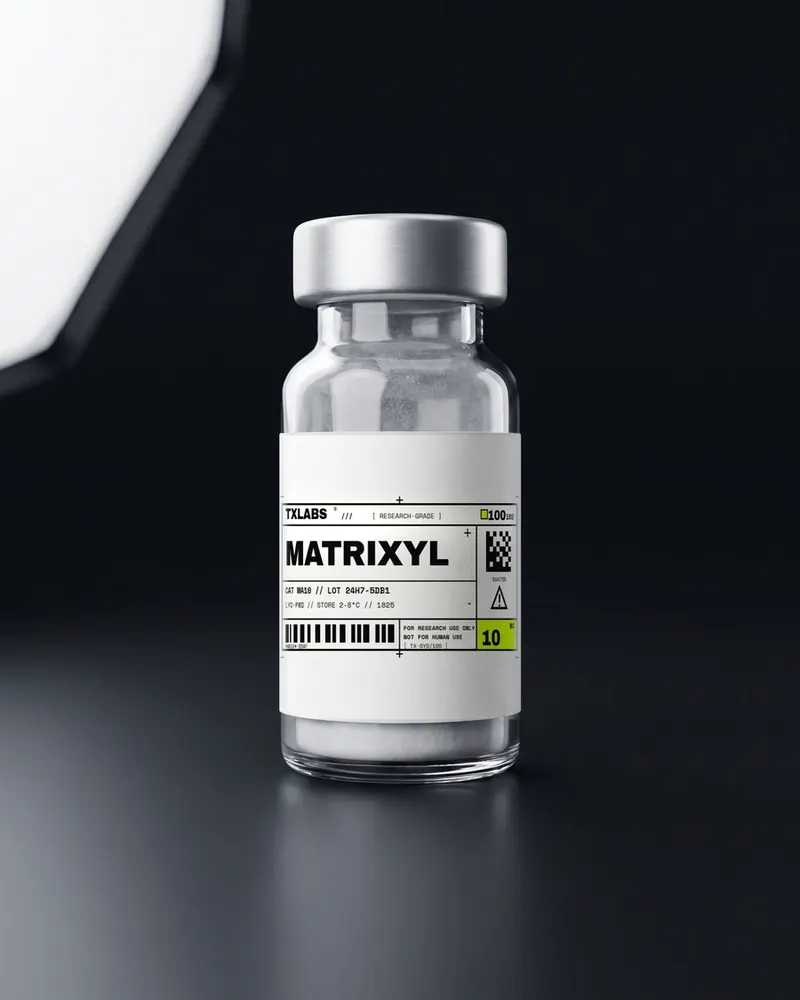
From $49 AUD · ≥98% HPLC purity · third-party COA · ships Australia-wide
What is Matrixyl?
Matrixyl (palmitoyl pentapeptide-4, Pal-KTTKS) is a synthetic matrikine peptide that signals extracellular-matrix and collagen pathways. It has been studied in laboratory research on fibroblast activity, collagen synthesis and dermal matrix models. Matrixyl is supplied as a reference material for matrikine and skin-model research.
Specifications
- From: $49 AUD
- Category: Aesthetic & Skin
- Form: Lyophilised powder
- Purity: ≥98% HPLC
- Testing: Third-party Certificate of Analysis
- Classification: Research reference material · For Research Use Only
What the research covers
Matrixyl is a trade name, and that is the first thing to establish about it. The original Matrixyl denotes palmitoyl pentapeptide-4, previously designated palmitoyl pentapeptide-3, with CAS number 214047-00-4, molecular formula C39H75N7O10 and a molecular weight of approximately 802 Da. It is a lipopeptide: the pentapeptide Lys-Thr-Thr-Lys-Ser, abbreviated KTTKS, carrying a palmitic acid chain amide-linked at the N-terminus. The sixteen-carbon acyl chain is the whole point of the design, since the free pentapeptide is hydrophilic and the palmitoyl group makes the conjugate amphiphilic.
The KTTKS sequence is a subfragment of the propeptide region of type I procollagen, released during collagen processing, and the published rationale for the molecule is that this fragment functions as a feedback signal in matrix turnover. In vitro work has examined the conjugate's effects on cultured dermal fibroblasts, reporting changes in the production of extracellular matrix components including collagen types, fibronectin and glycosaminoglycans.
Two cautions belong on this page. The first is the trade name. Later products marketed under the Matrixyl banner, including Matrixyl 3000 and Matrixyl synthe'6, contain different peptides altogether, so the name alone does not identify the molecule and only the analyte name and observed mass on a certificate establish which material is present. The second is provenance. A substantial share of the published work on this compound originates from the cosmetic ingredient industry or from studies with industry involvement, and independent replication of the reported in vitro findings is limited. The chemistry is well defined; the biological literature is narrower than the compound's commercial prominence suggests.
TXLABS supplies Matrixyl as an analytical reference material for laboratory research only. It is not an approved therapeutic good in Australia and is not supplied for human or veterinary administration.
Reading the certificate
For a lipopeptide the certificate has to establish two things at once: that the peptide sequence is right and that the acylation is right and complete. An observed mass consistent with roughly 802 Da confirms the intact conjugate; a mass corresponding to the unacylated pentapeptide would indicate incomplete coupling or hydrolysis, and it is a much cheaper material. Reversed-phase HPLC behaves unusually here because the palmitoyl chain gives very strong retention, so confirm the method is appropriate for a lipidic analyte rather than a generic peptide gradient. Given the trade name ambiguity, confirm the certificate names palmitoyl pentapeptide-4 or Pal-KTTKS specifically rather than simply Matrixyl. Salt form, residual solvent and water content complete the picture. TXLABS publishes third-party certificates for tested lots in the CoA library; no certificate is currently published for Matrixyl. The lot certificate is available on request to support@txlabs.bio.
Storage and handling
The palmitoyl chain dominates the practical chemistry. Palmitoyl pentapeptide-4 is amphiphilic and does not dissolve readily in plain water at useful concentrations; it behaves more like a surfactant, forming micellar aggregates above a critical concentration and adsorbing to hydrophobic surfaces. Stock solutions are conventionally prepared in a water-miscible organic solvent, or in water with gentle warming and a co-solvent, rather than in buffer alone, and material that appears not to have dissolved has usually aggregated rather than remained solid.
Chemically the peptide portion is not especially fragile. There is no cysteine, no methionine and no asparagine, so oxidation and deamidation are minor concerns. The serine and threonine hydroxyls and the amide bond to the palmitate are the sites to think about, with the acyl amide susceptible to slow hydrolysis under strongly acidic or alkaline conditions, which would liberate free KTTKS and palmitic acid.
Store the lyophilised solid at -20 C, desiccated and protected from light, and equilibrate before opening. Hold solutions cold, aliquot rather than freeze-thaw, and re-mix gently since amphiphiles separate on standing. Australian summer transit above 40 C is less damaging here than for most of the catalogue, but prompt cool storage remains sensible.
Working out concentration
The TXLABS Matrixyl vial is 10 mg. Ten milligrams into 2 mL gives 5 mg/mL; into 1 mL, 10 mg/mL; into 5 mL, 2 mg/mL. Using a molecular weight of approximately 802 Da, 5 mg/mL corresponds to roughly 6.2 millimolar, which is high, and cosmetic-science literature typically works several orders of magnitude below that, so a well-recorded dilution series is where the arithmetic actually matters. The caveat specific to this compound is that solubility, not stoichiometry, sets the practical ceiling: an aqueous stock at 10 mg/mL is unlikely to be a true solution. The reconstitution calculator handles the mass and volume pairing. Concentration arithmetic only, not a protocol.
How it relates to adjacent compounds
Matrixyl belongs to the small group of cosmetic-science peptides in this catalogue. SNAP-8 is its closest sibling by category, being an acetylated synthetic octapeptide with a comparable commercial history and a comparably industry-weighted literature, though the two have no sequence or mechanism in common. GHK-Cu overlaps in subject matter as a matrix-research tripeptide, but it is a copper complex with quite different chemistry and a longer independent literature. Hyaluronic acid shares the extracellular matrix research context while being a polysaccharide rather than a peptide at all. The grouping here is by research field and by catalogue category, not by structure, and it implies nothing about comparable activity or interchangeable use.