Alprostadil Australia — Prostaglandin E1 Reference Standard
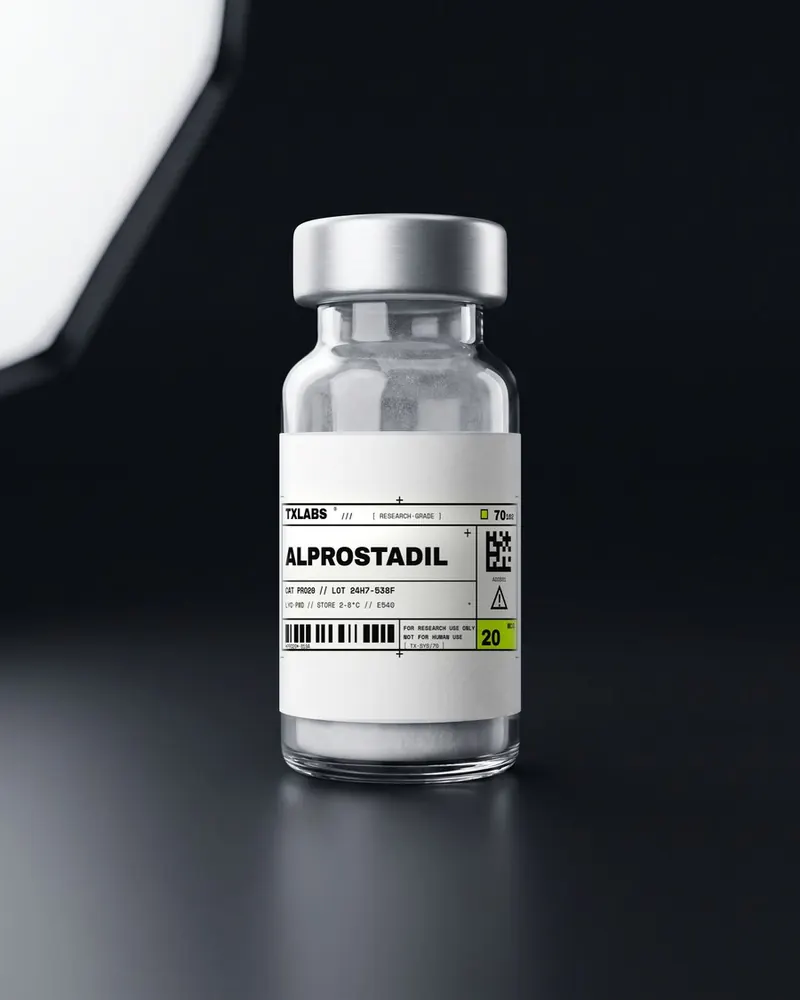
From $299 AUD · ≥98% HPLC purity · third-party COA · ships Australia-wide
What is Alprostadil?
Alprostadil (prostaglandin E1, PGE1) is a naturally occurring prostaglandin that acts as a vasodilator and inhibits platelet aggregation. It is used as a reference standard and investigated in research on vascular smooth muscle relaxation and blood flow.
Specifications
- From: $299 AUD
- Category: Aesthetic & Skin
- Form: Lyophilised powder
- Purity: ≥98% HPLC
- Testing: Third-party Certificate of Analysis
- Classification: Research reference material · For Research Use Only
What the research covers
Alprostadil is the pharmaceutical name for prostaglandin E1 (PGE1). It is a prescription-only medicine in Australia, and registered prescription products containing it exist on the Australian Register of Therapeutic Goods. TXLABS supplies alprostadil strictly as an analytical reference material for laboratory work. It is not supplied for human or veterinary administration, and nothing on this page describes a clinical use.
Chemically it is an outlier in this catalogue. Alprostadil is not a peptide at all: it is a C20 oxygenated fatty acid derivative with the molecular formula C20H34O5 and a molecular weight of approximately 354.5 Da, CAS 745-65-3. Structurally it is a cyclopentanone ring bearing a hydroxyl group, flanked by two aliphatic chains, one of which terminates in a free carboxylic acid and the other in a secondary alcohol adjacent to a trans double bond. It belongs to the prostanoid family, the eicosanoid signalling lipids generated enzymatically from twenty-carbon polyunsaturated fatty acids by the cyclooxygenase pathway. In alprostadil's case the precursor is dihomo-gamma-linolenic acid rather than arachidonic acid, which is why it carries a single chain double bond rather than the two found in prostaglandin E2.
The published literature on prostaglandin E1 is very large and predates the compound's pharmaceutical development by decades. It is used routinely as a laboratory standard and as a pharmacological tool: as an agonist reference at the EP prostanoid receptor subtypes EP1 through EP4, as a positive control in adenylate cyclase and cyclic AMP accumulation assays in cultured cells, and as an analyte in eicosanoid profiling by liquid chromatography with tandem mass spectrometry. Because prostanoids are chemically fragile and present at low abundance in biological matrices, well characterised reference material is a practical prerequisite for that analytical work rather than an optional refinement.
TXLABS supplies alprostadil as an analytical reference material for laboratory research only. It is a prescription medicine in Australia, it is not supplied for human or veterinary administration, and it is not offered for any therapeutic purpose.
Reading the certificate
A certificate for a prostanoid looks nothing like a peptide certificate. There is no sequence to confirm and no deletion sequences to worry about; what matters is the related substance profile. Ask whether the method resolves prostaglandin A1 and prostaglandin B1, the dehydration products, since their presence is the direct readout of how the material has been stored and handled. Chromatographic purity should be reported by HPLC with ultraviolet or mass spectrometric detection, and identity should be supported by an exact mass consistent with C20H34O5 near 354.5 Da together with a spectroscopic identity test. Residual solvent content, water content and the melting range are the other conventional small molecule attributes. TXLABS publishes third-party certificates for tested lots in the CoA library; no certificate is currently published for alprostadil. The certificate for the specific lot supplied is available on request to support@txlabs.bio.
Storage and handling
Alprostadil degrades by a route that has nothing in common with peptide chemistry. The beta-hydroxy ketone arrangement on the cyclopentanone ring is prone to dehydration, converting prostaglandin E1 to prostaglandin A1 and, under more basic conditions, on to prostaglandin B1. This is an intrinsic chemical instability rather than a contamination problem, and it accelerates with warmth, with moisture and sharply with pH away from neutral. Published stability work on aqueous prostaglandin E1 solutions identifies prostaglandin A1 as the principal degradation product formed on standing. The free carboxylic acid also makes the molecule sensitive to the ionic strength and pH of any diluent.
Store the solid at -20 C or colder, desiccated, sealed under an inert atmosphere where possible, and protected from light. Bring the vial to room temperature before opening so condensation does not wet the material. Concentrated stocks are conventionally prepared in absolute ethanol rather than water, kept cold and made fresh, because aqueous solutions are the least stable presentation. Australian summer freight regularly exceeds 40 C in unrefrigerated transit, and for a compound that dehydrates thermally this is a material risk rather than a theoretical one. Collect promptly and return to cold storage on arrival.
Working out concentration
The TXLABS alprostadil vial is 20 mcg, by a wide margin the smallest mass in this catalogue, and the arithmetic runs in micrograms rather than milligrams. Twenty micrograms taken up in 1 mL gives 20 mcg/mL; in 2 mL, 10 mcg/mL; in 5 mL, 4 mcg/mL. Converting to molarity using a molecular weight of 354.5 Da, 20 mcg/mL is approximately 56 micromolar. At these masses adsorptive loss to glass and plastic surfaces is a genuine accounting problem, not a rounding error, and it is one reason ethanolic stocks are conventional. The reconstitution calculator handles any vial and volume pairing. Concentration arithmetic only, not a protocol.
How it relates to adjacent compounds
Alprostadil sits in the aesthetic and skin category of this catalogue for cataloguing reasons rather than chemical ones. It shares no structural class with anything else stocked here. The nearest neighbours by category are glutathione, a tripeptide antioxidant, and hyaluronic acid, a polysaccharide, and the useful observation is that all three are non-peptide or non-standard-peptide materials that require different certificates from the synthetic peptides that dominate the catalogue. Within the hormone group, oxytocin acetate is the other compound here that is simultaneously a registered prescription medicine in Australia and a widely used laboratory reference standard, which puts it under the same regulatory framing. These are category and regulatory adjacencies only, and imply nothing whatever about comparable activity or interchangeable use.