MT-1 Australia — Melanotan-1 Linear MSH Analogue
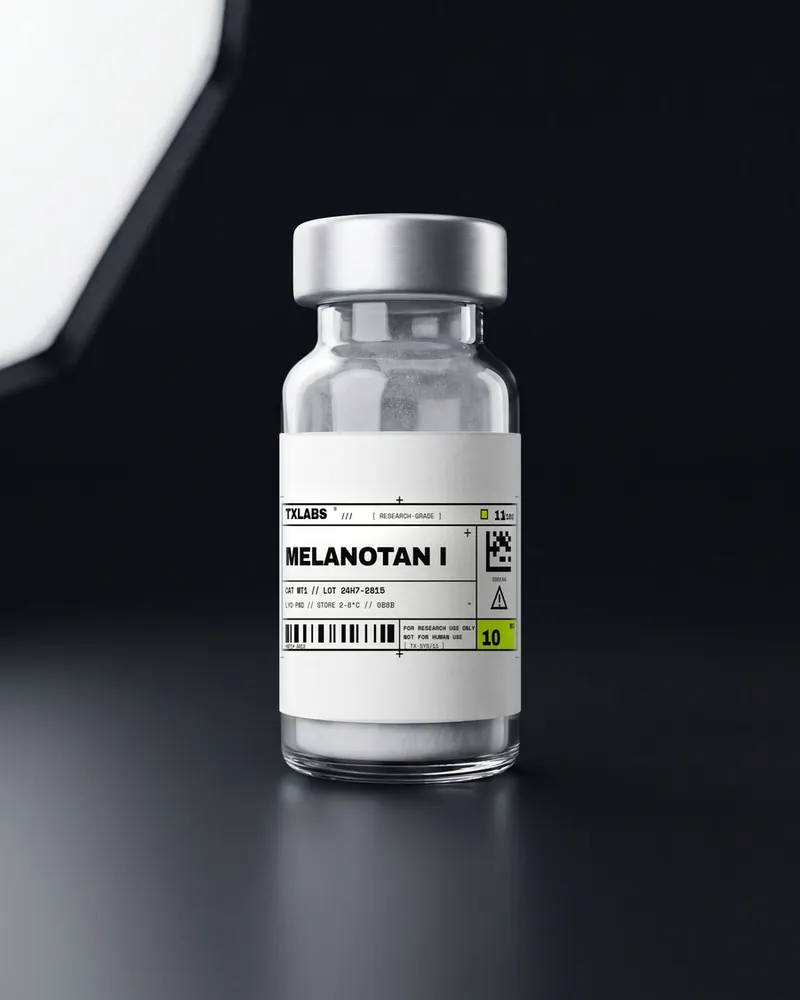
From $59 AUD · ≥98% HPLC purity · third-party COA · ships Australia-wide
What is MT-1?
MT-1 (Melanotan 1, afamelanotide) is a synthetic analogue of alpha-melanocyte-stimulating hormone that activates melanocortin-1 receptors. It is studied in research on melanogenesis and photoprotective pigmentation pathways.
Specifications
- From: $59 AUD
- Category: Aesthetic & Skin
- Form: Lyophilised powder
- Purity: ≥98% HPLC
- Testing: Third-party Certificate of Analysis
- Classification: Research reference material · For Research Use Only
What the research covers
MT-1, melanotan-1, is the compound whose international non-proprietary name is afamelanotide. It is a linear 13-residue analogue of alpha-melanocyte-stimulating hormone, written in the literature as [Nle4, D-Phe7]-alpha-MSH. PubChem lists the formula C78H111N21O19 and a molecular weight of 1646.8 Da. Two substitutions distinguish it from the native hormone: the methionine at position 4 is replaced by norleucine, which removes the oxidation-prone sulfur, and the phenylalanine at position 7 is replaced by its D-isomer, which resists enzymatic degradation. The N-terminus is acetylated and the C-terminus amidated, as in native alpha-MSH.
The structural contrast with melanotan II is the single most useful thing to understand about this compound, because the shared name family implies a similarity that does not exist. MT-1 is linear and retains the full 13-residue alpha-MSH length. Melanotan II is a cyclic heptapeptide, roughly half the length, closed by a lactam bridge between aspartate and lysine side chains. They are different molecules with different masses, 1646.8 Da against 1024.2 Da, different conformational behaviour and different reported selectivity across the melanocortin receptor subtypes, with MT-1 described in the literature as preferring the melanocortin-1 receptor while melanotan II is characterised as broadly non-selective. Confusing the two is common and is not a matter of degree.
Published research on MT-1 covers melanocortin receptor pharmacology, melanogenesis in melanocyte and animal models through MC1R signalling and consequent eumelanin synthesis, and a clinical development programme in erythropoietic protoporphyria. In Australia afamelanotide is registered on the Australian Register of Therapeutic Goods as SCENESSE, a 16 mg implant entered on 18 November 2020, sponsored by Clinuvel Pharmaceuticals, for the prevention of phototoxicity in adult patients with erythropoietic protoporphyria.
That registered product is a different thing entirely from this material. TXLABS supplies MT-1 as an unapproved analytical reference material for laboratory research only, not as a medicine, not as a cosmetic or tanning product, and not for human or veterinary administration.
Reading the certificate
Identity is the primary check and it is straightforward here, which is exactly why it should not be skipped. MT-1 sits at 1646.8 Da and melanotan II at 1024.2 Da, a difference of over 600 Da that any mass spectrometry method resolves, so a certificate that names the analyte and reports an observed mass settles the question of which melanotan is in the vial. Beyond that, confirm the norleucine at position 4 is reflected in the mass rather than a methionine, since the substitution changes the mass by sixteen daltons. The D-phenylalanine at position 7 introduces a stereochemical check that only chromatography can address. Oxidised tryptophan is the expected acquired impurity. TXLABS publishes third-party certificates for tested lots in the CoA library; none is currently published for MT-1. The lot certificate is available on request to support@txlabs.bio.
Storage and handling
MT-1's substitutions remove one liability and leave another. Replacing the position 4 methionine with norleucine eliminates the most oxidation-prone residue of native alpha-MSH, which is part of why the analogue is more robust than the parent hormone. The tryptophan at position 9 remains, however, and tryptophan is both photosensitive and oxidisable, so light-protected packaging and dark storage are chemical requirements rather than formalities. Store the lyophilised material at -20 °C, desiccated and shielded from light, and equilibrate the vial to room temperature before opening so that condensation does not wet a hygroscopic cake. Reconstituted solution is held at 2-8 °C in the dark, with single-use aliquots preferred over repeated freeze-thaw. Australian conditions combine intense ambient light with summer transit temperatures above 40 °C in vehicles and letterboxes, and the outer carton is the only light barrier a parcel has. Collect promptly, unpack indoors and refrigerate on arrival.
Working out concentration
The TXLABS MT-1 vial is 10 mg. Reconstituted with 2 mL of bacteriostatic water it gives 5 mg/mL; with 1 mL, 10 mg/mL; with 5 mL, 2 mg/mL. At 1646.8 Da a 5 mg/mL solution is approximately 3.0 mM. One labelling point is worth making: MT-1 and melanotan II are both stocked as 10 mg vials, both produce colourless solutions, and their masses differ by more than 600 Da without any visible sign, so stock containers should carry the compound name and not only a concentration if both are present on a bench. The reconstitution calculator resolves vial mass against volume. Concentration examples only, not a protocol.
How it relates to adjacent compounds
Melanotan II is the compound MT-1 is most often confused with and least resembles: a cyclic lactam-bridged heptapeptide of 1024.2 Da against MT-1's linear 13-residue 1646.8 Da structure, with a broadly non-selective melanocortin receptor profile where MT-1 is described as MC1R-preferring. PT-141 shares melanotan II's macrocyclic scaffold and differs from it only at the C-terminus. KPV is the C-terminal tripeptide of alpha-MSH and contains none of the core message sequence these compounds are built around. MT-1 is additionally the only compound in the melanocortin group corresponding to a substance registered as a medicine in Australia under a different name, which is why precision about what this material is and is not matters here. Structural and receptor relationships only.