Melanotan II Australia — Batch-Verified Research Peptide
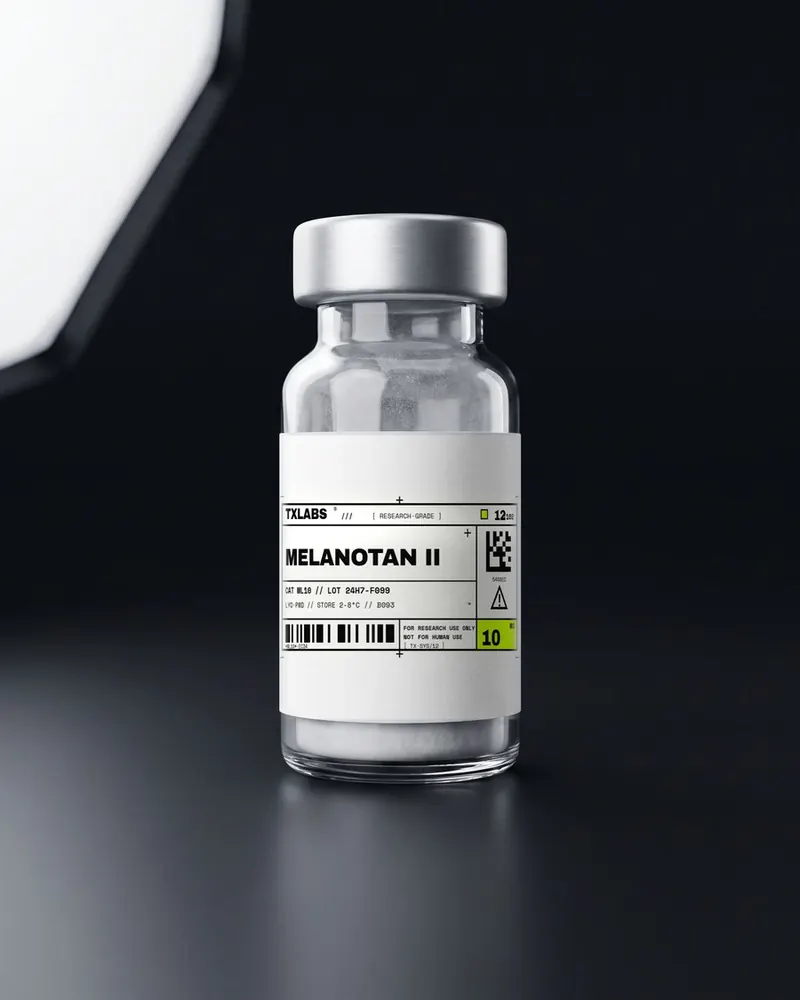
From $49 AUD · ≥98% HPLC purity · third-party COA · ships Australia-wide
What is MT-2 (Melanotan 2 Acetate)?
MT-2 (Melanotan 2 acetate) is a synthetic analogue of alpha-melanocyte-stimulating hormone and a non-selective melanocortin receptor agonist. It is investigated in research on melanogenesis and melanocortin signalling pathways.
Specifications
- From: $49 AUD
- Category: Aesthetic & Skin
- Form: Lyophilised powder
- Purity: ≥98% HPLC
- Testing: Third-party Certificate of Analysis
- Classification: Research reference material · For Research Use Only
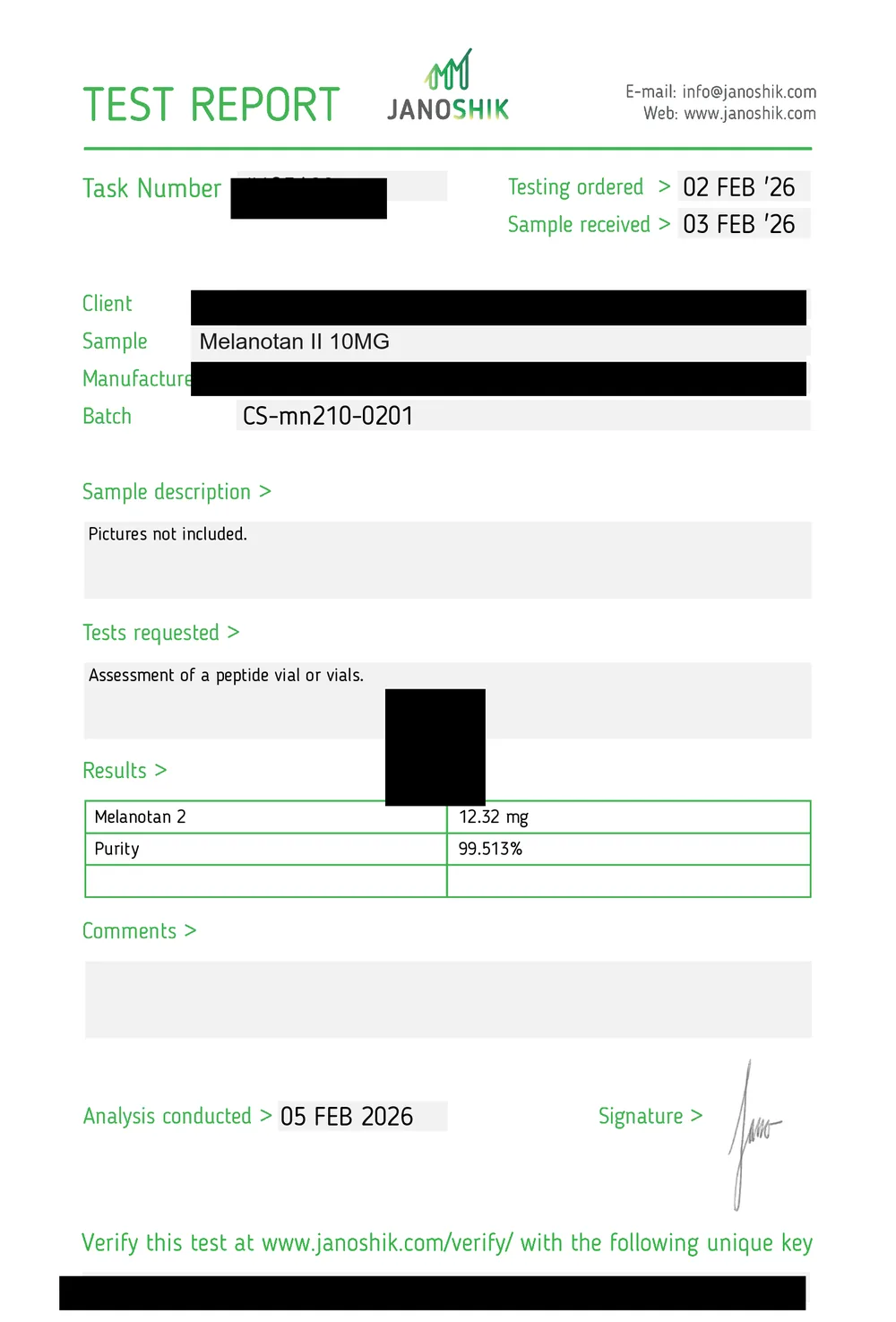 View full report ↗
Report ID and verification key are redacted on our copy of this certificate. Request the unredacted report, or see the full CoA library.
What the research covers
Melanotan II is a cyclic heptapeptide analogue of alpha-melanocyte-stimulating hormone with molecular formula C50H69N15O9 and molecular weight 1024.2 Da, supplied here as the acetate salt. Its structure, Ac-Nle-cyclo[Asp-His-D-Phe-Arg-Trp-Lys]-NH2, is a lactam-bridged macrocycle formed by a side-chain amide bond between aspartate and lysine. The ring constrains the His-D-Phe-Arg-Trp core message sequence shared across the melanocortin peptide family into a fixed conformation, and the combination of cyclisation, the D-phenylalanine substitution and the norleucine replacement confers marked resistance to enzymatic degradation relative to native alpha-MSH. It was developed in academic melanocortin chemistry programmes in the United States during the 1980s and 1990s.
Pharmacologically, melanotan II is characterised in the literature as a non-selective agonist across melanocortin receptor subtypes, with activity reported at MC1R, MC3R, MC4R and MC5R. That breadth is central to how it is used as a research tool: it is a standard reference agonist in melanocortin receptor pharmacology precisely because it engages the family broadly, in contrast to subtype-preferring ligands. Published research has examined melanogenesis in melanocyte and animal models through MC1R, energy homeostasis and feeding behaviour through MC3R and MC4R in rodents, and central nervous system endpoints attributed to MC4R. Its C-terminal acid analogue, bremelanotide, was identified as a metabolite and developed separately.
The Australian regulatory context is specific and adverse. The TGA has issued public warnings about melanotan products, which are not approved for supply or use in Australia, and has documented safety concerns associated with their unapproved use. TXLABS supplies melanotan II strictly as an analytical reference material for laboratory research. It is not an approved therapeutic good in Australia, is not a cosmetic or tanning product, and is not supplied for human or veterinary administration.
Reading the certificate
Two checks are specific to melanotan II. First, identity against its C-terminal acid analogue: melanotan II is the amide at 1024.2 Da and bremelanotide the acid at 1025.2 Da, a roughly one-dalton separation that low-resolution mass spectrometry may not resolve cleanly, making the analyte name and the method resolution both worth confirming. Second, salt form: this material is supplied as the acetate, and the counterion plus residual water contribute to gross powder weight without contributing peptide, which is why net peptide assay in milligrams is the figure that matters. Oxidised tryptophan is the expected degradation species. TXLABS publishes the Janoshik Analytical report in the CoA library: batch CS-mn210-0201, tested 5 February 2026, 99.513% purity with a 10 mg sample assaying 12.32 mg.
Storage and handling
The macrocyclic lactam structure makes melanotan II conformationally rigid and resistant to the backbone hydrolysis and isomerisation routes that affect linear peptides, so its practical stability is good. The specific liability is the tryptophan residue in the core message sequence: tryptophan is photosensitive and oxidation-prone, which makes light protection a chemical requirement rather than a formality. Store the lyophilised acetate salt at -20 °C, desiccated, in light-protected packaging, and equilibrate the vial to room temperature before opening so condensation does not wet the hygroscopic cake. Reconstituted solution is kept at 2-8 °C and shielded from light, with aliquoting preferred over repeated freeze-thaw. Under Australian conditions the combination of intense ambient light and summer transit temperatures routinely above 40 °C in letterboxes and delivery vehicles is exactly the environment that accelerates tryptophan degradation. Outer packaging is the only light barrier a parcel has, so prompt collection, indoor unpacking and refrigeration on arrival are the meaningful precautions.
Working out concentration
The TXLABS melanotan II vial is 10 mg. Reconstituted with 2 mL of bacteriostatic water it gives 5 mg/mL; with 1 mL, 10 mg/mL; with 5 mL, 2 mg/mL. At 1024.2 Da a 5 mg/mL solution is approximately 4.9 mM. One point deserves emphasis: melanotan II and PT-141 differ by roughly one dalton and are visually indistinguishable as lyophilised powder or in solution, so stock containers holding either should be labelled unambiguously if both are present in a laboratory. The reconstitution calculator resolves vial mass against diluent volume. These are worked concentration examples for record-keeping, not a protocol.
How it relates to adjacent compounds
Melanotan II sits at the centre of the melanocortin group in this catalogue. Its closest relative is PT-141 (bremelanotide), which shares the identical macrocyclic scaffold and core message sequence and differs only in bearing a C-terminal acid rather than an amide; PT-141 was identified as a metabolite of melanotan II. The two have different reported selectivity profiles across melanocortin receptor subtypes, which is a matter of pharmacological characterisation. KPV comes from the same parent hormone but the opposite end of it, being the C-terminal tripeptide of alpha-MSH with none of the core message sequence. Structural relationships only, with no comparison of effect.