Oxytocin Acetate Australia — Cyclic Nonapeptide Standard
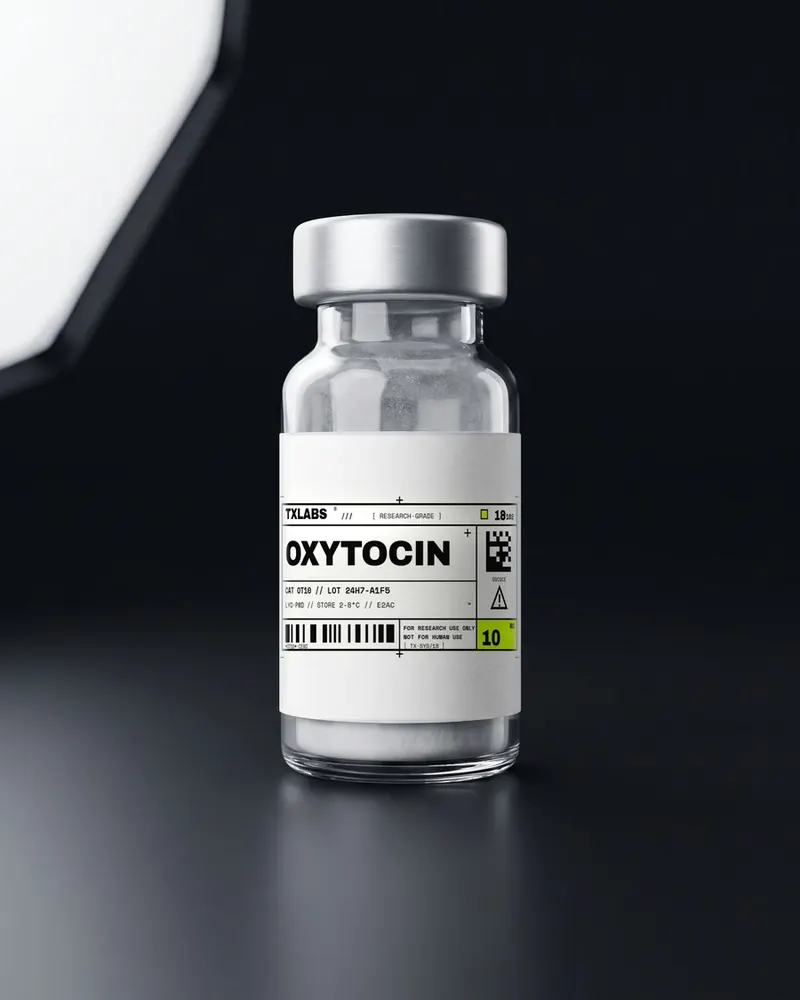
From $59 AUD · ≥98% HPLC purity · third-party COA · ships Australia-wide
What is Oxytocin Acetate?
Oxytocin Acetate is the acetate salt of oxytocin, a nine-amino-acid cyclic neuropeptide hormone that binds the oxytocin receptor. It is used in laboratory studies of social behaviour, receptor pharmacology, uterine and smooth-muscle physiology, and neuroendocrine signalling. Oxytocin Acetate is a common reference material in peptide hormone research.
Specifications
- From: $59 AUD
- Category: Hormones & Sexual Health
- Form: Lyophilised powder
- Purity: ≥98% HPLC
- Testing: Third-party Certificate of Analysis
- Classification: Research reference material · For Research Use Only
What the research covers
Oxytocin is a prescription-only medicine in Australia and registered prescription products containing it exist on the Australian Register of Therapeutic Goods. TXLABS supplies oxytocin acetate strictly as an analytical reference material for laboratory work. It is not supplied for human or veterinary administration, and no clinical indication or effect in humans is described here.
Structurally oxytocin is a cyclic nonapeptide, sequence Cys-Tyr-Ile-Gln-Asn-Cys-Pro-Leu-Gly-NH2, with an intramolecular disulfide bridge between the cysteine residues at positions 1 and 6 and a primary amide at the C-terminus. That disulfide closes a six-residue macrocycle and leaves a three-residue tail, an architecture it shares with vasopressin, from which it differs at only two positions. The molecular weight of the free peptide is approximately 1007 Da. TXLABS supplies the acetate salt, and the acetate counterion together with residual water contributes gross vial weight without contributing peptide, which is why peptide content and net peptide weight are distinct figures on any certificate.
Oxytocin was the first polypeptide hormone to have its structure determined and to be chemically synthesised, work carried out by Vincent du Vigneaud in the 1950s, and it has been a standard subject of peptide chemistry ever since. The published research literature falls into two broad strands. One is receptor pharmacology at the oxytocin receptor OXTR and at the related vasopressin receptors, where cross-reactivity between the two ligand families is a persistent methodological theme. The other is a very large preclinical behavioural literature in rodents and in prairie voles examining social recognition, pair bonding and related behaviours. That animal literature is extensive but its interpretation is contested, and translation from rodent behavioural paradigms to any statement about humans is not supported.
TXLABS supplies oxytocin acetate as an analytical reference material for laboratory research only. It is a prescription medicine in Australia, it is not supplied for human or veterinary administration, and it is not offered for any therapeutic purpose.
Reading the certificate
For a small cyclic disulfide peptide the interesting question on a certificate is what the chromatography resolves rather than what the headline percentage says. Ask whether the method separates the reduced linear form, which differs from the parent by two daltons and elutes differently, and whether it separates disulfide-linked dimers, which carry roughly double the parent mass. Ask whether deamidated species are resolved, since they are nearly isobaric and mass spectrometry alone will not exclude them. Confirm the observed mass is consistent with roughly 1007 Da for the free peptide, and confirm the salt form is stated, because acetate content and residual water are the difference between gross vial weight and actual peptide. TXLABS publishes third-party certificates for tested lots in the CoA library; no certificate is currently published for oxytocin acetate. The lot certificate is available on request to support@txlabs.bio.
Storage and handling
The disulfide bridge is the defining stability liability. It can be reduced by any thiol contamination, and it can scramble intermolecularly to give dimers and higher oligomers, a reaction favoured at alkaline pH and accelerated by warmth. Those products carry masses that are multiples or near-multiples of the parent, so they are visible to mass spectrometry if it is looked for, but they are not visible in the vial. The asparagine and glutamine residues are subject to deamidation, which is nearly isobaric with the parent and therefore chromatographic to detect. The C-terminal amide can hydrolyse to the free acid under acidic conditions, adding one dalton.
Separately, oxytocin is notoriously adsorptive. At low concentration it binds appreciably to glass and plastic, and dilute working solutions lose a measurable fraction to container walls. This is a documented practical problem and the usual explanation when a dilution series is not linear.
Store the lyophilised acetate at -20 C, desiccated and protected from light, and equilibrate the sealed vial before opening. Hold solutions at 2-8 C at mildly acidic pH and aliquot rather than freeze-thaw. Australian summer freight above 40 C accelerates disulfide scrambling, so prompt refrigeration matters.
Working out concentration
The TXLABS oxytocin acetate vial is 10 mg. Reconstituted with 2 mL of bacteriostatic water it gives 5 mg/mL; with 1 mL, 10 mg/mL; with 5 mL, 2 mg/mL. Using a free peptide molecular weight of approximately 1007 Da, 5 mg/mL is close to 5.0 millimolar and 2 mg/mL close to 2.0 millimolar, a convenient coincidence worth noting because it makes molar estimation easy. One caution applies: the stated vial mass is of the acetate salt, so the peptide content is lower than the gross figure and molar calculations based on the label mass will slightly overestimate. The reconstitution calculator handles any pairing. Concentration arithmetic only, not a protocol.
How it relates to adjacent compounds
Oxytocin's closest structural relative is vasopressin, which is not stocked here, but the catalogue does contain several compounds that share its architecture or its position in the endocrine system. PT-141 and Melanotan II are the other cyclic peptides in this catalogue, both closed by a lactam bridge rather than a disulfide, which makes an instructive contrast: a lactam is chemically robust where a disulfide is the weakest link in the molecule. Kisspeptin-10 and gonadorelin are neighbours in the hormone group as short defined peptides supplied for receptor work. These are structural and category adjacencies only, and imply nothing about comparable activity or interchangeable use.