Liraglutide Australia — GLP-1 Analogue Reference Material
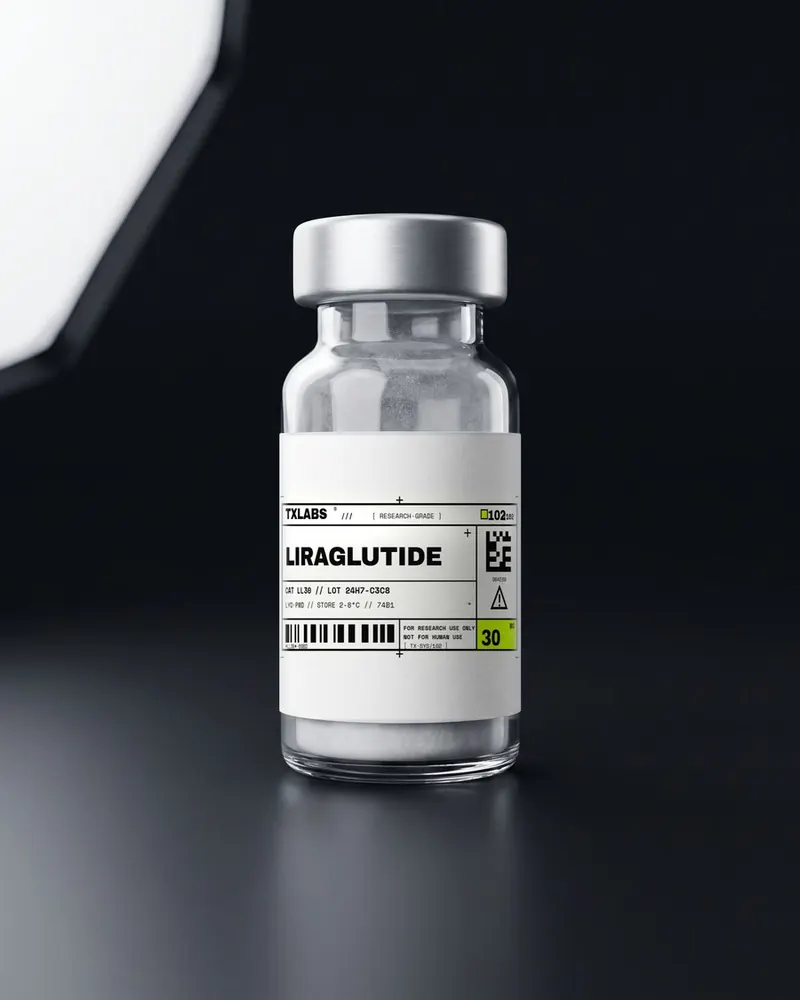
From $299 AUD · ≥98% HPLC purity · third-party COA · ships Australia-wide
What is Liraglutide?
Liraglutide is a synthetic GLP-1 (glucagon-like peptide-1) receptor agonist that binds and activates the GLP-1 receptor. This acylated peptide analogue is investigated in preclinical research on incretin signalling, glucose metabolism and appetite-regulating pathways. Liraglutide serves as a reference standard in GLP-1 receptor studies.
Specifications
- From: $299 AUD
- Category: Metabolic & GLP-1
- Form: Lyophilised powder
- Purity: ≥98% HPLC
- Testing: Third-party Certificate of Analysis
- Classification: Research reference material · For Research Use Only
What the research covers
Liraglutide is a synthetic analogue of human glucagon-like peptide-1 and an agonist at the GLP-1 receptor, a class B G-protein-coupled receptor. PubChem lists the formula C172H265N43O51 and a molecular weight near 3751 Da. Two modifications distinguish it from native GLP-1(7-37): a lysine-to-arginine substitution at position 34, which directs acylation to a single site, and attachment of a C16 palmitic acid chain to the lysine 26 side chain through a glutamic acid spacer. That acylation promotes reversible albumin binding and self-association in solution, which together slow absorption and clearance. It is worth noting that liraglutide uses a saturated C16 fatty acid where the later analogues semaglutide and tirzepatide use longer fatty diacids, and the reported circulating half-life differs accordingly, measured in hours rather than days. The progression from liraglutide to the diacid-bearing analogues is one of the clearest illustrations in peptide chemistry of how acylation chemistry maps onto pharmacokinetics.
Liraglutide is among the most thoroughly characterised peptides available as a research reference material. Published work spans receptor binding and signalling assays, structural studies of GLP-1 receptor activation, self-association and micelle formation in solution, rodent and non-human primate pharmacology, and very large randomised clinical trial programmes in type 2 diabetes and in obesity extending back more than fifteen years. Because it has been in clinical use longer than the newer analogues, the post-marketing and mechanistic literature around it is correspondingly deeper.
In Australia liraglutide is registered on the Australian Register of Therapeutic Goods as VICTOZA, first registered in 2010, and as SAXENDA, registered on 24 December 2015, both sponsored by Novo Nordisk Pharmaceuticals. Both are prescription medicines. TXLABS supplies liraglutide only as an analytical reference material for method qualification, identity confirmation, receptor pharmacology and stability work. It is not supplied for human or veterinary administration.
Reading the certificate
For liraglutide the certificate should address identity and related substances rather than lead with a purity percentage. Confirm mass-spectrometric identity against the expected value near 3751 Da; des-palmitoyl liraglutide, which has lost the C16 chain, and deamidated variants both chromatograph near the parent on reversed-phase HPLC. Check that the assay is reported in milligrams against label weight, since salt counterion and residual water inflate gross powder weight without adding peptide, and confirm the certificate names a specific batch rather than being issued generically. High-molecular-weight species by size-exclusion chromatography are the other meaningful check for a self-associating peptide. TXLABS publishes third-party certificates for tested lots in the CoA library; none is currently published for liraglutide. The lot certificate is available on request to support@txlabs.bio.
Storage and handling
Liraglutide's self-association behaviour is the handling fact that matters most. In solution it forms reversible oligomers, and the balance between soluble oligomer and irreversible aggregate is sensitive to concentration, pH, temperature and mechanical stress. Add diluent gently down the inner wall of the vial, swirl rather than shake, and avoid vortexing entirely; foaming indicates the air-liquid interface stress that pushes the equilibrium the wrong way. Store the lyophilised cake at -20 °C, desiccated and protected from light, and equilibrate the vial to room temperature before opening so condensation does not settle on cold glass. Reconstituted solution is kept at 2-8 °C and shielded from light, with single-use aliquots preferred over repeated freeze-thaw. In Australian conditions the transit leg is the exposure: summer road freight and unattended letterboxes above 40 °C combine heat with agitation, which is the worst pairing for a self-associating acylated peptide. Collect promptly and refrigerate on arrival.
Working out concentration
Liraglutide is stocked in 10 mg and 30 mg vials, a threefold spread. A 10 mg vial reconstituted with 2 mL of bacteriostatic water gives 5 mg/mL; with 1 mL, 10 mg/mL. A 30 mg vial with 3 mL gives 10 mg/mL, and with 6 mL, 5 mg/mL. At roughly 3751 Da, a 5 mg/mL solution is approximately 1.3 mM. Because liraglutide self-associates, the concentration chosen is not purely an arithmetic convenience: higher stock concentrations sit further along the oligomerisation equilibrium, which is worth noting in the record. The reconstitution calculator resolves vial mass against diluent volume. Concentration examples only, not a protocol.
How it relates to adjacent compounds
Liraglutide is the earliest of the acylated GLP-1 analogues in this catalogue and the structural reference point for the rest. Semaglutide keeps the same basic strategy but replaces the C16 saturated acid with a C18 fatty diacid on a hydrophilic spacer and adds an alpha-aminoisobutyric acid substitution to block dipeptidyl peptidase-4 cleavage. Tirzepatide moves to a GIP-derived backbone with a C20 diacid and dual receptor activity, and retatrutide extends that to three receptors. Read as a series, these show how acylation chemistry and receptor scope were changed in successive designs. Its depth of published characterisation is also what makes liraglutide the most useful of the four as a method-development comparator when qualifying an assay for a newer analogue. Structural relationships only, not comparisons of effect.