Tirzepatide Australia — GIP/GLP-1 Reference Material
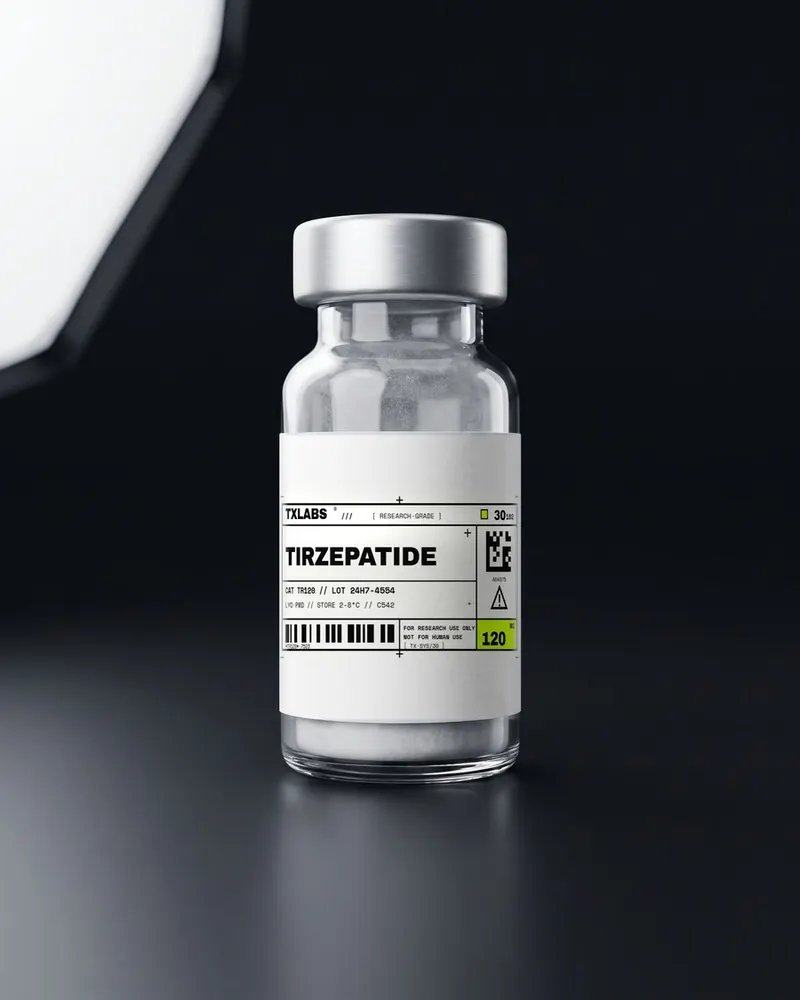
From $49 AUD · ≥98% HPLC purity · third-party COA · ships Australia-wide
What is Tirzepatide?
Tirzepatide is a synthetic dual GIP and GLP-1 receptor agonist (a unimolecular incretin peptide). It has been investigated in research on incretin receptor signalling, insulin secretion, glucose regulation and energy-metabolism pathways. Tirzepatide is a reference material in metabolic and receptor-pharmacology studies.
Specifications
- From: $49 AUD
- Category: Metabolic & GLP-1
- Form: Lyophilised powder
- Purity: ≥98% HPLC
- Testing: Third-party Certificate of Analysis
- Classification: Research reference material · For Research Use Only
What the research covers
Tirzepatide is a synthetic 39-residue peptide characterised in the literature as a dual agonist at two class B G-protein-coupled receptors: the glucose-dependent insulinotropic polypeptide receptor (GIPR) and the glucagon-like peptide-1 receptor (GLP-1R). PubChem lists its molecular formula as C225H348N48O68 with a molecular weight near 4813 Da. Unlike semaglutide and liraglutide, which are built on the GLP-1 backbone, tirzepatide's sequence is derived from native GIP, and its affinity for the GLP-1 receptor is engineered rather than inherited. Two alpha-aminoisobutyric acid residues confer resistance to dipeptidyl peptidase-4 cleavage, and a C20 fatty diacid attached through a linker to a lysine side chain drives reversible albumin binding, which is the structural basis for the extended circulating half-life reported for the molecule.
The mechanistic literature on tirzepatide is unusually detailed for a peptide of this age. Published receptor pharmacology has compared its potency and efficacy at GIPR and GLP-1R, and has described a signalling profile at the GLP-1 receptor that is imbalanced relative to native GLP-1, with beta-arrestin recruitment weaker in proportion to cAMP accumulation. Whether that imbalance explains anything observed downstream remains an open question in the literature rather than a settled account. Preclinical work has examined GIP receptor biology in adipose tissue and in the central nervous system, an area that was comparatively neglected before dual agonists made it relevant again. Large randomised clinical trial programmes in type 2 diabetes and in obesity have been reported since 2021.
In Australia tirzepatide is registered on the Australian Register of Therapeutic Goods as MOUNJARO, sponsored by Eli Lilly Australia, with pre-filled pen entries registered from December 2022 and vial entries from July 2023. It is a prescription medicine. TXLABS supplies tirzepatide only as an analytical reference material for laboratory work: method qualification, LC-MS identity confirmation, receptor pharmacology and stability studies. It is not supplied for human or veterinary administration and nothing here describes therapeutic use.
Reading the certificate
For a large acylated peptide, a purity percentage on its own answers very little. The species that matter are des-acyl tirzepatide, in which the fatty diacid has been lost, and deletion sequences from incomplete coupling across 39 residues; both can chromatograph close to the parent on reversed-phase HPLC while being different molecules. Identity should therefore be established by mass spectrometry against the expected mass near 4813 Da, and the assay should be reported in milligrams against the vial's label weight rather than as a percentage alone. TXLABS publishes third-party certificates for its tested lots in the CoA library. No certificate is currently published for tirzepatide, and this page does not claim one. The certificate covering the specific lot supplied is available on request to support@txlabs.bio.
Storage and handling
Lyophilised tirzepatide is held at -20 °C for long-term storage, desiccated and protected from light, with 2-8 °C adequate for material in active use. The fatty diacid makes the molecule amphiphilic, so it accumulates at air-liquid interfaces and can aggregate under shear: add diluent slowly down the inner wall of the vial, rotate gently, and do not vortex or shake. Visible foaming is the signal that interface stress has occurred. Equilibrate a frozen vial to room temperature before breaking the seal, because condensation on cold glass wets a hygroscopic cake. Reconstituted solution is kept at 2-8 °C and shielded from light; if a portion must be frozen, aliquot into single-use volumes rather than cycling one vial. Australian transit is where most avoidable damage occurs. Summer road freight and unattended letterboxes routinely exceed 40 °C, and the larger acylated peptides have less thermal headroom than short sequences. Collect parcels promptly and refrigerate on arrival.
Working out concentration
Concentration is mass divided by diluent volume, nothing more. A 10 mg tirzepatide vial reconstituted with 1 mL of bacteriostatic water gives 10 mg/mL; with 2 mL, 5 mg/mL. A 30 mg vial with 3 mL also gives 10 mg/mL, and a 120 mg vial with 4 mL gives 30 mg/mL. The TXLABS range spans 10 mg to 120 mg per vial, a twelvefold spread, so an identical diluent volume produces wildly different concentrations across the catalogue and the arithmetic is worth writing down rather than assuming. At 4813 Da, a 10 mg/mL solution corresponds to roughly 2.1 mM. The reconstitution calculator resolves any vial and volume pairing. Worked concentration examples only, not a protocol.
How it relates to adjacent compounds
Tirzepatide sits between the single-receptor and triple-receptor ends of the incretin group in this catalogue. Semaglutide is a GLP-1 receptor agonist built on the GLP-1 backbone; retatrutide adds glucagon receptor agonism to the GIP and GLP-1 activities on a glucagon/GIP scaffold. Tirzepatide differs from both in being built on native GIP rather than GLP-1, which is a genuine difference in design lineage and not a statement about relative effect. Cagrilintide is often stored alongside these but belongs to the amylin family and acts through calcitonin receptor complexes, a separate receptor system entirely. The practical consequence in a laboratory holding several of them is that none can stand in as a system-suitability standard for another, despite the shared design vocabulary. These are structural and receptor-level relationships only.