Retatrutide Australia — Batch-Verified Research Peptide
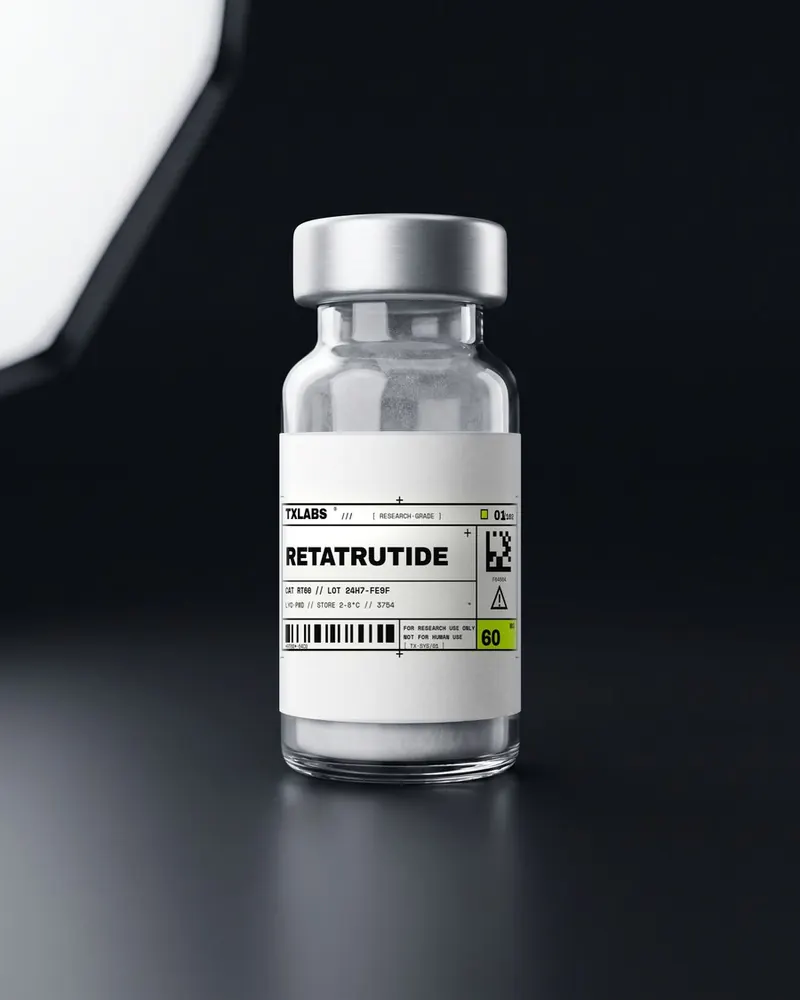
From $229 AUD · ≥98% HPLC purity · third-party COA · ships Australia-wide
What is Retatrutide?
Retatrutide (LY3437943) is a synthetic triple agonist peptide that activates the GLP-1, GIP and glucagon receptors. It is studied in preclinical research on energy metabolism, appetite signalling and glucose regulation, and is supplied strictly as a reference material for laboratory use.
Specifications
- From: $229 AUD
- Category: Metabolic & GLP-1
- Form: Lyophilised powder
- Purity: ≥98% HPLC
- Testing: Third-party Certificate of Analysis
- Classification: Research reference material · For Research Use Only
 View full report ↗
What the research covers
Retatrutide, identified in the literature by its development code LY3437943, is a synthetic single-chain peptide engineered as an agonist at three class B G-protein-coupled receptors simultaneously: the glucagon-like peptide-1 receptor (GLP-1R), the glucose-dependent insulinotropic polypeptide receptor (GIPR) and the glucagon receptor (GCGR). Its backbone is drawn from the glucagon/GIP peptide family and carries several non-proteinogenic substitutions, reported to include alpha-aminoisobutyric acid residues that resist dipeptidyl peptidase-4 cleavage, together with a long-chain fatty diacid attached through a linker to a lysine side chain. Published molecular weights place the molecule in the region of 4.7 kDa. The acyl chain promotes reversible albumin binding, and pharmacokinetic characterisation reported in the literature describes a circulating half-life on the order of several days.
Research interest in retatrutide centres on what happens when GLP-1, GIP and glucagon receptor signalling are engaged from a single molecular entity rather than by combining separate agonists. Preclinical work has examined receptor binding and cAMP signalling potency at each of the three receptors, and rodent studies have investigated food intake, energy expenditure and hepatic lipid handling. A phase 2 randomised clinical trial in adults with obesity was published in 2023 and reported changes in body weight and metabolic parameters across the treatment arms studied, and further clinical programmes have been registered since. Because glucagon receptor agonism is what distinguishes retatrutide from dual GLP-1/GIP agonists, a recurring theme in the literature is the contribution of GCGR signalling to energy expenditure and hepatic substrate use, and how that is balanced against effects on glycaemia.
In a laboratory context retatrutide is handled as a reference material for analytical method development, receptor pharmacology assays, stability and formulation work, and as a comparator in incretin-analogue research. TXLABS supplies it for those purposes only. It is not an approved therapeutic good in Australia and is not supplied for human or veterinary administration.
Reading the certificate
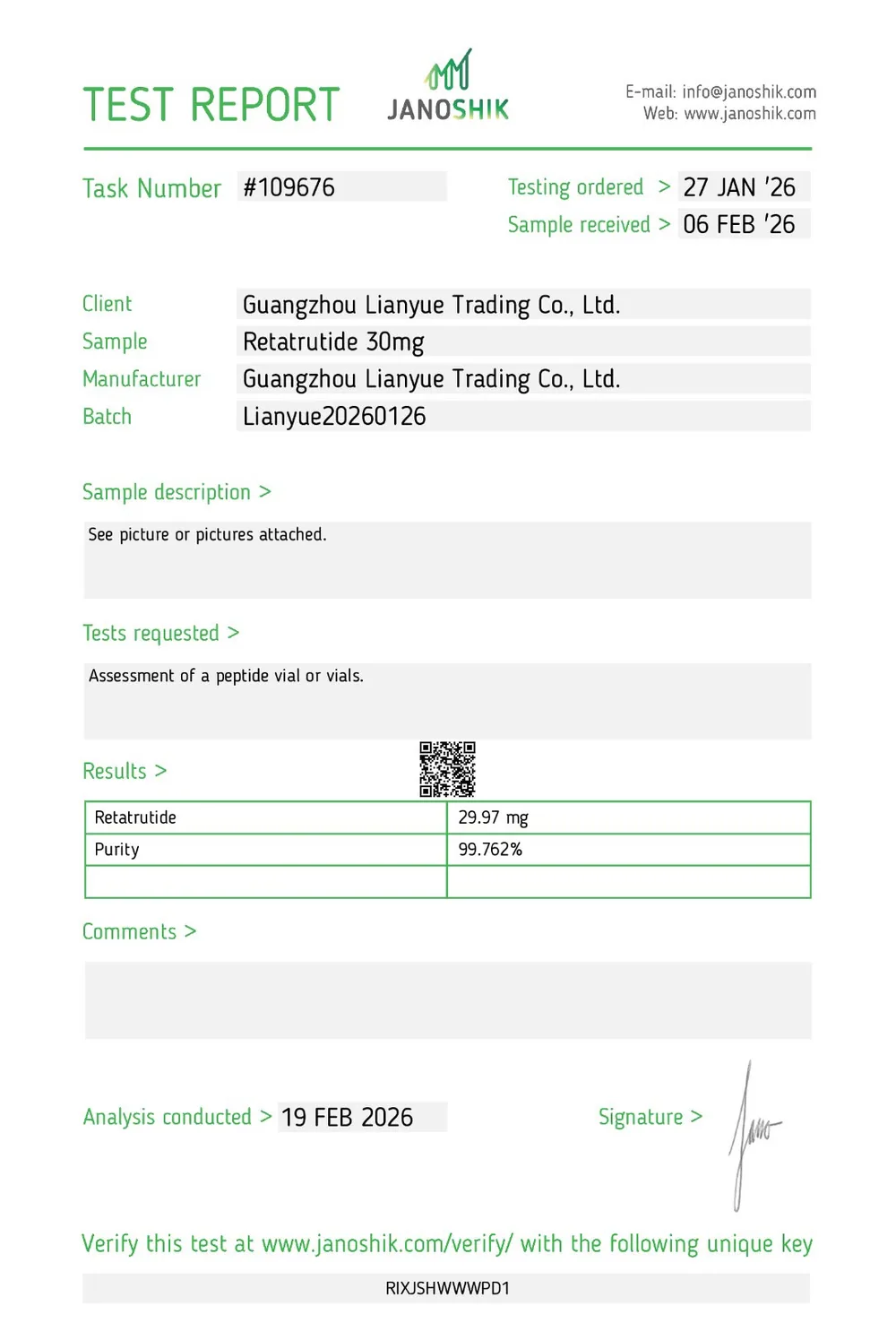
For an acylated multi-receptor peptide of this size, purity by reversed-phase HPLC is necessary but not sufficient. Confirm that identity was established by mass spectrometry against the expected molecular mass, because a des-acyl or truncated related species can chromatograph close to the parent peak while being the wrong molecule. Read the assay figure in milligrams against the vial's label weight, and treat the purity percentage as belonging to that specific lot rather than to the product line. TXLABS publishes the Janoshik Analytical report for retatrutide in the CoA library: a 30 mg sample assayed at 29.97 mg with 99.762% purity. It is one of the reports where the laboratory task number and verification key are published, so the result can be checked directly against Janoshik's records rather than taken on trust.
Storage and handling
Lyophilised retatrutide is supplied as a dry cake and is held at -20 °C for long-term storage, desiccated and protected from light; 2-8 °C is adequate for short-term working stock. Because the molecule is fatty-acid acylated and comparatively large, it is more prone to aggregation in solution than short peptides, so mechanical stress matters: add diluent slowly down the inner wall of the vial, swirl rather than shake, and avoid vortexing or foaming. Allow a frozen vial to equilibrate to room temperature before breaking the seal, since opening cold glass in humid air draws condensation into a hygroscopic cake. Reconstituted material is normally kept refrigerated at 2-8 °C and protected from light; where longer storage is needed, aliquot into single-use volumes and freeze once rather than subjecting one vial to repeated freeze-thaw cycles. Australian transit is the practical variable. Summer road freight, delivery vans and unattended letterboxes routinely exceed 40 °C, and a metal box in direct sun runs hotter again. Lyophilised powder tolerates brief ambient excursions, but parcels are best collected promptly and refrigerated on arrival rather than left in a vehicle or mailbox.
Working out concentration
Concentration is arithmetic: the mass in the vial divided by the volume of diluent added. A 10 mg vial reconstituted with 2 mL of bacteriostatic water gives 5 mg/mL; the same vial with 1 mL gives 10 mg/mL; a 30 mg vial with 3 mL also gives 10 mg/mL. Retatrutide is stocked from 10 mg through to 60 mg per vial, so an identical diluent volume produces very different concentrations across the range, which is worth confirming before any downstream calculation. The reconstitution calculator performs the conversion for any vial size and volume. These are worked concentration examples for laboratory record-keeping, not a protocol.
How it relates to adjacent compounds
Retatrutide sits at the structurally most complex end of the incretin-analogue group in this catalogue. Semaglutide shares the same engineering strategy of a fatty diacid on a lysine side chain to extend circulating half-life, but is a GLP-1 receptor agonist built on the GLP-1 backbone rather than a triple agonist built on a glucagon/GIP scaffold. The relationship is one of design lineage, not equivalence, and the two are not interchangeable in any assay. Structurally unrelated but often stored alongside it are the growth-hormone-axis peptides such as tesamorelin and ipamorelin, which act through GHRH and ghrelin receptor families respectively. These are structural and mechanistic relationships only, not statements about relative effect.