Adipotide Australia — FTPP Peptidomimetic, 5 and 10 mg
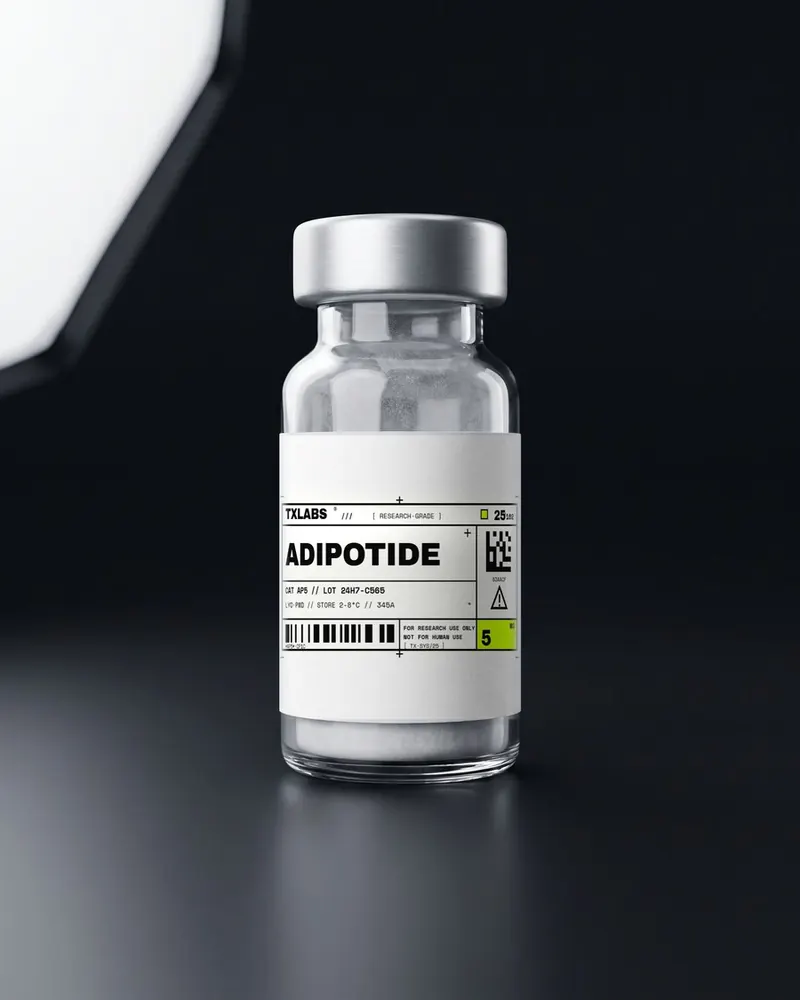
From $139 AUD · ≥98% HPLC purity · third-party COA · ships Australia-wide
What is Adipotide?
Adipotide (FTPP, prohibitin-targeting peptide) is a proapoptotic peptidomimetic that homes to prohibitin on white-adipose-tissue vasculature. It has been investigated in preclinical research on targeted endothelial apoptosis, adipose-tissue vascular biology and metabolic regulation. Adipotide serves as a reference compound in adipose and tumour-vasculature studies.
Specifications
- From: $139 AUD
- Category: Metabolic & GLP-1
- Form: Lyophilised powder
- Purity: ≥98% HPLC
- Testing: Third-party Certificate of Analysis
- Classification: Research reference material · For Research Use Only
What the research covers
Adipotide, also called FTPP or prohibitin-targeting peptide 1, is a two-module peptidomimetic with the composition CKGGRAKDC-GG-D(KLAKLAK)2. The first module is a nine-residue cyclic motif, CKGGRAKDC, identified by phage display screening reported by Kolonin, Saha, Chan, Pasqualini and Arap in 2004 as homing to the endothelial surface of vessels supplying white adipose tissue, where the proposed binding partner is a complex involving prohibitin and annexin A2. A glycine-glycine linker joins it to the second module, D(KLAKLAK)2, an amphipathic pro-apoptotic sequence built entirely from D-amino acids. The design logic is targeted delivery: the first module concentrates the construct at a particular vascular bed, and the second disrupts mitochondrial membranes in the cells that internalise it. The work originated at the University of Texas Health Science Center at Houston.
The most important fact about adipotide is its development history, and it should not be softened. A phase 1 human trial commenced in 2012. Clinical development was subsequently discontinued, with nephrotoxicity reported as the reason. There is no approved adipotide product in any jurisdiction, no current regulatory application, and the compound is not registered on the ARTG. Preclinical reports in rodent and non-human primate models exist and are the bulk of what is published, but the programme that would have tested those findings in humans was stopped.
Structurally the construct is unusual enough to matter analytically. The all-D payload means its stereochemistry cannot be read from a mass measurement, and the two cysteines in the targeting module raise a cyclisation question that an intact mass does not settle.
TXLABS supplies adipotide as an analytical reference material for laboratory research only. It is not an approved therapeutic good in Australia and is not supplied for human or veterinary administration.
Reading the certificate
Two questions dominate a certificate for this construct and neither is answered by a purity percentage. The first is chirality. The payload is built from D-amino acids, and chirality has no mass, so an all-L version of the same sequence is isobaric and indistinguishable by mass spectrometry alone. Only chiral analysis, typically amino acid analysis after hydrolysis with chiral separation, establishes that the D-form is present. The second is the disulfide. The targeting module contains two cysteines, and whether they are oxidised into the intended cyclic form, reduced, or scrambled into oligomers changes the molecule's behaviour while an intact mass measurement may barely distinguish them; a reduced species differs by two daltons. Ask what was actually measured. TXLABS publishes third-party certificates for tested lots in the CoA library; none is published for adipotide, and the lot certificate is available on request to support@txlabs.bio.
Storage and handling
Adipotide combines features that pull in different directions. The D-amino-acid payload is essentially immune to proteolysis, since proteases are stereospecific, but the L-amino-acid targeting module is not, so residual enzymatic activity in a buffer still has a substrate. The KLAKLAK repeats are strongly cationic and amphipathic, which means the construct adsorbs readily to glass and plastic surfaces and dilute working solutions lose material to container walls; low-binding plasticware is the standard mitigation. The two cysteines make oxidation and disulfide scrambling a genuine concern, so minimise headspace and avoid prolonged exposure to air in solution. Hold the lyophilised material at -20 °C, desiccated and dark, equilibrate sealed to room temperature before opening, and keep reconstituted solution at 2-8 °C in single-use aliquots. Australian summer transit above 40 °C is unhelpful for any cysteine-containing peptide, since elevated temperature accelerates thiol oxidation; collect parcels promptly and refrigerate.
Working out concentration
Adipotide is stocked at 5 mg and 10 mg. The 5 mg vial with 1 mL of bacteriostatic water gives 5 mg/mL; with 2 mL, 2.5 mg/mL. The 10 mg vial with 1 mL gives 10 mg/mL, with 2 mL gives 5 mg/mL and with 5 mL gives 2 mg/mL. Because the construct is strongly cationic and adsorbs to surfaces, the concentration in a dilute working solution can drift below the calculated figure over time even though the arithmetic was correct, which is a property of the material rather than an error in the calculation. The reconstitution calculator converts vial mass against volume. These are concentration examples only, not a protocol.
How it relates to adjacent compounds
FOXO4-DRI is the closest analytical relative in the catalogue: another construct built from D-amino acids whose identity cannot be settled by mass spectrometry, and whose page sets out the chirality problem in detail. The two share a design philosophy of using D-stereochemistry for protease resistance while pursuing entirely unrelated targets. Kisspeptin-10 and other short cationic peptides in the catalogue share adipotide's surface-adsorption behaviour and the handling that follows from it. AOD9604 appears in adjacent metabolic research literature while being an entirely different kind of molecule. These are chemical and analytical adjacencies and carry no implication about comparative activity.