Semaglutide Australia — Batch-Verified Reference Material
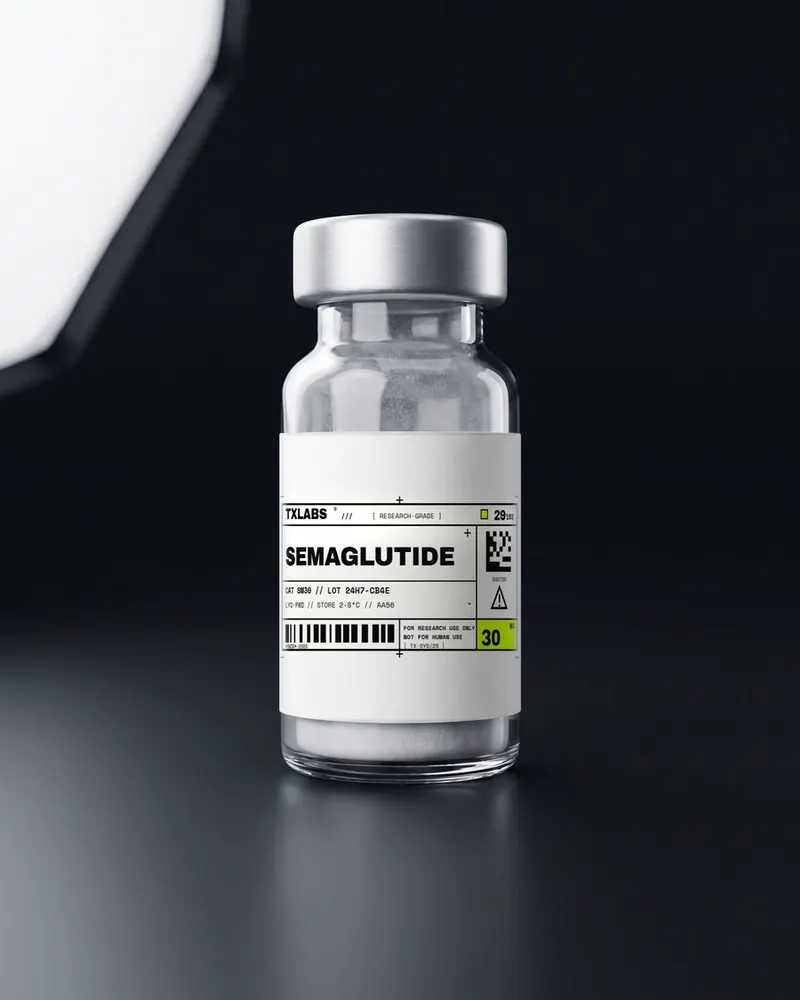
From $59 AUD · ≥98% HPLC purity · third-party COA · ships Australia-wide
What is Semaglutide?
Semaglutide is a long-acting glucagon-like peptide-1 (GLP-1) receptor agonist and analogue of native GLP-1. It is used in laboratory studies of incretin signalling, insulin secretion, glucose homeostasis, appetite pathways and receptor pharmacology. Semaglutide is a widely used reference compound in metabolic and GLP-1 research.
Specifications
- From: $59 AUD
- Category: Metabolic & GLP-1
- Form: Lyophilised powder
- Purity: ≥98% HPLC
- Testing: Third-party Certificate of Analysis
- Classification: Research reference material · For Research Use Only
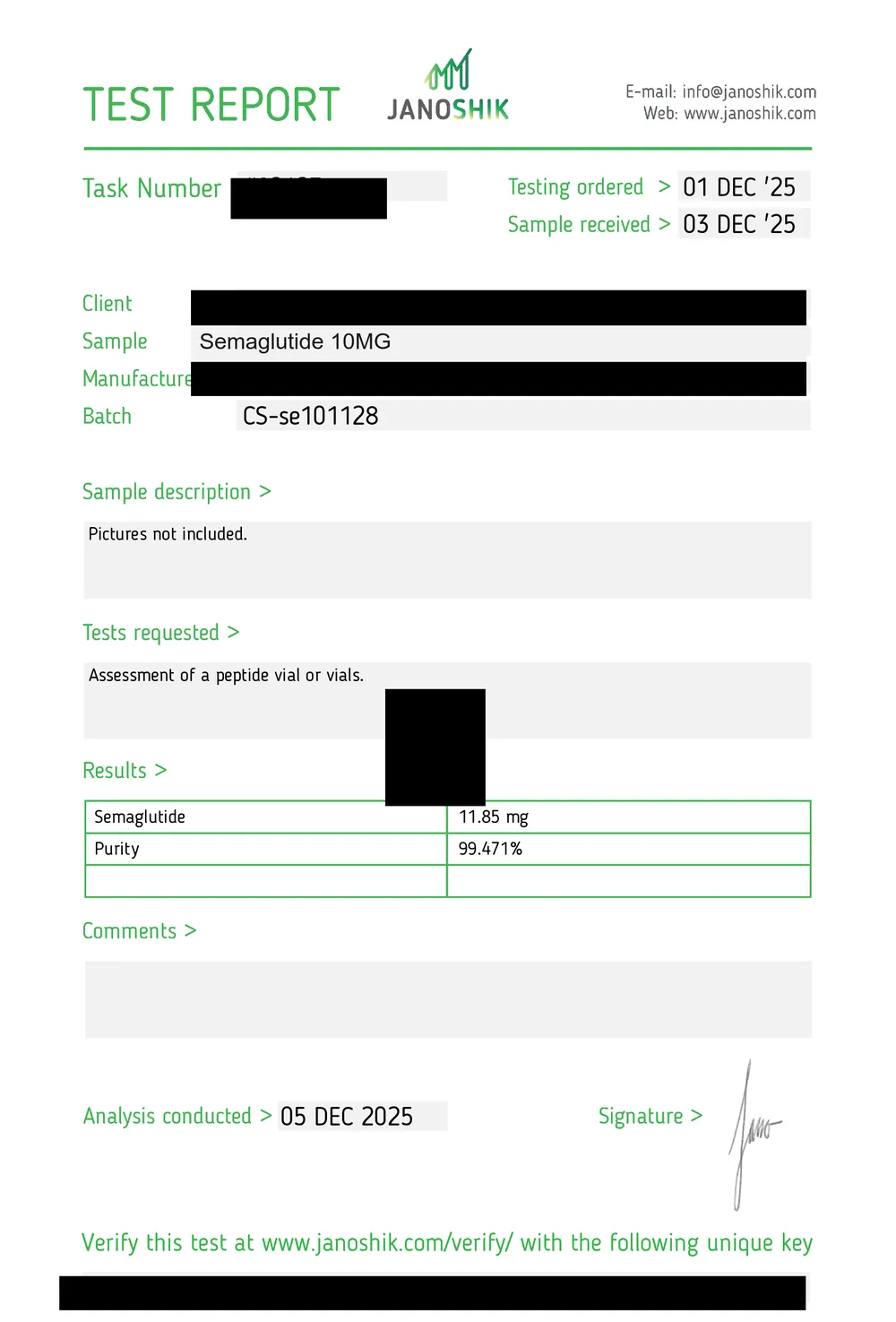 View full report ↗
Report ID and verification key are redacted on our copy of this certificate. Request the unredacted report, or see the full CoA library.
What the research covers
Semaglutide is a synthetic analogue of human glucagon-like peptide-1 (GLP-1) and a selective agonist at the GLP-1 receptor, a class B G-protein-coupled receptor. It has the molecular formula C187H291N45O59 and a molecular weight of approximately 4114 Da. Three structural modifications distinguish it from native GLP-1: substitution of alanine at position 8 with alpha-aminoisobutyric acid, which blocks cleavage by dipeptidyl peptidase-4; substitution at position 34 to direct acylation to a single site; and attachment of a C18 fatty diacid to the lysine 26 side chain through a short hydrophilic spacer. The diacid drives reversible binding to serum albumin, which is the principal reason its reported circulating half-life is measured in days rather than minutes.
Semaglutide is among the most heavily characterised peptides in modern pharmacology. Published work spans receptor binding and beta-arrestin recruitment assays, structural studies of GLP-1 receptor activation, rodent and non-human primate pharmacology examining gastric emptying and food intake, and very large randomised clinical trial programmes in type 2 diabetes and obesity that have reported on glycaemic endpoints, body weight and cardiovascular outcomes. More recent literature has examined GLP-1 receptor expression outside the pancreas, including in the central nervous system, kidney and cardiovascular tissue, and what that distribution implies for observed effects.
In Australia semaglutide is a registered prescription medicine and a Schedule 4 substance, which places strict limits on how it may be discussed publicly. TXLABS supplies semaglutide only as a laboratory reference material for analytical, assay-development and comparator use: for method qualification, LC-MS identity confirmation, receptor pharmacology and stability studies. It is not supplied for human or veterinary administration and nothing on this page describes therapeutic use.
Reading the certificate
For an acylated GLP-1 analogue the informative checks are identity and related-substance profile rather than a single purity number. Confirm mass spectrometric identity against the expected 4114 Da, since des-acyl semaglutide and des-amido variants share close retention behaviour on reversed-phase HPLC. Look at the assay in milligrams against label weight, and confirm the certificate is tied to a named batch rather than issued generically. TXLABS publishes the Janoshik Analytical certificate for semaglutide in the CoA library, covering batch CS-se101128, tested 5 December 2025: a 10 mg sample assaying 11.85 mg at 99.471% purity. On that report the supplier redacted the task number and verification key, and the library says so plainly rather than implying a level of proof the image cannot support.
Storage and handling
Lyophilised semaglutide is stored at -20 °C for long-term holding, kept desiccated and shielded from light; 2-8 °C is sufficient for material in active use. Like other albumin-binding acylated peptides it has amphiphilic character, so it partitions to air-liquid interfaces and can aggregate under shear. Introduce diluent slowly down the vial wall, rotate the vial gently and do not vortex or invert vigorously; visible foaming indicates the surface stress that promotes fibrillation. Bring frozen vials to room temperature before opening, because condensation on chilled glass will wet a hygroscopic cake and accelerate degradation. Reconstituted solution is held at 2-8 °C and protected from light, with aliquoting preferred over repeated freeze-thaw if any portion is to be frozen. In Australian conditions the transit leg is the weak point: interstate road parcels can sit in vehicles well above 40 °C in summer, and Top End humidity adds a moisture load. Dry cake tolerates short excursions, but prompt collection and immediate refrigeration on arrival is the sensible default.
Working out concentration
Working out concentration is a single division: milligrams in the vial divided by millilitres of diluent. A 10 mg semaglutide vial reconstituted with 1 mL of bacteriostatic water gives 10 mg/mL; with 2 mL it gives 5 mg/mL; with 4 mL, 2.5 mg/mL. A 30 mg vial with 3 mL likewise gives 10 mg/mL. TXLABS stocks 10, 15, 20 and 30 mg vials, so the same volume of diluent yields a threefold concentration spread across the range. The reconstitution calculator works the arithmetic for any vial and volume combination. These are worked examples of concentration only, not administration guidance of any kind.
How it relates to adjacent compounds
Semaglutide belongs to the acylated incretin-analogue family in this catalogue and shares its half-life-extension chemistry with retatrutide, which uses a comparable fatty-diacid strategy but is built on a glucagon/GIP backbone and engages three receptors rather than one. The relationship is structural and historical, not a claim about relative performance. Further removed are the growth-hormone-axis peptides tesamorelin and CJC-1295 without DAC with ipamorelin, which act on GHRH and ghrelin receptors and share no sequence homology with the incretins; they appear in the same catalogue because of overlapping laboratory handling requirements, not overlapping mechanism. Semaglutide is also the compound in this catalogue with the most extensive published characterisation, which makes it a common system-suitability and method-qualification standard rather than only a subject of study.