AICAR Australia — Acadesine Nucleoside, 50 and 100 mg
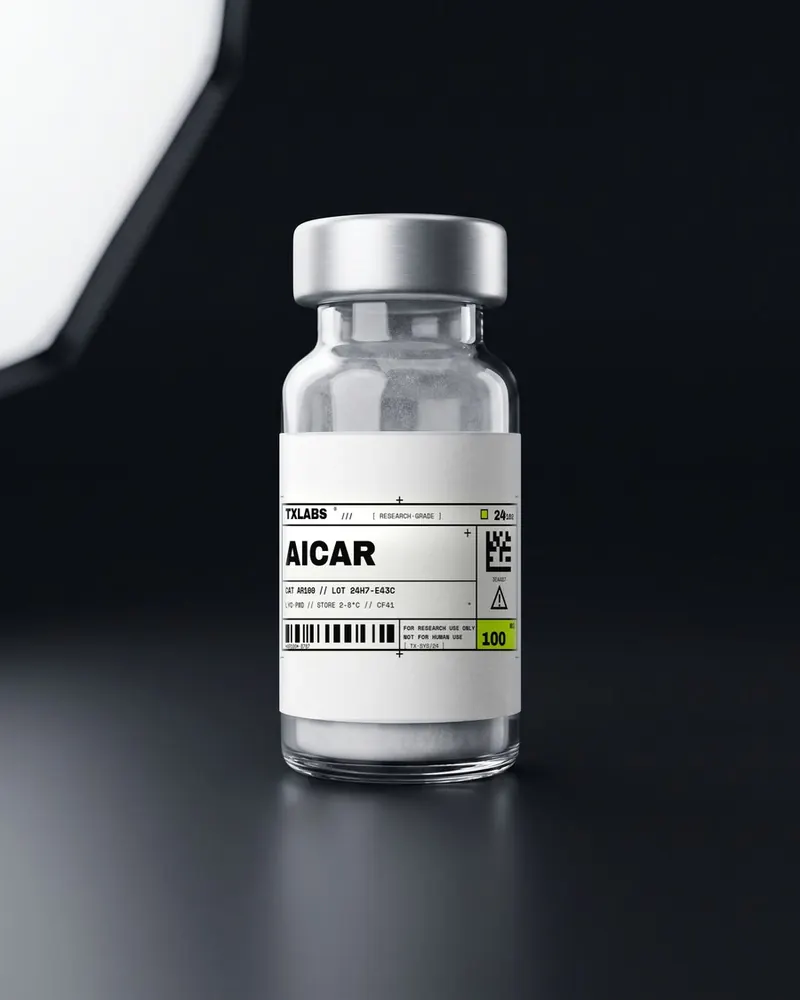
From $59 AUD · ≥98% HPLC purity · third-party COA · ships Australia-wide
What is AICAR?
AICAR (acadesine, 5-aminoimidazole-4-carboxamide ribonucleotide) is a nucleotide analogue and AMP-activated protein kinase (AMPK) activator. It is used in laboratory studies of cellular energy metabolism, glucose uptake, fatty-acid oxidation and mitochondrial biogenesis. AICAR is a standard research reference for probing the AMPK signalling pathway.
Specifications
- From: $59 AUD
- Category: Metabolic & GLP-1
- Form: Lyophilised powder
- Purity: ≥98% HPLC
- Testing: Third-party Certificate of Analysis
- Classification: Research reference material · For Research Use Only
What the research covers
AICAR, also written acadesine or AICA-riboside, is a nucleoside rather than a peptide: 5-aminoimidazole-4-carboxamide ribonucleoside, formula C9H14N4O5, molecular weight approximately 258.23. It consists of a ribose sugar joined to an imidazole carboxamide base, which is a structure from nucleotide metabolism rather than from peptide chemistry, and it is stocked alongside peptides because of the research literature it belongs to rather than because it shares anything with them chemically.
Its mechanism is unusually well defined. AICAR is taken into cells by adenosine transporters and is then phosphorylated intracellularly to ZMP, the monophosphate. ZMP is a structural mimic of AMP, and it binds the gamma subunit of AMP-activated protein kinase, producing allosteric activation of the enzyme without any actual change in the cell's AMP to ATP ratio. AMPK sits at the centre of cellular energy sensing, so a compound that activates it pharmacologically has been widely used as an experimental tool for probing that pathway.
The study that made AICAR notorious outside metabolism laboratories was reported by Narkar and colleagues in Cell in 2008, which described increased running endurance in sedentary mice. That result is the reason AICAR appears on the World Anti-Doping Agency Prohibited List among hormone and metabolic modulators, as an AMPK activator, prohibited at all times both in and out of competition. The list is revised annually and the current edition should be consulted for the position that applies.
One naming caution: AICAR strictly denotes the riboside, while ZMP denotes the intracellular monophosphate it is converted to. The two are used interchangeably in loose writing and they are different molecules with different masses.
TXLABS supplies AICAR as an analytical reference material for laboratory research only. It is not an approved therapeutic good in Australia and is not supplied for human or veterinary administration.
Reading the certificate
AICAR should be characterised as a nucleoside and a certificate written on a peptide template is a warning sign in itself. The appropriate elements are HPLC purity with ultraviolet detection, which is straightforward here because the imidazole carboxamide chromophore absorbs usefully, identity by nuclear magnetic resonance and by mass spectrometry against 258.23, water content, residual solvents from synthesis and crystallisation, and a statement of whether the material is the free nucleoside, a salt or a hydrate. The related substances worth asking about are the free base AICA without the ribose, which is the obvious hydrolysis product, and the monophosphate ZMP if any phosphorylated material is present. TXLABS publishes third-party certificates for tested lots in the CoA library; no certificate is currently published for AICAR, and the certificate for the specific lot supplied is provided on request to support@txlabs.bio.
Storage and handling
A nucleoside is a different proposition from a peptide in storage terms. There is no backbone to hydrolyse in the peptide sense, no conformational state to preserve and no aggregation behaviour, so AICAR is handled as an ordinary stable organic solid: dry, dark, desiccated, at refrigerated or room temperature according to the supplier's specification, with freezing neither required nor harmful. The vulnerabilities that do exist are hydrolysis of the glycosidic bond under acidic conditions and the general instability of an aminoimidazole to prolonged light exposure, so avoid strongly acidic solutions if the material has to be stored rather than used, and keep it out of direct light. Solubility in water is moderate rather than unlimited and is better in warm water or mildly basic buffer than in cold water. Australian transit conditions are less critical for this compound than for anything peptide in the catalogue, though a parcel baking in direct summer sun is still worth collecting promptly.
Working out concentration
The division is the same as for any vial: milligrams over millilitres. A 50 mg AICAR vial with 5 mL of diluent gives 10 mg/mL; with 10 mL, 5 mg/mL; with 2.5 mL, 20 mg/mL. The 100 mg vial with 10 mL gives 10 mg/mL and with 5 mL gives 20 mg/mL. Because the molecular weight of 258.23 is small compared with the peptides in this catalogue, a given mass concentration corresponds to a far higher molar concentration than the same figure would for a four kilodalton peptide, which is worth checking rather than assuming when adapting a method. Confirm the salt or hydrate form before converting. The calculator handles mass against volume. Concentration examples only, not a protocol.
How it relates to adjacent compounds
5-Amino-1MQ is the other non-peptide small molecule in this part of the catalogue and shares AICAR's characterisation requirements: nuclear magnetic resonance, salt form declaration and small-molecule chromatography rather than a peptide assay. NAD is adjacent by subject matter, since AMPK activity and nicotinamide dinucleotide metabolism both sit in cellular energy sensing, though the two compounds act through unrelated routes. MOTS-c appears in overlapping metabolic literature while being a mitochondrially encoded peptide with entirely different chemistry, and it is a useful reminder that shared research territory is not shared chemistry. Nothing else in the catalogue is a nucleoside, which makes AICAR's characterisation requirements unlike anything shelved beside it. These are analytical-category and subject-matter adjacencies and say nothing about comparative activity.