Mazdutide Australia — GLP-1/Glucagon Reference Material
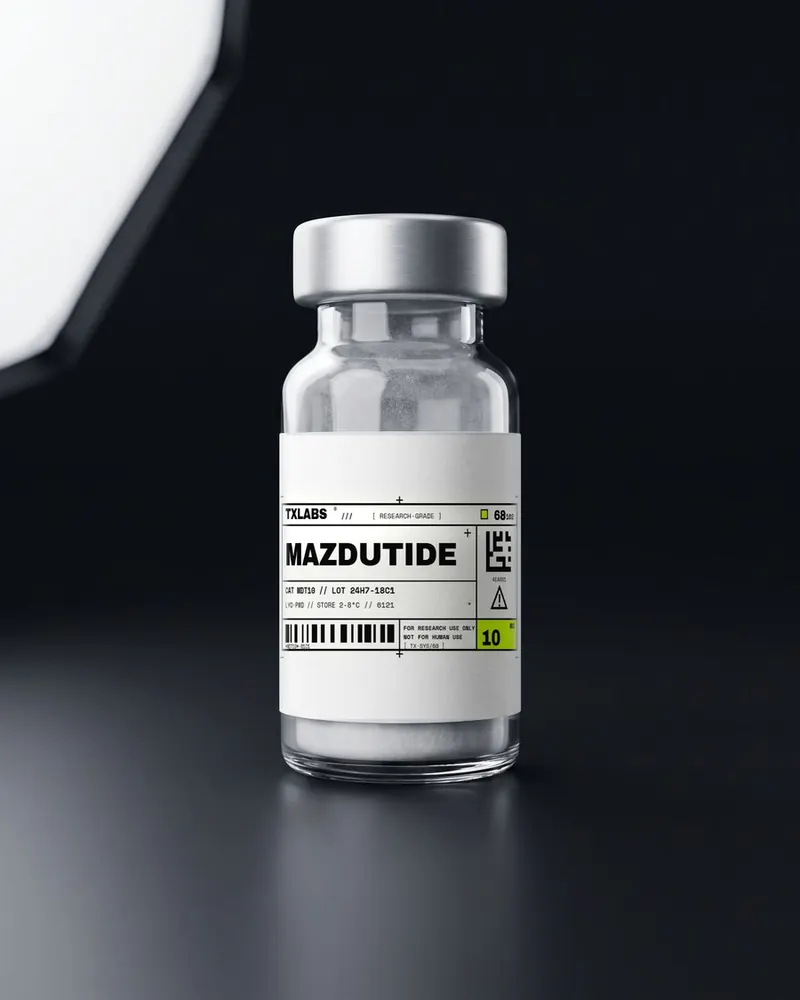
From $359 AUD · ≥98% HPLC purity · third-party COA · ships Australia-wide
What is Mazdutide?
Mazdutide (IBI362, LY3305677) is an oxyntomodulin-based peptide that acts as a dual GLP-1 and glucagon receptor agonist. It is investigated in metabolic research on appetite regulation, energy expenditure, glucose control and hepatic lipid metabolism.
Specifications
- From: $359 AUD
- Category: Metabolic & GLP-1
- Form: Lyophilised powder
- Purity: ≥98% HPLC
- Testing: Third-party Certificate of Analysis
- Classification: Research reference material · For Research Use Only
What the research covers
Mazdutide, identified in the literature by the development codes IBI362 and LY3305677, is a synthetic acylated peptide described as a dual agonist at the glucagon-like peptide-1 receptor and the glucagon receptor. PubChem lists the molecular formula C207H317N45O65 and a molecular weight near 4476 Da. Its design lineage runs through oxyntomodulin, a naturally occurring proglucagon-derived peptide that engages both the GLP-1 and glucagon receptors natively but is cleared too quickly to be a useful pharmacological tool. Analogues in this class therefore start from an oxyntomodulin-like scaffold and add protease-resistant substitutions together with a fatty acid or diacid acylation that supports reversible albumin binding.
The research interest in GLP-1 and glucagon receptor co-agonism is specific and long-standing. Glucagon receptor signalling in the liver influences hepatic glucose output and lipid handling and has been examined in relation to energy expenditure, while GLP-1 receptor signalling has an opposing effect on glycaemia. The pharmacological question is what ratio of activity at the two receptors produces a coherent overall profile, and much of the published work in this area concerns exactly that balance rather than either receptor alone. Preclinical characterisation of mazdutide has included receptor binding and cAMP signalling assays at both receptors and metabolic endpoints in animal models, and clinical trial programmes have been reported, with a substantial share conducted in China.
The independent literature on mazdutide is thin compared with the older incretin analogues. Most of what is published derives from the development programme itself, peer-reviewed mechanistic work from unaffiliated groups is limited, and details of the exact substitutions and acylation chemistry are not as thoroughly documented in the open literature as they are for semaglutide. Where this page describes structure it does so in general terms for that reason.
TXLABS supplies mazdutide as an analytical reference material for laboratory research only. It is not an approved therapeutic good in Australia and is not supplied for human or veterinary administration.
Reading the certificate
The useful checks on a certificate for this compound are identity and related substances rather than a headline purity figure. Confirm that mass spectrometry was used and that the observed mass corresponds to the expected value near 4476 Da, because a des-acyl species that has lost its fatty chain will elute close to the parent on reversed-phase HPLC without being the same molecule. Confirm the assay is stated in milligrams against label weight, since counterion and residual water contribute to gross powder mass. Ask whether the certificate names the specific batch. TXLABS publishes third-party certificates for its tested lots in the CoA library; none is currently published for mazdutide, and this page does not imply otherwise. The certificate for the lot supplied is available on request to support@txlabs.bio.
Storage and handling
Mazdutide is a fatty-acylated peptide of roughly 4.5 kDa, which places it in the handling class where surface activity and aggregation matter more than chemical degradation. Introduce diluent slowly down the inner wall of the vial and rotate gently; vortexing, vigorous inversion and any handling that produces foam impose the interface shear that nucleates aggregation in this class. Store the lyophilised cake at -20 °C, desiccated and protected from light, and let a frozen vial reach room temperature before the seal is broken so that condensation does not wet a hygroscopic powder. Reconstituted solution is held at 2-8 °C, protected from light, and divided into single-use aliquots if any portion is to be frozen. Repeated freeze-thaw concentrates solute at the ice interface and is the fastest way to lose a peptide of this size. In Australian conditions the lyophilised form tolerates brief warm excursions, but summer transit temperatures above 40 °C are worth designing around: collect promptly and refrigerate on arrival.
Working out concentration
Mazdutide is stocked as a 10 mg vial. Reconstituted with 1 mL of bacteriostatic water it gives 10 mg/mL; with 2 mL, 5 mg/mL; with 5 mL, 2 mg/mL. At approximately 4476 Da, a 5 mg/mL solution corresponds to roughly 1.1 mM, which is the figure needed when a published receptor assay specifies molar rather than mass concentration and a long dilution series has to be planned from a practical stock. Recording the diluent volume alongside the vial mass at the moment of reconstitution is what makes the concentration reconstructable weeks later. The reconstitution calculator performs the arithmetic. Concentration examples only, not a protocol.
How it relates to adjacent compounds
Mazdutide's closest catalogue relative by mechanism is survodutide, which is also described as a GLP-1 and glucagon receptor dual agonist but comes from a separate development programme with a different scaffold and a different molecular mass, so the two are analytically distinguishable and are not interchangeable. Retatrutide adds GIP receptor agonism to the same two activities, making it a triple agonist rather than a dual one. Semaglutide engages the GLP-1 receptor alone and represents the single-receptor end of the same design space. The four acylated metabolic peptides stocked here differ enough in mass that any of them can be identified unambiguously by mass spectrometry in a mixed inventory, which is worth relying on rather than the label. These are mechanistic and structural relationships only, not comparisons of effect.