Retatrutide + Cagrilintide 5mg Australia — Blend
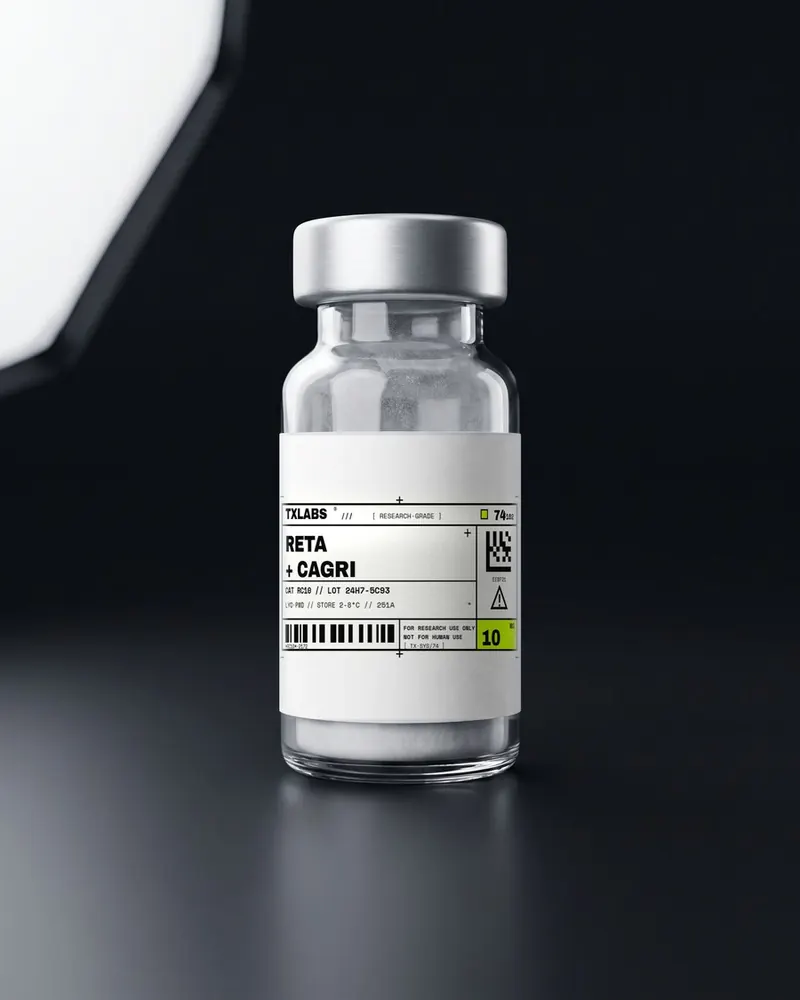
From $329 AUD · ≥98% HPLC purity · third-party COA · ships Australia-wide
What is Retatrutide 5mg+cagrilintide 5mg?
Retatrutide 5mg+cagrilintide 5mg is a research blend of the triple GIP/GLP-1/glucagon agonist retatrutide with the amylin analogue cagrilintide. It is investigated in metabolic research on appetite signalling, energy expenditure, glucose control and body-weight regulation.
Specifications
- From: $329 AUD
- Category: Metabolic & GLP-1
- Form: Lyophilised powder
- Purity: ≥98% HPLC
- Testing: Third-party Certificate of Analysis
- Classification: Research reference material · For Research Use Only
What the research covers
This vial contains two acylated peptides co-lyophilised together, nominally 5 mg of retatrutide and 5 mg of cagrilintide, 10 mg of peptide in total. What distinguishes this pairing from the more common incretin combinations is that the two components engage entirely separate receptor families rather than adding another incretin receptor to the set.
Retatrutide, development code LY3437943, is a synthetic single-chain peptide of approximately 4.7 kilodaltons engineered to activate three class B G protein-coupled receptors at once: the glucagon-like peptide-1 receptor, the glucose-dependent insulinotropic polypeptide receptor and the glucagon receptor. Its backbone comes from the glucagon and GIP peptide family and carries non-proteinogenic substitutions including alpha-aminoisobutyric acid residues that resist dipeptidyl peptidase-4 cleavage, together with a long-chain fatty diacid attached through a linker to a lysine side chain.
Cagrilintide, development code AM833, sits outside the incretin system altogether. It is a long-acting acylated analogue of amylin, built on a 37-residue amylin and pramlintide family backbone with substitutions and a C20 fatty diacid attached through a gamma-glutamate linker, acting as a non-selective agonist at the amylin receptors, which are calcitonin receptor and RAMP complexes, and at the calcitonin receptor.
One thing should be stated plainly: there is very little published evidence for this specific combination as a combination. The two compounds appear together in the same research territory because investigators have been interested in engaging incretin and amylin signalling in parallel, not because studies have established that co-formulation produces something the individual peptides do not. Neither component is registered on the ARTG.
TXLABS supplies this blend as an analytical reference material for laboratory research only. It is not an approved therapeutic good in Australia and is not supplied for human or veterinary administration.
Reading the certificate
The certification problem here is a harder version of the usual blend problem. Both components are acylated peptides with long fatty diacid chains, similar hydrophobicity and comparable retention behaviour, so they occupy the same region of a reversed-phase gradient and a generic method will not cleanly resolve them. What a certificate needs to show is a method developed for this separation, per-component assay in milligrams against the nominal 5 mg each, per-component purity, and identity by observed mass for each analyte named individually. A single combined purity figure describes nothing measurable. Both components also generate des-acyl related species that elute close to their parents, so ask whether those were looked for. TXLABS publishes third-party certificates for tested lots in the CoA library; no certificate is currently published for this blend, and the certificate for the lot supplied is provided on request to support@txlabs.bio.
Storage and handling
Both components are large acylated peptides, which means both are amphiphilic, both accumulate at air-liquid interfaces, and both can aggregate under shear. Amylin family sequences are notably aggregation-prone and retatrutide is comparatively large, so this blend deserves gentler handling than most: introduce diluent slowly down the inner wall of the vial, swirl rather than shake, and treat visible foam as a signal to stop. Store the lyophilised cake at -20 °C, desiccated and protected from light, and allow a frozen vial to reach room temperature sealed before opening so that condensation does not settle on a hygroscopic cake. Reconstituted material is held at 2-8 °C in the dark and divided into single-use aliquots rather than freeze-thaw cycled. The blend-specific risk is differential degradation quietly changing the component ratio while the vial looks unchanged. Australian summer freight, where parcels sit above 40 °C in vehicles and letterboxes, is precisely how that happens; collect promptly and refrigerate.
Working out concentration
Track concentration per component. This vial holds nominally 5 mg of retatrutide and 5 mg of cagrilintide, 10 mg total. With 1 mL of bacteriostatic water that is 5 mg/mL of each and 10 mg/mL total; with 2 mL, 2.5 mg/mL of each and 5 mg/mL total; with 4 mL, 1.25 mg/mL of each and 2.5 mg/mL total. Molar concentrations are not equal even where mass concentrations are, because the two components have different molecular weights, so equal milligrams do not mean equal moles. That asymmetry is easy to overlook and worth writing into the record explicitly. The reconstitution calculator handles the mass arithmetic. Concentration examples only, not a protocol.
How it relates to adjacent compounds
Both components are stocked individually as retatrutide and cagrilintide, and those pages carry the full detail on each molecule. Cagrilintide with semaglutide is the catalogue's other amylin-containing blend and pairs the same amylin analogue with a single-receptor GLP-1 agonist rather than a triple agonist, which is the clearest illustration of what varying one component changes. Tirzepatide is the dual GLP-1 and GIP receptor agonist that sits between retatrutide and semaglutide in receptor coverage, and is the obvious reference point for how much of this design space is occupied by single engineered molecules rather than by co-formulation. These are structural and formulation relationships described because they govern how the material must be characterised, and they imply nothing about comparative activity.