Survodutide Australia — Dual Agonist Reference Material
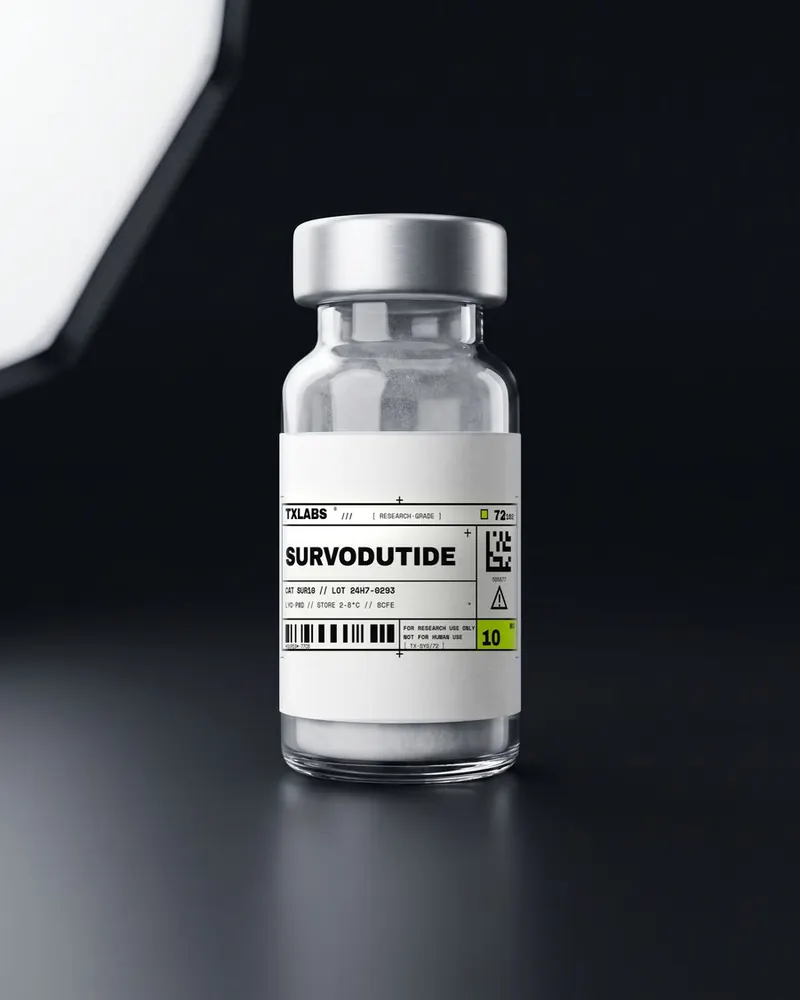
From $489 AUD · ≥98% HPLC purity · third-party COA · ships Australia-wide
What is Survodutide?
Survodutide (BI 456906) is a 29-amino-acid oxyntomodulin-based peptide that acts as a dual glucagon and GLP-1 receptor agonist. It is investigated in metabolic and hepatology research on appetite, energy expenditure, glucose regulation and liver fat.
Specifications
- From: $489 AUD
- Category: Metabolic & GLP-1
- Form: Lyophilised powder
- Purity: ≥98% HPLC
- Testing: Third-party Certificate of Analysis
- Classification: Research reference material · For Research Use Only
What the research covers
Survodutide, identified in the literature by the development code BI 456906, is a synthetic acylated peptide described as a dual agonist at the glucagon-like peptide-1 receptor and the glucagon receptor. PubChem lists the molecular formula C192H289N47O61 and a molecular weight near 4232 Da, making it the smaller of the two GLP-1/glucagon co-agonists in this catalogue. Like others in the class it descends conceptually from oxyntomodulin, the proglucagon-derived peptide that activates both receptors natively, and adds protease-resistant residue substitutions together with a fatty acid modification that supports reversible albumin binding and the long circulating half-life reported for the molecule.
The published research programme has covered receptor binding and cAMP signalling at both target receptors, metabolic characterisation in rodent models, and clinical trial activity in obesity and, separately, in liver disease contexts where hepatic glucagon receptor signalling is the mechanistic rationale. That hepatic angle is what distinguishes the research literature on GLP-1/glucagon co-agonists from that on GLP-1/GIP dual agonists: glucagon receptors are densely expressed in liver, and the effect of engaging them on hepatic substrate handling is a research question in its own right rather than a side note.
As with mazdutide, the independent literature on survodutide is limited. The great majority of published characterisation originates from the sponsoring development programme, mechanistic work from unaffiliated laboratories is sparse, and the fine structural detail available in the open literature is less complete than for semaglutide or liraglutide. Descriptions of substitution positions and acylation chemistry on this page are therefore kept general, because writing something specific that cannot be verified would be worse than writing something true and broad.
TXLABS supplies survodutide as an analytical reference material for laboratory research only. It is not an approved therapeutic good in Australia and is not supplied for human or veterinary administration.
Reading the certificate
For a peptide of this size and chemistry, the informative certificate checks are mass-spectrometric identity against the expected value near 4232 Da, a related-substance profile rather than a bare purity number, and net peptide assay in milligrams against label weight. The des-acyl species is the impurity to ask about specifically, because it retains the peptide backbone, loses only the fatty chain, and elutes close enough to the parent on reversed-phase HPLC that a purity percentage alone will not reveal it. Deletion sequences from solid-phase synthesis are the other expected population at this chain length. TXLABS publishes third-party certificates for tested lots in the CoA library; no certificate is currently published for survodutide. The lot-specific certificate is available on request to support@txlabs.bio.
Storage and handling
Survodutide is handled on the terms of any fatty-acylated peptide in the four-kilodalton range. The lyophilised cake is stored at -20 °C, desiccated and protected from light, and brought to room temperature before the vial is opened, so that humid air does not condense onto a cold hygroscopic powder. Add diluent slowly down the inner wall and rotate the vial rather than shaking it: amphiphilic peptides concentrate at the air-liquid interface, and the shear from vortexing is what converts that into aggregation. Reconstituted solution is kept at 2-8 °C, shielded from light, and aliquoted into single-use volumes if freezing is required, because ice-interface stress during each freeze-thaw cycle acts hardest on larger peptides. Australian conditions add the usual transit problem. Delivery vehicles and unattended letterboxes in summer regularly exceed 40 °C, and northern humidity adds a moisture load to any packaging breach. Collect promptly, unpack indoors and refrigerate.
Working out concentration
Survodutide is stocked as a single 10 mg vial. Reconstituted with 1 mL of bacteriostatic water it gives 10 mg/mL; with 2 mL, 5 mg/mL; with 4 mL, 2.5 mg/mL. At approximately 4232 Da, a 10 mg/mL solution is roughly 2.4 mM, useful when a published receptor assay is specified in nanomolar terms and the dilution series has to be planned from a practical working stock. Because there is only one vial size, the diluent volume is the only variable, which makes it the number worth recording in the laboratory notebook at the time. The reconstitution calculator handles the arithmetic. Worked concentrations only, not a protocol.
How it relates to adjacent compounds
Mazdutide is survodutide's closest functional counterpart in this catalogue, sharing the GLP-1 and glucagon receptor combination while differing in scaffold, development origin and molecular mass; the roughly 240 Da difference between them is what separates the two by mass spectrometry. Retatrutide engages the same two receptors plus GIP, making it a triple agonist. Tirzepatide combines GLP-1 with GIP instead of glucagon and is built from a GIP rather than a glucagon-family backbone. In a laboratory holding several of these acylated peptides, the observed mass is the only dependable label, since the lyophilised powders and the reconstituted solutions are indistinguishable by eye. These are receptor and structural relationships only, and say nothing about relative activity in any system.