Cagrilintide + Semaglutide 5mg Australia — Blend
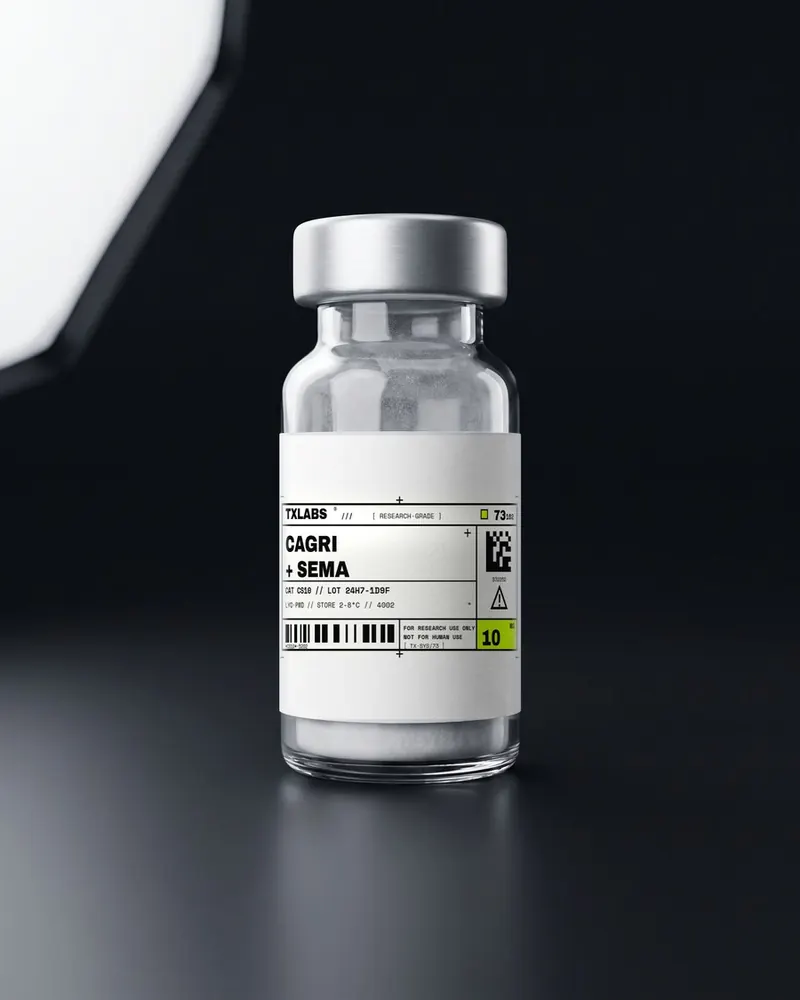
From $289 AUD · ≥98% HPLC purity · third-party COA · ships Australia-wide
What is cagrilintide 5mg+Semaglutide 5mg?
cagrilintide 5mg+Semaglutide 5mg is a research blend pairing the amylin analogue cagrilintide with the GLP-1 receptor agonist semaglutide. Cagrilintide targets amylin and calcitonin receptors while semaglutide activates the GLP-1 receptor; the combination is studied in metabolic research on satiety, food intake and body-weight regulation.
Specifications
- From: $289 AUD
- Category: Metabolic & GLP-1
- Form: Lyophilised powder
- Purity: ≥98% HPLC
- Testing: Third-party Certificate of Analysis
- Classification: Research reference material · For Research Use Only
What the research covers
This vial holds two acylated peptides co-lyophilised into a single cake, nominally 5 mg of cagrilintide and 5 mg of semaglutide, 10 mg of peptide in total. They come from different hormone families and act on different receptor systems; they are combined because they have been studied in the same experimental territory, not because they are chemically related.
Cagrilintide, development code AM833, is a long-acting acylated analogue of amylin developed by Novo Nordisk. It is built on a 37-residue amylin and pramlintide family backbone with substitutions, carrying a C20 fatty diacid attached through a gamma-glutamate linker; that acyl chain drives reversible albumin binding and is the reason its reported half-life is long. Pharmacologically it is a non-selective agonist at the amylin receptors, which are complexes of the calcitonin receptor with receptor activity-modifying proteins, and at the calcitonin receptor itself.
Semaglutide is a glucagon-like peptide-1 receptor agonist, formula C187H291N45O59, molecular weight approximately 4114 daltons. It carries an alpha-aminoisobutyric acid substitution at position 8 that resists dipeptidyl peptidase-4 cleavage and a C18 fatty diacid on the lysine 26 side chain attached through a hydrophilic spacer. In Australia semaglutide is a Schedule 4 substance and a registered prescription medicine, which places strict limits on how it may be discussed publicly, and nothing on this page describes therapeutic use of either component.
One structural point has direct analytical consequences: both components are acylated peptides of broadly similar size and hydrophobicity, which makes them harder to resolve from one another than a pairing of chemically dissimilar peptides would be.
TXLABS supplies this blend as an analytical reference material for laboratory research only. It is not an approved therapeutic good in Australia and is not supplied for human or veterinary administration.
Reading the certificate
A single combined purity percentage is not a meaningful measurement for a vial containing two different molecules, and a certificate offering one should prompt questions about what was actually measured and against which reference. Both components separate by reversed-phase chromatography and mass spectrometry, so there is no technical obstacle to quantifying each independently; the difficulty is that two similarly sized acylated peptides need a method developed for that separation rather than a generic gradient. Each component also brings its own related substances: des-acyl species chromatograph close to their parents in both cases and are the impurity class most easily missed. Look for per-component assay in milligrams, per-component purity, and identity by observed mass for each. TXLABS publishes third-party certificates for tested lots in the CoA library; none is published for this blend, and the lot certificate is available on request to support@txlabs.bio.
Storage and handling
A co-lyophilised blend is stored on the terms of its least stable component, and here both components are amphiphilic acylated peptides that partition to air-liquid interfaces and aggregate under shear. Amylin family peptides are particularly aggregation-prone. Add diluent slowly down the inner wall of the vial, rotate gently, and do not vortex or invert vigorously: visible foaming is the surface stress that nucleates aggregation. Hold the lyophilised cake at -20 °C, desiccated and dark, and equilibrate a frozen vial to room temperature before breaking the seal so condensation does not wet a hygroscopic cake. Reconstituted solution goes to 2-8 °C, protected from light, in single-use aliquots. The specific hazard in a blend is that the two components degrade at different rates and shift the ratio with no visible sign at all. Australian summer transit above 40 °C is exactly the condition that produces that silent drift, so collect promptly and refrigerate.
Working out concentration
For a blend, concentration has to be tracked per component or the record cannot be interpreted later. This vial holds nominally 5 mg of cagrilintide and 5 mg of semaglutide, 10 mg total. Reconstituted with 1 mL of bacteriostatic water it gives 5 mg/mL of each component and 10 mg/mL of total peptide; with 2 mL, 2.5 mg/mL of each and 5 mg/mL total; with 5 mL, 1 mg/mL of each and 2 mg/mL total. Recording only the total is the standard error, because it overstates either individual component by a factor of two. The reconstitution calculator handles the arithmetic. Concentration examples only, not a protocol.
How it relates to adjacent compounds
Both components are stocked individually: cagrilintide in 5 and 10 mg vials and semaglutide in several sizes, and reading those two pages gives the component detail this one compresses. Retatrutide with cagrilintide is the other amylin-containing blend in the catalogue and pairs the same amylin analogue with a triple incretin receptor agonist instead. Choosing between a blend and two single vials is a question of experimental design and per-component traceability rather than of chemistry, since the molecules are identical whichever vial they arrive in. Tirzepatide is a further point of comparison, a dual incretin receptor agonist built as one engineered molecule rather than assembled from two components in a vial. These are structural and formulation relationships and imply nothing about comparative activity.