Thymosin Alpha-1 Australia — Batch-Verified Peptide
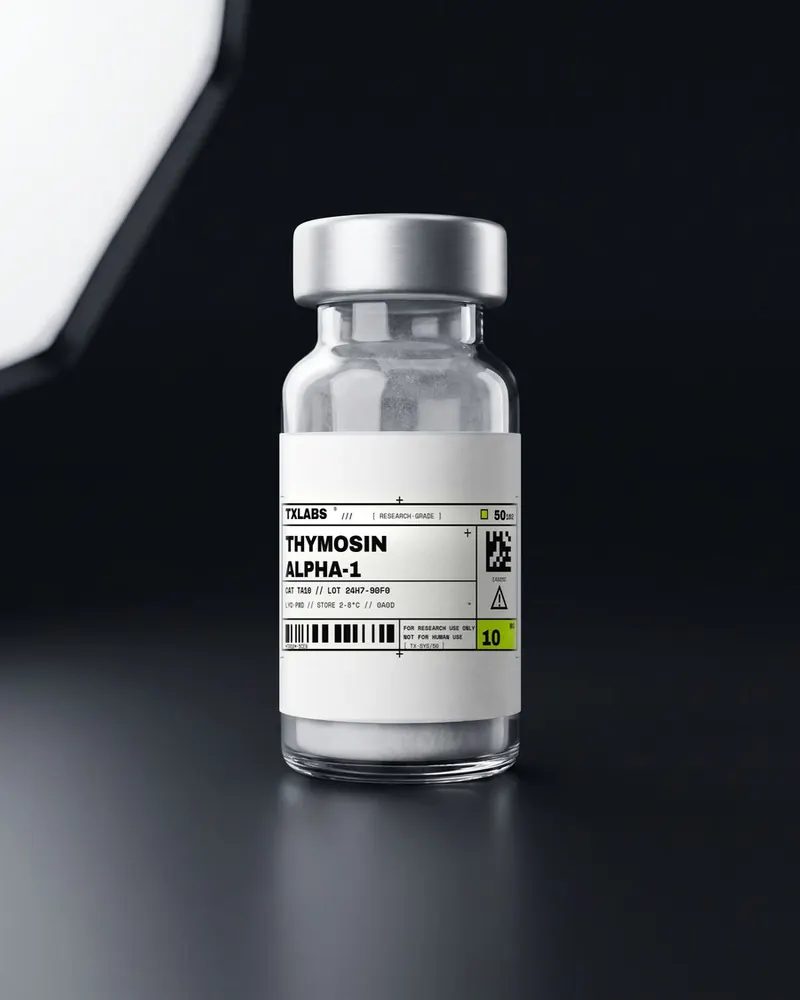
From $109 AUD · ≥98% HPLC purity · third-party COA · ships Australia-wide
What is Thymosin Alpha-1?
Thymosin Alpha-1 (Talpha1, thymalfasin) is a 28-amino-acid thymic peptide that modulates innate and adaptive immune signalling. It is studied in laboratory and preclinical research on T-cell maturation, dendritic cell function, and immune response pathways.
Specifications
- From: $109 AUD
- Category: Longevity & Bioregulators
- Form: Lyophilised powder
- Purity: ≥98% HPLC
- Testing: Third-party Certificate of Analysis
- Classification: Research reference material · For Research Use Only
 View full report ↗
What the research covers
Thymosin alpha-1 is a 28-residue, N-terminally acetylated peptide with molecular formula C129H215N33O55 and molecular weight 3108.3 Da. It was originally isolated from thymosin fraction 5, a partially purified bovine thymus preparation, and is derived in vivo from a larger precursor protein, prothymosin alpha. The N-terminal acetylation is part of the native structure rather than a synthetic modification, and any synthetic reference material should reproduce it. Despite the shared thymosin prefix, it has no structural or functional relationship to the beta thymosins such as thymosin beta-4; the shared name reflects a common isolation source rather than a common molecular family.
The research literature on thymosin alpha-1 is predominantly immunological. Published work has examined effects on T lymphocyte maturation and differentiation, dendritic cell function, and cytokine production profiles, with a substantial mechanistic strand focused on signalling through Toll-like receptors, particularly TLR9 and TLR2, on dendritic and other innate immune cells. That receptor interaction is the most-cited proposed mechanism for its immunomodulatory description in the literature.
Clinically, thymosin alpha-1 has been studied over several decades and is a registered medicine in a number of countries under the name thymalfasin, with published trial programmes in chronic hepatitis B and C, as a vaccine adjuvant in specific populations, and in sepsis and critical care research. Its use in those settings is jurisdiction-specific and it is not registered in every country. More recent work has examined it in the context of immune reconstitution and infection research.
TXLABS supplies thymosin alpha-1 as an analytical reference material for laboratory research only. It is not an approved therapeutic good in Australia and is not supplied for human or veterinary administration.
Reading the certificate
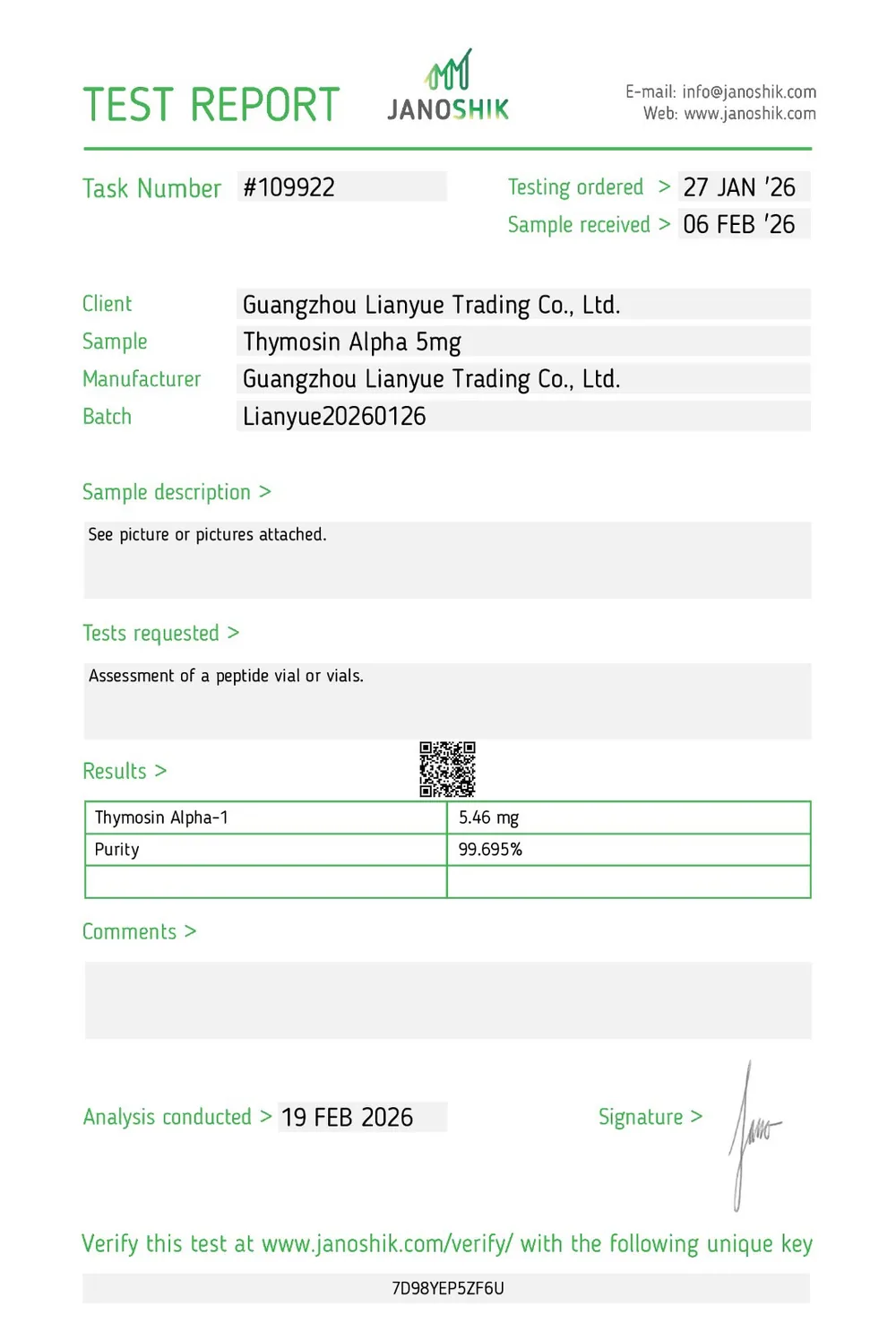
Two checks are specific to this compound. First, N-terminal acetylation is part of the native structure, so the observed mass should reflect an acetylated 28-mer near 3108.3 Da; a mass forty-two daltons lower indicates the des-acetyl peptide, a different molecule. Second, at 28 residues the deletion-sequence population from incomplete solid-phase couplings is non-trivial, and those species often elute near the parent, so mass spectrometric identity confirmation carries real weight alongside the HPLC percentage. Confirm the salt form is stated and read assay in milligrams against label. TXLABS publishes the Janoshik Analytical report in the CoA library: a 5 mg sample assaying 5.46 mg at 99.695% purity, and it is one of the reports published with the task number and verification key intact for independent checking.
Storage and handling
At 28 residues thymosin alpha-1 sits in the middle of this catalogue for size and handling demands. Usefully, its sequence contains no cysteine and no methionine, which removes disulfide scrambling and methionine oxidation from the list of concerns, but it is acidic and highly water-soluble and, like most peptides of this length, is vulnerable to aggregation and surface adsorption at low concentration. Store the lyophilised cake at -20 °C, desiccated and protected from light, and equilibrate the vial to room temperature before breaking the seal so condensation does not settle onto cold glass. Add diluent gently down the vial wall and swirl rather than shake. Reconstituted material is held at 2-8 °C and protected from light, and aliquoted into single-use volumes before any freezing, since freeze-thaw stress acts hardest on longer, flexible peptides. For Australian transit, the dry cake tolerates short excursions, but a 28-residue peptide has less thermal margin than a tetrapeptide, so parcels are best collected promptly and refrigerated on arrival rather than left in a hot vehicle or letterbox.
Working out concentration
The TXLABS thymosin alpha-1 vial is 10 mg. Reconstituted with 2 mL of bacteriostatic water it gives 5 mg/mL; with 1 mL, 10 mg/mL; with 5 mL, 2 mg/mL. At 3108.3 Da the molar arithmetic differs sharply from that of the short peptides in the catalogue: 5 mg/mL corresponds to roughly 1.6 mM, whereas the same mass concentration of a tripeptide would be about nine times more concentrated in molar terms. Where a published immunology method specifies nanomolar concentrations, that conversion and the dilution series that follows are where the arithmetic needs checking. The reconstitution calculator handles it. Concentration examples only, not a protocol.
How it relates to adjacent compounds
The most important relationship to state for thymosin alpha-1 is a negative one: it is unrelated to TB-500 / thymosin beta-4 despite the shared name. Alpha and beta thymosins were both named after being isolated from thymus extracts, but they have different sequences, different lengths, different structures and entirely different described functions, one immunological and one actin-binding. Confusing them is a common cataloguing error. Within the longevity and bioregulator category it is stocked alongside epithalon and MOTS-c, which share the category but neither sequence nor mechanism. Structural relationships only, with no comparison of effect intended or implied. If a supplier catalogue lists thymosin alpha-1 and thymosin beta-4 as variants of one product, that alone is grounds to question its analytical documentation.