FOXO4-DRI Australia — Retro-Inverso Senescence Peptide
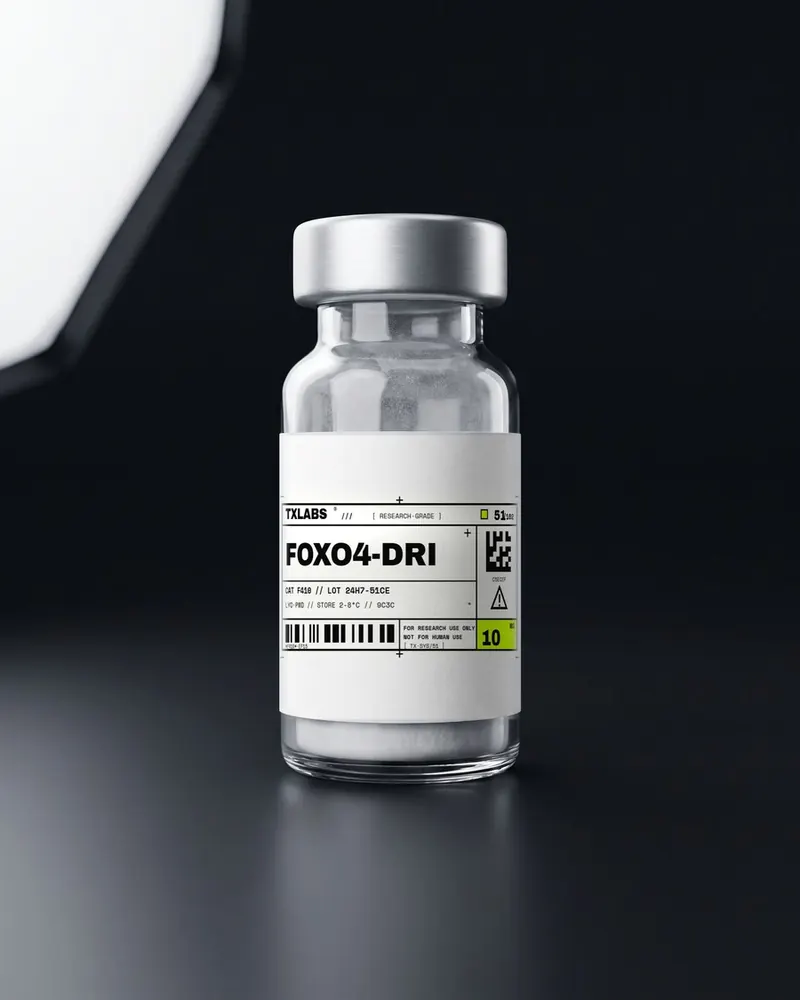
From $769 AUD · ≥98% HPLC purity · third-party COA · ships Australia-wide
What is FOXO4?
FOXO4 (FOXO4-DRI) is a synthetic D-retro-inverso peptide that disrupts the FOXO4-p53 protein interaction in senescent cells. It is investigated in senolytic research on cellular senescence, p53 signalling, and age-related tissue models.
Specifications
- From: $769 AUD
- Category: Longevity & Bioregulators
- Form: Lyophilised powder
- Purity: ≥98% HPLC
- Testing: Third-party Certificate of Analysis
- Classification: Research reference material · For Research Use Only
What the research covers
FOXO4 in this catalogue denotes FOXO4-DRI, a synthetic peptide designed to interfere with the protein-protein interaction between the transcription factor FOXO4 and the tumour suppressor p53. DRI stands for D-retro-inverso, a specific and well-defined chemical strategy: the amino acid sequence of the parent peptide is written in reverse and built entirely from D-amino acids rather than the natural L-isomers. Reversing the sequence and inverting the chirality of every residue produces a molecule whose side-chain topology approximates that of the original while its backbone runs the opposite way, which typically preserves binding to a target surface while conferring near-total resistance to proteolysis, since proteases are stereospecific.
The biological rationale reported in the literature is that senescent cells accumulate FOXO4, which sequesters p53 in the nucleus and prevents the apoptotic programme that would otherwise remove them. A peptide that disrupts that interaction is proposed to release p53 and permit selective apoptosis of senescent cells while sparing proliferating ones, which is what places FOXO4-DRI in the senolytic category. The founding publication appeared in 2017 from a group at Erasmus University Medical Center, and subsequent work by other laboratories has examined the peptide in cultured senescent cell systems and in animal disease models.
The evidence base should be read with care. It rests on a small number of preclinical publications, independent replication of the original findings is limited, senolytic research generally is an active and contested field, and there is no consistent, authoritative primary source for the exact molecular weight of the commercial peptide, with figures near 4826 Da quoted in secondary sources rather than in the primary literature. This page therefore describes the design principle rather than asserting a sequence or an exact mass; the figure on the lot certificate is the reference to work from.
TXLABS supplies FOXO4-DRI as an analytical reference material for laboratory research only. It is not an approved therapeutic good in Australia and is not supplied for human or veterinary administration.
Reading the certificate
The defining analytical problem for an all-D peptide is that chirality is invisible to mass spectrometry. A D-retro-inverso peptide and its L-parent written forwards have the same amino acid composition and, for a fully retro-inverted sequence, closely comparable mass, so a mass-only identity check cannot establish that what is in the vial is the retro-inverso form rather than a cheaper conventional L-peptide. Chiral analysis, or amino acid analysis after hydrolysis with chiral separation, is the method that answers it, and reversed-phase retention behaviour provides supporting evidence. Ask what the certificate actually establishes on this point. TXLABS publishes third-party certificates for tested lots in the CoA library; no certificate is currently published for FOXO4-DRI. The lot certificate is available on request to support@txlabs.bio.
Storage and handling
The all-D composition removes the degradation route that dominates for ordinary peptides: proteases are stereospecific and largely do not act on D-residues, so residual enzymatic activity in a buffer or on glassware is not the threat it would be for an L-peptide. What remains are the ordinary physical and chemical routes, which chirality does nothing to prevent. Hydrolysis, deamidation, oxidation of any susceptible residue and aggregation all proceed identically in a D-peptide, so cold, dark, dry storage is still required. Hold the lyophilised material at -20 °C, desiccated and protected from light, and equilibrate the vial to room temperature before opening. Keep reconstituted solution at 2-8 °C, shielded from light, and aliquot into single-use volumes rather than freeze-thaw cycling. Cell-penetrating peptides of this class are typically strongly cationic and adsorb to surfaces, so dilute working solutions lose material to container walls. Australian summer transit above 40 °C remains a real risk and prompt refrigeration is the sensible response.
Working out concentration
The TXLABS FOXO4-DRI vial is 10 mg. Reconstituted with 2 mL of bacteriostatic water it gives 5 mg/mL; with 1 mL, 10 mg/mL; with 5 mL, 2 mg/mL. Molar conversion depends on the molecular weight, and because no authoritative primary source fixes that figure for the commercial peptide, the mass reported on the certificate for the lot supplied should be used rather than a number taken from a secondary listing. Working from a quoted mass that does not match the material is one of the more common sources of error in this compound's arithmetic. The reconstitution calculator resolves vial mass against diluent volume. Concentration examples only, not a protocol.
How it relates to adjacent compounds
FOXO4-DRI is the only retro-inverso peptide in this catalogue, which makes its closest relationships conceptual rather than structural. Epithalon shares the ageing-research category and the bioregulator tradition but is a short synthetic L-tetrapeptide from an entirely separate research lineage. MOTS-c and humanin appear in the same broad literature on cellular ageing while being mitochondrially encoded peptides with unrelated mechanisms. Nothing in this catalogue shares FOXO4-DRI's chemistry or its protein-protein interaction target. It is also the only compound in the catalogue whose identity cannot be established by mass spectrometry alone, which sets its certification requirements apart from everything shelved beside it. These are subject-matter adjacencies only, and imply nothing about comparative activity.