NAD+ Australia — Batch-Verified Research Coenzyme
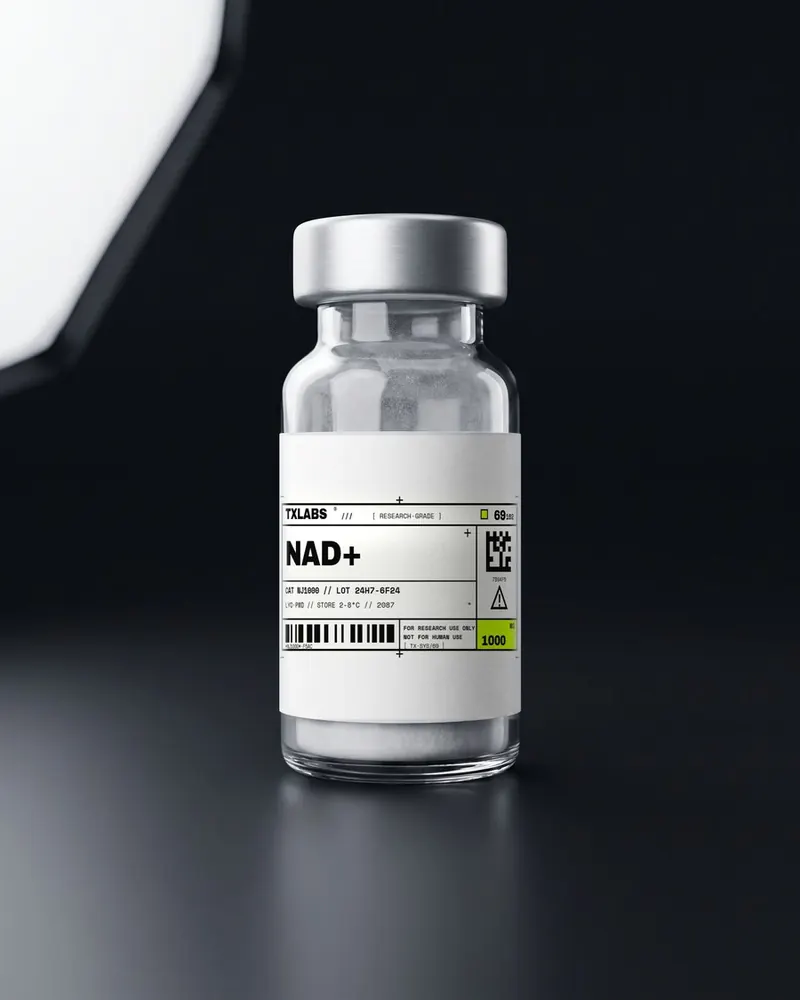
From $149 AUD · ≥98% HPLC purity · third-party COA · ships Australia-wide
What is NAD+?
NAD+ (nicotinamide adenine dinucleotide) is a coenzyme central to cellular redox reactions and energy metabolism. Present in all living cells, it is studied in research on mitochondrial function, DNA repair, sirtuin signalling and cellular ageing.
Specifications
- From: $149 AUD
- Category: Longevity & Bioregulators
- Form: Lyophilised powder
- Purity: ≥98% HPLC
- Testing: Third-party Certificate of Analysis
- Classification: Research reference material · For Research Use Only
 View full report ↗
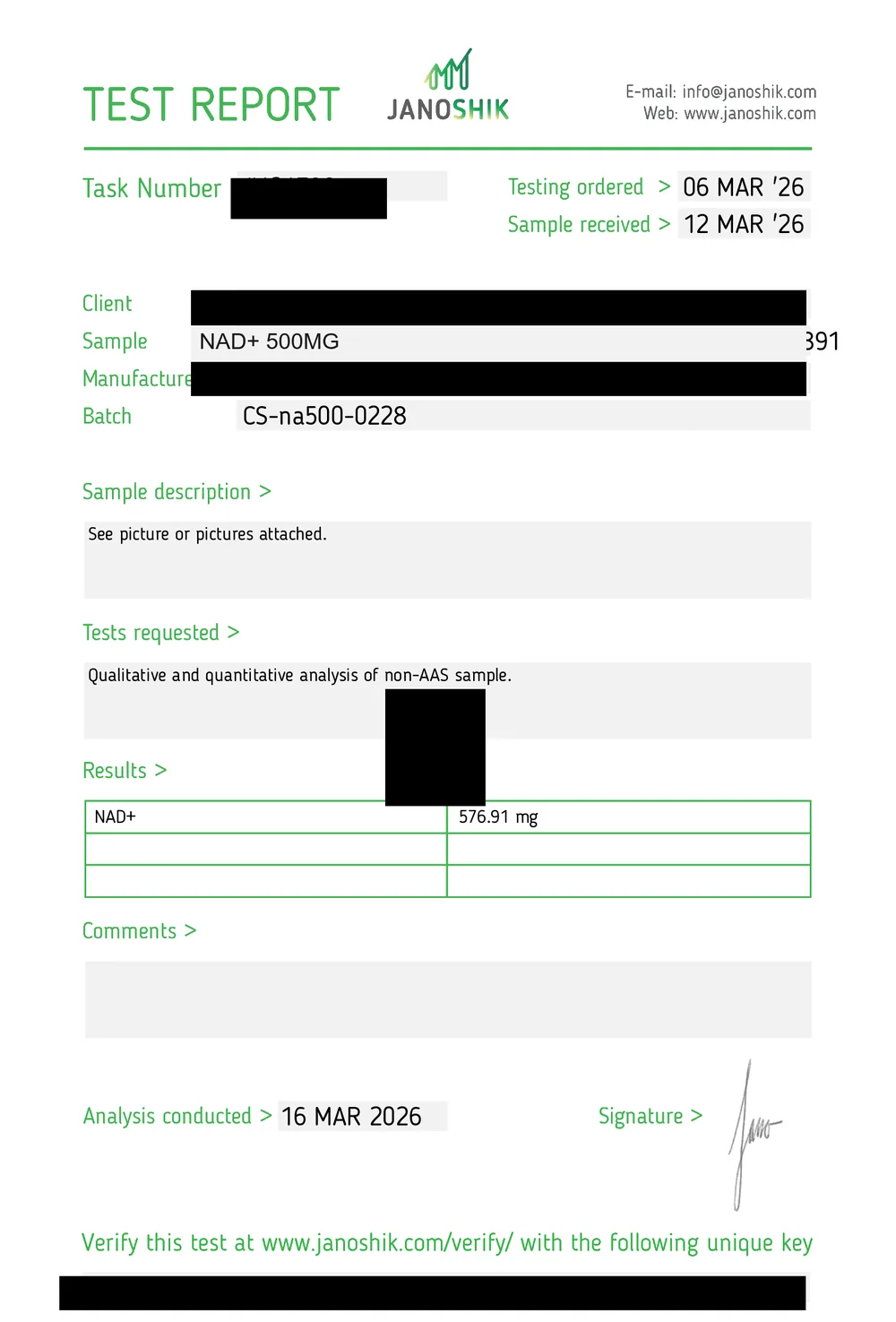
Report ID and verification key are redacted on our copy of this certificate. Request the unredacted report, or see the full CoA library.
This sample is quantified by assay mass — the laboratory did not report a purity percentage for it. Where a vial holds two peptides, each is measured separately and a single combined purity figure is not meaningful.
What the research covers
NAD+ is not a peptide. Nicotinamide adenine dinucleotide is a dinucleotide coenzyme, molecular formula C21H27N7O14P2 and molecular weight 663.4 Da, composed of nicotinamide mononucleotide and adenosine monophosphate joined through a pyrophosphate bridge. Its listing alongside research peptides is a matter of catalogue convenience, not chemical kinship, and almost every handling and analytical assumption that applies to a peptide needs to be revisited for it.
NAD+ is one of the most thoroughly characterised molecules in biochemistry. It is the principal hydride-accepting cofactor of catabolic metabolism, cycling between the oxidised NAD+ and reduced NADH states in glycolysis, the tricarboxylic acid cycle, fatty acid oxidation and oxidative phosphorylation, and its phosphorylated relative NADP+/NADPH serves reductive biosynthesis and antioxidant regeneration. Beyond redox chemistry, NAD+ is consumed as a substrate rather than recycled by three enzyme families that have driven most of the recent literature: the sirtuin deacylases, the poly-ADP-ribose polymerases involved in DNA damage response, and the ectoenzyme CD38. Research over the past two decades has examined tissue NAD+ concentrations in ageing and metabolic disease models, the salvage and de novo biosynthetic pathways including the rate-limiting enzyme NAMPT, and the effect of precursor supplementation with nicotinamide riboside and nicotinamide mononucleotide in animal and human studies. Analytical work on NAD+ quantification methods, including LC-MS and enzymatic cycling assays, is itself a substantial literature because the molecule is labile and easily lost during sample preparation.
For a laboratory buyer the practical significance of that literature is that NAD+ is used as a reagent and standard across a wide range of enzymatic assays, including dehydrogenase-coupled activity measurements, sirtuin and PARP activity assays, and calibration of quantification methods, so the mass actually present in a vial matters more than any nominal purity claim. TXLABS supplies NAD+ as a laboratory reference material only. It is not supplied for human or veterinary administration.
Reading the certificate
NAD+ is the clearest case in the catalogue for reading a certificate on mass rather than percentage. Because it is a small nucleotide rather than a synthetic peptide, a reversed-phase HPLC purity figure of the kind reported for peptides is not the informative measure, and the TXLABS certificate for NAD+ reports mass quantification without a purity percentage rather than inventing one. What matters is how many milligrams of NAD+ the laboratory actually found in the vial, since the material is hygroscopic and any water taken up adds weight without adding compound. The relevant degradation products, nicotinamide and ADP-ribose, are also the species a method should be able to distinguish. TXLABS publishes the Janoshik Analytical report in the CoA library: batch CS-na500-0228, tested 16 March 2026, a 500 mg sample assaying 576.91 mg of NAD+.
Storage and handling
NAD+ demands more care in solution than most peptides and less in some other respects. It is highly hygroscopic as a solid, so keeping the lyophilised or crystalline material desiccated is not optional; store at -20 °C, tightly sealed, and equilibrate the vial to room temperature before opening, since condensation onto a strongly hygroscopic solid is a real and rapid problem. In aqueous solution NAD+ is genuinely unstable, and its degradation is pH-dependent: it hydrolyses more readily in alkaline conditions and undergoes acid-catalysed cleavage of the glycosidic bond under acidic ones, so near-neutral or slightly acidic diluents are generally preferred and freshly prepared solutions are the norm in analytical work. Degradation products include nicotinamide and ADP-ribose. Keep solutions cold, use them promptly, and aliquot before freezing rather than cycling. For Australian conditions, the combination of summer heat and humidity is worse for NAD+ than for a peptide, because moisture uptake by the dry solid is the failure mode. Collect parcels promptly, keep the vial sealed until needed, and refrigerate on arrival.
Working out concentration
NAD+ is stocked in 100 mg, 250 mg, 500 mg and 1000 mg vials, an order of magnitude larger than the peptide vials, so the arithmetic sits in a different range. A 500 mg vial reconstituted with 5 mL of bacteriostatic water gives 100 mg/mL; with 10 mL, 50 mg/mL. A 100 mg vial with 2 mL gives 50 mg/mL. At 663.4 Da the molar figures are large: 50 mg/mL is roughly 75 mM, which is why laboratory protocols for NAD+ almost always describe a concentrated stock followed by substantial dilution into buffer. The reconstitution calculator handles the mass-over-volume step. Worked concentration arithmetic only, not a protocol.
How it relates to adjacent compounds
NAD+ is the only non-peptide in this group and shares no structural relationship with anything else in the catalogue. Its adjacency is thematic: it sits in the longevity and bioregulator category alongside MOTS-c, which appears in overlapping cellular energy-metabolism literature through AMPK and folate-cycle signalling rather than through redox chemistry, and epithalon, a synthetic tetrapeptide from the Russian bioregulator tradition with no metabolic-cofactor role at all. The practical reason to note the difference is handling: NAD+ needs hygroscopicity and solution-pH management that peptide protocols do not cover, and applying peptide storage habits to it will not preserve it. Subject-matter adjacency only.