Thymalin Australia — Thymus Polypeptide Fraction
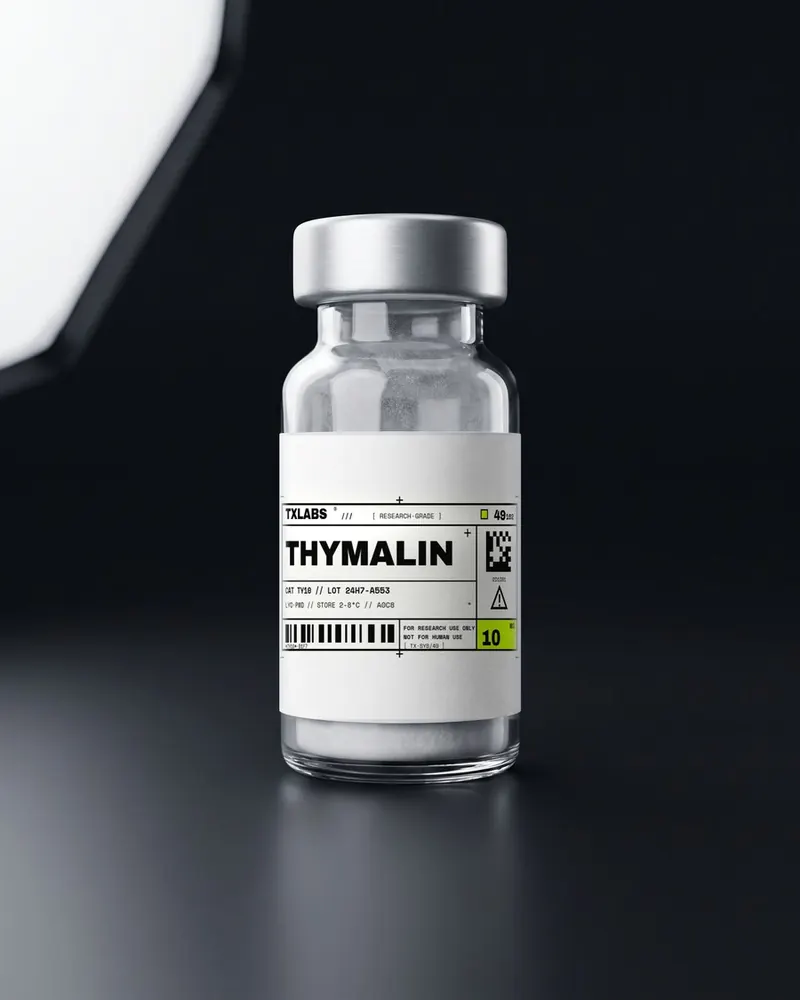
From $39 AUD · ≥98% HPLC purity · third-party COA · ships Australia-wide
What is Thymalin?
Thymalin is a thymus-derived peptide preparation that modulates immune cell activity in research settings. This polypeptide complex, isolated from thymic tissue, is investigated in preclinical studies of immune regulation, T-cell differentiation, and ageing biology.
Specifications
- From: $39 AUD
- Category: Longevity & Bioregulators
- Form: Lyophilised powder
- Purity: ≥98% HPLC
- Testing: Third-party Certificate of Analysis
- Classification: Research reference material · For Research Use Only
What the research covers
Thymalin is not a single defined molecule, and everything useful about handling and assessing it follows from that fact. It is a polypeptide fraction extracted from calf thymus tissue, developed within the Soviet and later Russian peptide bioregulator research tradition, and what is in the vial is a mixture of peptides of varying lengths rather than one sequence with one molecular weight. No molecular formula can be quoted for it, no single mass identifies it, and the composition of any given preparation depends on the extraction and fractionation process used to make it.
The research tradition it belongs to describes tissue-derived peptide fractions as bioregulators acting on the tissue of origin, and thymalin has been studied in that framework in relation to thymic and immune parameters in animal and human observational work. That literature exists in volume but is largely Russian-language, published over several decades, and its methods and reporting conventions differ substantially from those expected in the international peer-reviewed literature. Independent replication outside those groups is limited. Anyone reading it should be aware that a claim well attested within that tradition may have no corroboration outside it, and this page does not attempt to summarise findings that cannot be independently verified.
There is a second point worth naming: thymalin is animal-tissue-derived, extracted from bovine thymus. That places it in a different regulatory and safety category from a synthetic peptide, since source species, geographical origin of the herd, and documentation addressing viral and transmissible spongiform encephalopathy safety become material questions about the product rather than optional extras.
TXLABS supplies thymalin as a laboratory reference material only. It is not an approved therapeutic good in Australia and is not supplied for human or veterinary administration.
Reading the certificate
A reversed-phase HPLC purity percentage is close to meaningless for a peptide mixture, because purity is defined relative to a single intended analyte and there isn't one. A certificate reporting ninety-nine per cent purity for thymalin should raise questions rather than confidence. The characterisation that would actually be informative is different in kind: total peptide or protein content by a quantitative method, molecular weight distribution by size-exclusion chromatography or gel electrophoresis showing the fraction's profile, batch-to-batch consistency against a reference chromatogram, and, because the material is bovine-tissue-derived, documented source species, geographical origin and viral and TSE safety information. TXLABS publishes third-party certificates for tested lots in the CoA library; no certificate is currently published for thymalin. The documentation held for the lot supplied is available on request to support@txlabs.bio.
Storage and handling
A peptide mixture is stored on the terms of its most fragile constituent, and since the composition is not fully defined, the conservative approach is the only defensible one. Hold the lyophilised material at -20 °C, desiccated and protected from light, and equilibrate the vial to room temperature before opening so that condensation does not wet a hygroscopic powder. Reconstituted solution should be held at 2-8 °C, protected from light, and used within a short window rather than stored, because a mixture containing longer peptides will degrade unevenly and there is no single analytical marker that would reveal it. Aliquot before freezing rather than freeze-thaw cycling. Being tissue-derived rather than synthetic, the material may also carry residual biological components that make aseptic technique more consequential than it would be for a purified synthetic peptide. Australian summer transit above 40 °C is an unquantifiable risk for an incompletely characterised mixture, which argues for prompt collection and refrigeration rather than tolerance of excursions.
Working out concentration
The TXLABS thymalin vial is 10 mg. Reconstituted with 2 mL of bacteriostatic water it gives 5 mg/mL; with 1 mL, 10 mg/mL; with 5 mL, 2 mg/mL. Those figures are total peptide mass per unit volume, which is the only concentration that can honestly be stated for a mixture. Molar concentration cannot be calculated at all, because there is no single molecular weight to divide by, and any molarity quoted for thymalin should be treated as an error. That limitation is a property of the material rather than of the arithmetic. The reconstitution calculator handles mass and volume. Concentration examples only, not a protocol.
How it relates to adjacent compounds
The instructive comparison is thymosin alpha-1, a defined 28-residue synthetic peptide of known sequence and known mass that originates from thymic research but is a single molecular entity. Set beside thymalin, it shows exactly what is gained by chemical definition: an identity that mass spectrometry can confirm, a purity figure that means something, and a molar concentration that can be calculated. Thymalin belongs instead with the tissue-extract bioregulators such as vilon and epithalon's research tradition. It is the only tissue-extract product in this catalogue, and consequently the only one where source documentation forms part of what characterises the material rather than accompanying it. These are categorical and provenance relationships, not comparisons of activity.