N-Acetyl Epitalon Amidate Australia — Capped AEDG
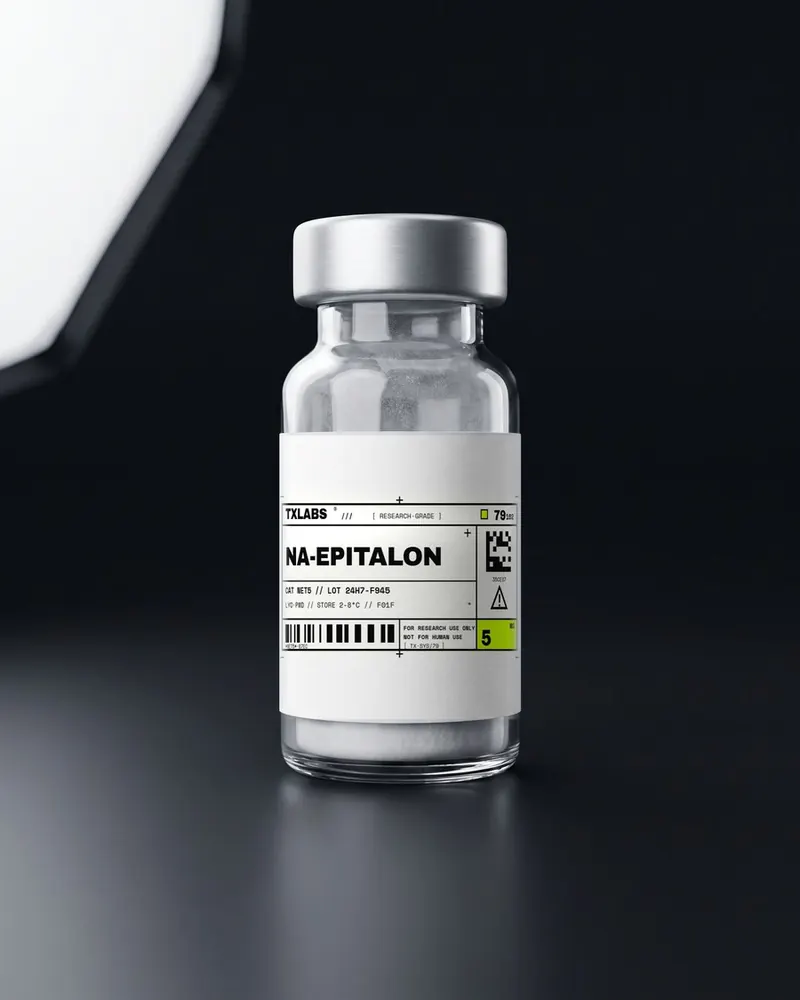
From $189 AUD · ≥98% HPLC purity · third-party COA · ships Australia-wide
What is N-Acetyl Epitalon Amidate?
N-Acetyl Epitalon Amidate (Ac-AEDG-NH2) is a stabilised tetrapeptide bioregulator studied for effects on telomerase activity. An N-terminally acetylated, C-terminally amidated form of Epitalon (Epithalon, AEDG) derived from pineal peptides, it is investigated in laboratory research on hTERT expression, telomere maintenance and cellular ageing.
Specifications
- From: $189 AUD
- Category: Longevity & Bioregulators
- Form: Lyophilised powder
- Purity: ≥98% HPLC
- Testing: Third-party Certificate of Analysis
- Classification: Research reference material · For Research Use Only
What the research covers
N-acetyl epitalon amidate is the tetrapeptide epitalon, Ala-Glu-Asp-Gly, with both termini chemically capped: an acetyl group on the N-terminal amine and an amide in place of the C-terminal carboxylate, written Ac-Ala-Glu-Asp-Gly-NH2. The parent sequence comes from the ultrashort peptide bioregulator programme of Professor Vladimir Khavinson at the St Petersburg Institute of Bioregulation and Gerontology, and epitalon carries the largest published literature of any compound in that tradition.
The rationale for the capping is straightforward and rests on well-understood chemistry rather than on anything specific to this family. Exopeptidases attack peptides from the ends. Aminopeptidases require a free alpha-amino group at the N-terminus and carboxypeptidases require a free alpha-carboxylate at the C-terminus; remove both and the two dominant degradation routes for a short peptide in a biological matrix are closed off. For a four-residue sequence, which offers no internal structure to shelter behind and few sites for endopeptidases to act on, terminal capping is the principal available stabilisation strategy. The same approach is applied elsewhere in this catalogue to other short bioregulator sequences.
What is not established is the step that marketing copy usually assumes. Acetylation removes a positive charge at the N-terminus and amidation removes a negative one at the C-terminus, so the capped molecule has a different charge distribution, different hydrogen-bonding capacity and different overall polarity from the parent. Those changes can preserve target engagement or abolish it. Whether the modified peptide retains whatever activity epitalon has is an assumption in this space rather than a demonstrated fact, and the published work on the capped form is thinner than the work on the parent.
TXLABS supplies N-acetyl epitalon amidate as an analytical reference material for laboratory research only. It is not an approved therapeutic good in Australia and is not supplied for human or veterinary administration.
Reading the certificate
The impurities to ask about here are specific and predictable, because a capping reaction has exactly two ways to fall short. Incomplete acetylation leaves the free N-terminal amine, giving a species roughly forty-two daltons lighter than the target; incomplete amidation leaves the free acid, about one dalton heavier. Both are close enough to the parent in chromatographic behaviour to be missed by a coarse method, and the one dalton case in particular demands real mass accuracy rather than a nominal figure. Ask what mass was observed and to what precision, and whether the uncapped parent peptide was specifically excluded. The acetylation does at least help the chromatography: the capped peptide retains properly on reversed-phase where bare AEDG barely does. TXLABS publishes third-party certificates for tested lots in the CoA library; none is published for this compound, and the lot certificate is available on request to support@txlabs.bio.
Storage and handling
Capping the termini improves resistance to exopeptidases; it does nothing about the chemical degradation routes that operate independently of enzymes. Hydrolysis, deamidation of the C-terminal amide back to the free acid, and moisture uptake all proceed exactly as they would in the parent peptide, so cold, dry, dark storage remains the requirement. Hold the lyophilised material at -20 °C, desiccated and protected from light, and bring a cold vial to room temperature sealed before opening, since two acidic side chains make the cake hygroscopic. Reconstituted solution goes to 2-8 °C in the dark, divided into single-use aliquots. One practical difference from bare epitalon is worth knowing: the acetyl group makes the capped peptide measurably more hydrophobic, so it wets and dissolves slightly less eagerly and retains better on a column. In Australian conditions the usual caution applies, with summer parcels regularly exceeding 40 °C in transit; prompt collection and refrigeration is the sensible response.
Working out concentration
Concentration is mass divided by volume, unchanged by the modification. A 10 mg vial reconstituted with 1 mL of bacteriostatic water gives 10 mg/mL; with 2 mL, 5 mg/mL; with 5 mL, 2 mg/mL. The same arithmetic applies to whatever vial mass is supplied, so work from the mass printed on the label rather than from a figure remembered from another product. One caution on molar conversion: the capped peptide is heavier than bare epitalon, by roughly the mass of an acetyl group less the difference between an amide and an acid, so a molecular weight carried across from the parent gives a molarity that is wrong. The reconstitution calculator handles the mass arithmetic. Concentration examples only, not a protocol.
How it relates to adjacent compounds
Epithalon is the uncapped parent and the compound whose literature underpins interest in this one; comparing the two pages shows how much of the case for the modified form is chemistry and how much is inference. The same capping strategy is applied to other short sequences in this catalogue as N-acetyl semax amidate and N-acetyl selank amidate, whose parents are semax and selank. Pancragen is a bioregulator from the same programme that carries a C-terminal amide as part of its original design rather than as a modification bolted on afterwards. These are chemical and provenance relationships and say nothing about comparative activity.