Testagen Australia — Lys-Glu-Asp-Gly Tetrapeptide
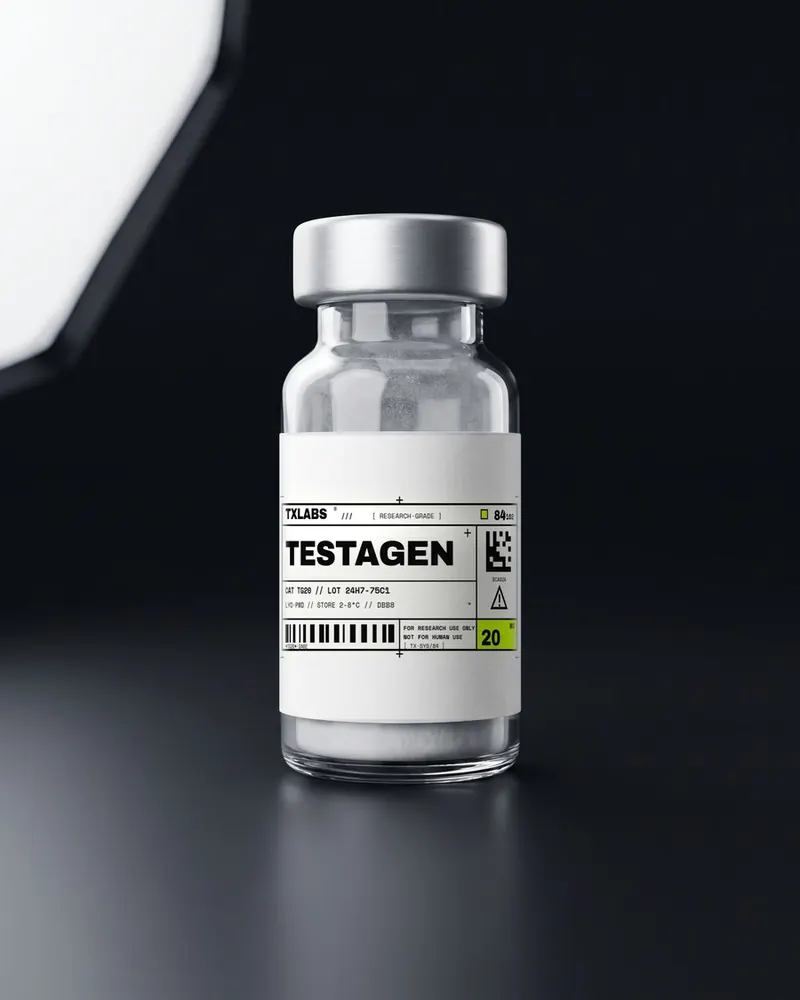
From $109 AUD · ≥98% HPLC purity · third-party COA · ships Australia-wide
What is Testagen?
Testagen (Lys-Glu-Asp-Gly, KEDG) is a synthetic tetrapeptide bioregulator of the Khavinson class studied in reproductive-tissue research. It is investigated in preclinical studies of testicular tissue and hypothalamic-pituitary-gonadal axis regulation, and is described as a tissue-specific short peptide affecting gene expression.
Specifications
- From: $109 AUD
- Category: Longevity & Bioregulators
- Form: Lyophilised powder
- Purity: ≥98% HPLC
- Testing: Third-party Certificate of Analysis
- Classification: Research reference material · For Research Use Only
What the research covers
Testagen is a synthetic tetrapeptide, Lys-Glu-Asp-Gly, from the ultrashort peptide programme conducted by Professor Vladimir Khavinson and colleagues at the St Petersburg Institute of Bioregulation and Gerontology. Within that programme it is the member named for testicular tissue, and its characterisation was performed by the originating groups.
The most useful thing to understand about testagen is not its biology but its name. Testagen, Livagen, Ovagen, Vesugen and the rest are labels coined inside a single research programme in the late twentieth century. They are not international nonproprietary names. They are not consistently mapped to CAS numbers across suppliers. No regulator maintains a register that binds any of them to a structure. Nothing prevents two vendors from selling different molecules under identical labels, and there is no mechanism by which a purchaser would find out. The sequence is the only durable identifier, and ordering, recording and verifying by sequence rather than by trade name is the single practice that protects a laboratory record in this part of the catalogue.
That abstract point has two concrete instances here. Testagen differs from livagen, Lys-Glu-Asp-Ala, by a single methylene group. It also differs from epitalon, Ala-Glu-Asp-Gly, by one substitution at the first position, which is notable because epitalon carries a far larger literature than anything else in this tradition and is consequently the compound testagen is most likely to be conflated with by anyone reading quickly.
On mechanism, the originating literature proposes direct interaction with DNA or chromatin-associated proteins producing tissue-selective changes in gene expression rather than receptor agonism. That is a hypothesis internal to one tradition, argued largely from modelling. The literature is concentrated in a few connected laboratories, largely Russian-language, decades old in parts, and independently replicated only to a limited extent.
TXLABS supplies testagen as a laboratory reference material only. It is not an approved therapeutic good in Australia and is not supplied for human or veterinary administration.
Reading the certificate
Because the product name carries no regulatory weight, the certificate is the only document that connects what was ordered to what arrived, and it should be read as an identity document first and a purity document second. The identity elements are a named analyte written as a sequence or an unambiguous synonym, an observed mass, and a stated lot number that matches the vial. Purity determined at 214 nm on a barely-retained peak is the weakest part of such a certificate and should not be the part relied on. Ask specifically whether the fourteen dalton neighbour and the alanine-substituted relative in the same family were excluded, because a generic tetrapeptide designation excludes neither. TXLABS publishes third-party certificates for tested lots in the CoA library; no certificate is currently published for testagen, and the certificate for the lot supplied is available on request to support@txlabs.bio.
Storage and handling
Storage requirements follow from a small, charged, polar tetrapeptide with no oxidisable residue: -20 °C for the lyophilised cake, desiccated and dark, with short-term working stock acceptable at 2-8 °C, and reconstituted solution held at 2-8 °C in the dark and aliquoted into single-use volumes rather than freeze-thaw cycled. Two acidic side chains make the powder hygroscopic, so a vial should reach room temperature sealed before the closure is broken. One handling practice matters more for this compound than for most: label the container with the sequence, not only the trade name. If a solution is transferred, split or stored beside livagen or epithalon material, a label reading Lys-Glu-Asp-Gly is unambiguous where a label reading Testagen is not. Australian summer transit remains the uncontrolled variable, with vehicle and letterbox temperatures routinely above 40 °C in most states; a dry cake tolerates brief excursions, but prompt collection and refrigeration is the sensible default.
Working out concentration
Testagen is supplied in a 20 mg vial. Reconstituted with 2 mL of bacteriostatic water it gives 10 mg/mL; with 4 mL, 5 mg/mL; with 5 mL, 4 mg/mL; with 10 mL, 2 mg/mL. Note that livagen, its nearest structural neighbour, is stocked at both 10 mg and 20 mg, so a volume carried across from a livagen vial without checking the mass produces a concentration that is out by a factor of two. Record vial mass, diluent volume and sequence together. The reconstitution calculator handles any combination of vial mass and volume. These are worked concentration examples for laboratory records, not a protocol.
How it relates to adjacent compounds
Livagen is the fourteen dalton neighbour and the compound testagen is most easily substituted for; its page treats the analytical side of that relationship in detail. Epithalon is one substitution away at the first residue and carries the largest published literature of any compound in this tradition, which makes it both the natural reference point and the most likely source of misattributed claims. Vesugen is the Lys-Glu-Asp core underlying all of them and the expected truncation product of a testagen synthesis. These are sequence relationships within one research programme and say nothing about relative activity or usefulness.