Vilon Australia — Lys-Glu Dipeptide Bioregulator
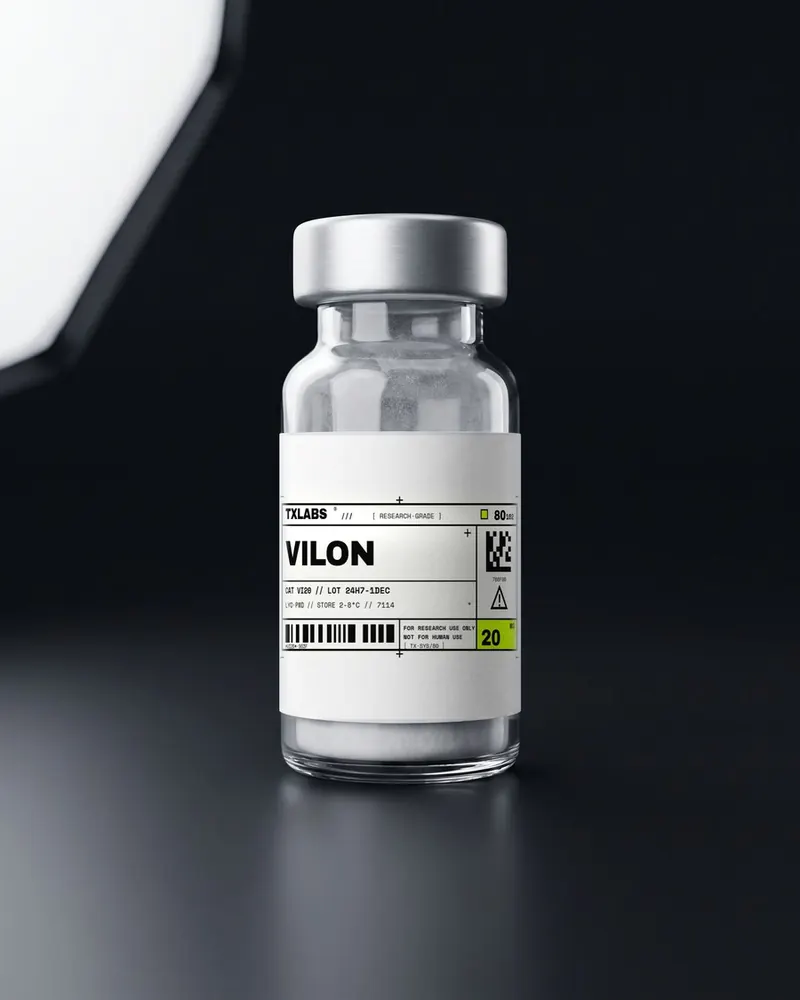
From $109 AUD · ≥98% HPLC purity · third-party COA · ships Australia-wide
What is Vilon?
Vilon (Lys-Glu, KE) is a synthetic dipeptide bioregulator of the Khavinson class studied in research on immune function. Developed at the St Petersburg Institute of Bioregulation and Gerontology, it is investigated in preclinical studies of thymus and immune-cell regulation and tissue-specific gene expression.
Specifications
- From: $109 AUD
- Category: Longevity & Bioregulators
- Form: Lyophilised powder
- Purity: ≥98% HPLC
- Testing: Third-party Certificate of Analysis
- Classification: Research reference material · For Research Use Only
What the research covers
Vilon is a synthetic dipeptide, Lys-Glu, and at two residues it is the shortest molecule in this catalogue. It belongs to the family of ultrashort peptide bioregulators developed across several decades by Professor Vladimir Khavinson and colleagues at the St Petersburg Institute of Bioregulation and Gerontology. Each compound in that programme was characterised against a particular tissue and given a trade name accordingly; vilon is the member named for immune tissue, and the thymic and immunological work associated with it sits within that programme rather than outside it.
The mechanism advanced in that literature is not classical receptor agonism. It proposes that ultrashort peptides enter cells and interact directly with DNA or with chromatin-associated proteins, modulating gene expression in a tissue-selective way. That proposal has been argued largely through molecular modelling and through the originating groups' own experimental work, and it should be read as a hypothesis within a particular research tradition rather than as an established mechanism. A 2022 paper from the same group examining how these peptides might cross membranes concluded that ultrashort peptide transport into the cell has not been properly studied, and rested its own conclusions on computational docking against the POT and LAT transporter families. Vilon is one of the few members for which that transport argument is least strained, since the proton-coupled oligopeptide transporters PEPT1 and PEPT2 do preferentially move di- and tripeptides.
The wider evidence base warrants the same caution the whole family warrants. The publications are concentrated in a small number of originating laboratories, are largely Russian-language, span decades, and follow reporting conventions that differ from those of the international peer-reviewed literature. Independent replication outside those groups is limited, so a finding well attested inside that tradition may have no corroboration beyond it.
TXLABS supplies vilon as an analytical reference material for laboratory research only. It is not an approved therapeutic good in Australia and is not supplied for human or veterinary administration.
Reading the certificate
Two residues break most of the assumptions behind a routine peptide certificate. Lys-Glu contains no tryptophan, tyrosine or phenylalanine, so there is no useful ultraviolet chromophore above about 230 nm and detection falls back to the peptide bond near 214 nm, which responds to almost everything including buffer components and the diluent. It is also extremely polar and elutes at or near the void volume of a standard C18 gradient, where it co-elutes with salts; a sharp early peak on a generic reversed-phase method has demonstrated very little. Ask whether a retentive method was used at all, and read the net peptide content rather than the gross weight, because counterion and residual water are a far larger share of a 275 dalton dipeptide than of a 4 kilodalton peptide. TXLABS publishes third-party certificates for tested lots in the CoA library; none is currently published for vilon, and the certificate for the lot supplied is available on request to support@txlabs.bio.
Storage and handling
A dipeptide has no tertiary structure to lose and no aggregation-prone hydrophobic face, so vilon is chemically robust by the standards of this catalogue. The real vulnerability is water. Lys-Glu is small, charged at both ends and strongly hygroscopic, and a thin cake in a 10 mg vial will draw moisture out of humid air within minutes of the seal being broken. Equilibrate a cold vial fully to room temperature before opening, because condensation onto chilled glass is the most common way this material is ruined, and a deliquesced cake cannot be weighed or trusted. Hold the lyophilised powder at -20 °C, desiccated and dark; 2-8 °C is adequate for short-term working stock. In solution it is water-soluble without difficulty and is held at 2-8 °C, aliquoted rather than freeze-thaw cycled. Australian conditions bite hardest on the humidity side rather than the heat side for this one: a Brisbane or Darwin wet-season delivery left in a letterbox exposes a hygroscopic powder to conditions no amount of refrigeration afterwards will reverse.
Working out concentration
Concentration is one division: milligrams in the vial over millilitres of diluent. The 10 mg vilon vial reconstituted with 2 mL of bacteriostatic water gives 5 mg/mL; with 1 mL, 10 mg/mL; with 5 mL, 2 mg/mL. The 20 mg vial with 2 mL gives 10 mg/mL, and with 4 mL, 5 mg/mL. One caution specific to a dipeptide: if you convert to molarity, the figure depends on whether you are dividing by the free-peptide mass or by the mass of the salt form actually in the vial, and for a molecule this small the counterion is a large fraction of the weight. The reconstitution calculator handles mass against volume. Concentration examples only, not a protocol.
How it relates to adjacent compounds
Vilon is the shortest member of a graded series stocked here. Adding aspartate gives vesugen (Lys-Glu-Asp), and extending that core by one further residue gives livagen, testagen, prostamax and pancragen in turn. Reading those pages alongside this one shows how quickly the analytical picture changes as residues are added: a chromophore appears with pancragen's tryptophan, retention improves, and the counterion correction shrinks. Further afield, thymalin occupies the opposite extreme of the same research tradition, being an undefined bovine thymus polypeptide fraction rather than a single sequence, and is the useful comparison for what chemical definition buys you. These are structural and provenance relationships within one research programme and say nothing about comparative activity.