CJC-1295 without DAC Australia — Modified GRF(1-29)
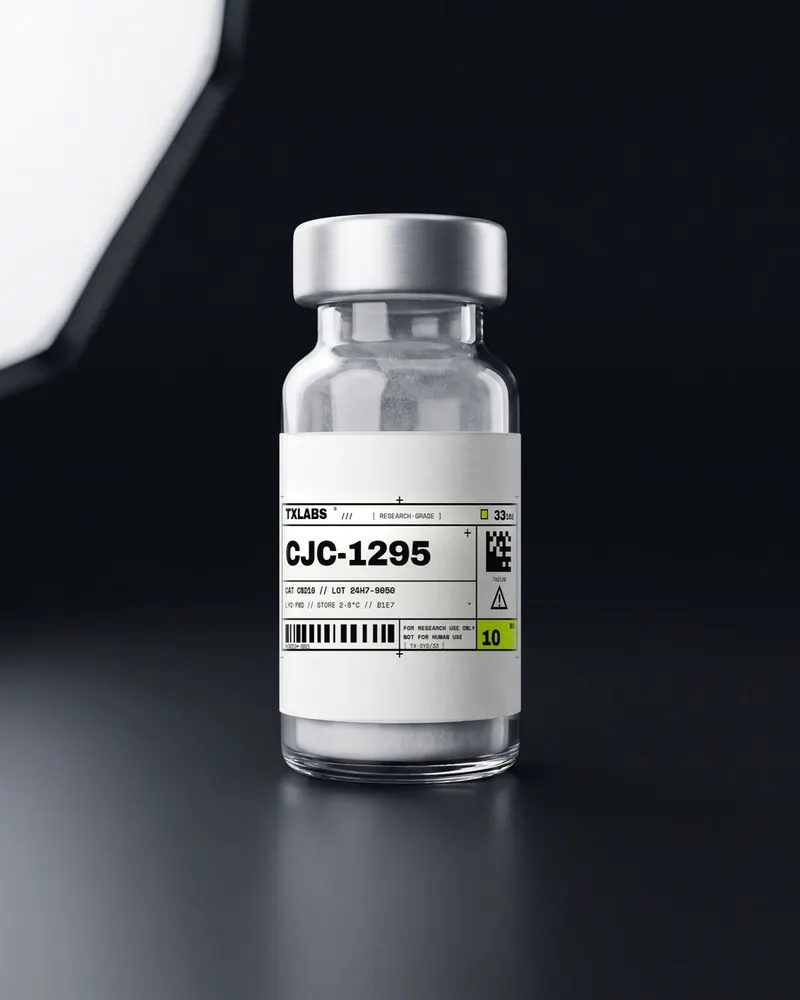
From $99 AUD · ≥98% HPLC purity · third-party COA · ships Australia-wide
What is CJC-1295 without DAC?
CJC-1295 without DAC (Modified GRF 1-29, Mod GRF 1-29) is a short-acting GHRH analogue that stimulates pulsatile growth hormone secretion. This modified peptide is studied in laboratory research on the growth hormone-releasing hormone receptor and is frequently paired with a ghrelin mimetic in research protocols.
Specifications
- From: $99 AUD
- Category: GH & Secretagogues
- Form: Lyophilised powder
- Purity: ≥98% HPLC
- Testing: Third-party Certificate of Analysis
- Classification: Research reference material · For Research Use Only
What the research covers
CJC-1295 without DAC is more accurately described as modified GRF(1-29), and the more precise name is worth using because the product name invites confusion with a different molecule. It is a synthetic analogue of growth hormone-releasing hormone built on GHRH(1-29), the shortest N-terminal fragment that retains full agonist activity at the GHRH receptor, and carries four reported amino acid substitutions: D-alanine at position 2, glutamine at 8, alanine at 15 and leucine at 27. Its molecular weight is near 3368 Da, roughly 10 Da above sermorelin's 3357.9 Da, the difference arising from those substitutions.
The D-alanine at position 2 does the essential work. Native GHRH and sermorelin are cleaved rapidly by dipeptidyl peptidase-4 at the N-terminal dipeptide, and replacing the L-alanine at position 2 with its D-isomer blocks that cleavage. The remaining substitutions are reported to address other degradation and oxidation liabilities, including the methionine at position 27 that sermorelin retains. Even so, this molecule carries no albumin-binding modification at all, and its reported circulating half-life remains short, on the order of minutes rather than hours. That is the entire point of the without DAC designation and the reason the two CJC-1295 forms are studied as separate research tools.
Published work using modified GRF(1-29) has examined GHRH receptor binding and Gs-coupled cAMP accumulation in pituitary cell preparations, the pulsatile pattern of growth hormone release that follows brief receptor engagement, and the combination of GHRH receptor agonism with ghrelin receptor agonism, since the two receptor systems are separate inputs converging on the same somatotroph population.
TXLABS supplies modified GRF(1-29) as an analytical reference material for laboratory research only. It is not an approved therapeutic good in Australia and is not supplied for human or veterinary administration.
Reading the certificate
The impurity population to expect at 29 residues is deletion and truncation sequences arising from incomplete coupling in solid-phase synthesis, and these can elute close to the parent, which is why mass-spectrometric identity carries more weight than a purity percentage. Confirm the observed mass against the expected value near 3368 Da, and specifically confirm it is not near 3647 Da, which would indicate DAC-bearing material, or near 3357.9 Da, which would indicate unsubstituted sermorelin. The D-alanine at position 2 introduces a stereochemical check as well: epimerisation produces a diastereomer of identical mass that only chromatography can resolve. TXLABS publishes third-party certificates for tested lots in the CoA library; no certificate is currently published for this compound. The lot certificate is available on request to support@txlabs.bio.
Storage and handling
At 29 residues this is a mid-length synthetic peptide, more fragile in solution than a pentapeptide and less so than a 44-mer. The lyophilised cake is stored at -20 °C, desiccated and protected from light, and brought to room temperature before the vial is opened so that condensation does not wet a hygroscopic powder. Reconstituted solution is held at 2-8 °C, shielded from light, and divided into single-use aliquots if any portion must be frozen, because each freeze-thaw cycle concentrates solute at the ice interface and drives aggregation of longer peptides preferentially. Add diluent gently down the vial wall and swirl rather than shake. Unlike its DAC-bearing counterpart, this molecule contains no reactive maleimide, so it is chemically simpler to store, and thiol-containing buffers pose no particular problem. Australian summer transit remains the practical risk: parcels in vehicles or letterboxes above 40 °C are best avoided by prompt collection and immediate refrigeration.
Working out concentration
The TXLABS vial is 10 mg. Reconstituted with 1 mL of bacteriostatic water it gives 10 mg/mL; with 2 mL, 5 mg/mL; with 5 mL, 2 mg/mL. At approximately 3368 Da, a 5 mg/mL solution corresponds to roughly 1.5 mM. This is close enough to the concentration figures for the DAC-bearing version that stock containers holding either should be labelled unambiguously if both are present, since the two solutions are visually identical and the molecules differ by about 280 Da. The reconstitution calculator resolves any vial and volume combination. These are worked concentration examples only and not a protocol.
How it relates to adjacent compounds
CJC-1295 with DAC is the same peptide carrying a maleimidopropionamide group that conjugates covalently to serum albumin, roughly 280 Da heavier and with a very different reported half-life. Sermorelin is the unmodified GHRH(1-29) parent, which shows what the four substitutions here were introduced to fix. Ipamorelin acts on the ghrelin receptor GHS-R1a rather than the GHRH receptor, which is why the two are studied as complementary inputs and are co-formulated in the combination vial. The GHRP hexapeptides stocked here, including GHRP-2, act at that same ghrelin receptor with different reported selectivity profiles again. Structural and receptor relationships only, with no implication about relative activity.