Adamax Australia — Adamantane-Modified Research Peptide
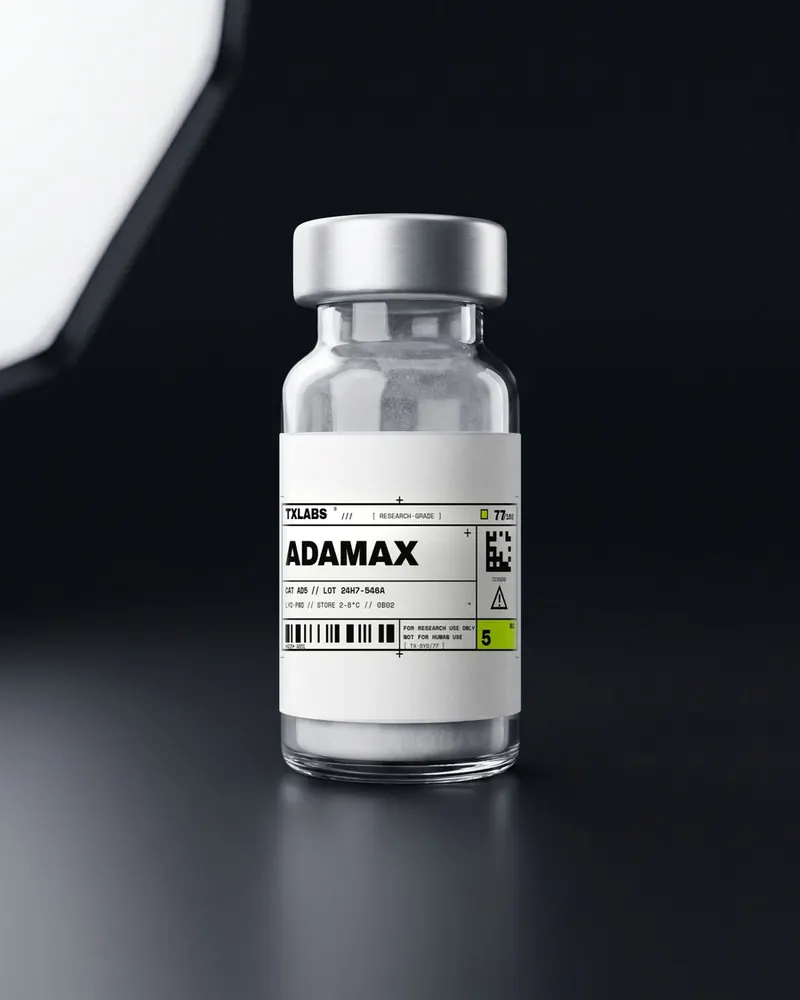
From $89 AUD · ≥98% HPLC purity · third-party COA · ships Australia-wide
What is Adamax (Adamantane)?
Adamax (adamantane-modified Semax analogue) is a synthetic nootropic peptide studied for effects on neurotrophic signalling. It pairs the Semax (ACTH-derived) core sequence with an adamantane group intended to improve stability and blood-brain barrier penetration, and is investigated in preclinical research on BDNF expression, memory and synaptic plasticity.
Specifications
- From: $89 AUD
- Category: Cognitive & Nootropic
- Form: Lyophilised powder
- Purity: ≥98% HPLC
- Testing: Third-party Certificate of Analysis
- Classification: Research reference material · For Research Use Only
What the research covers
Adamax is one of the least well documented compounds in this catalogue, and the honest starting point is that its structure cannot be confirmed from any authoritative source. It is described in the supply chain as an adamantane-modified peptide related to the Semax family, and vendor descriptions circulate that variously place the adamantyl group at the N-terminus of the Semax heptapeptide, describe an acetylated and amidated sequence with an appended adamantylated residue, or give no structure at all. These descriptions are not consistent with one another. We could not identify peer-reviewed pharmacological literature, a PubChem entry or a patent that fixes the sequence, the position of the adamantyl group or the molecular weight of the material sold under this name. This page therefore describes the general chemistry that the name implies and declines to assert a structure.
Adamantane conjugation is itself a well-established and unremarkable medicinal chemistry strategy. Adamantane is a rigid, cage-like, highly lipophilic tricyclic hydrocarbon, and attaching an adamantyl group to a polar molecule raises its lipophilicity substantially, which is used to improve membrane permeability and to slow enzymatic degradation by introducing steric bulk at a site of attack. The approach appears in approved medicines such as amantadine and memantine, and it has been applied deliberately in neuropeptide design, most clearly in the CNTF-derived tetrapeptide known as P021, where an adamantylated residue was added specifically to raise lipophilicity and blood-brain barrier permeability.
What is not available is any of that reasoning applied to this specific compound in the published record. Its identity rests on vendor description rather than on published characterisation, and no independent pharmacological work on it could be located. That is a substantive limitation rather than a gap in this page, and it makes analytical confirmation of the material more important here than for almost anything else in the catalogue.
TXLABS supplies Adamax as an analytical reference material for laboratory research only. It is not an approved therapeutic good in Australia and is not supplied for human or veterinary administration.
Reading the certificate
This is the compound in the batch where a certificate carries the most weight, precisely because there is nothing else to check the material against. With no published structure, no reference standard and no consensus molecular weight, the observed mass on the lot certificate is effectively the identity of the material rather than a confirmation of it. Ask for the observed mass as a number, ask what the analyte was named as in the report, and ask whether any structural evidence beyond mass was obtained, since mass alone cannot establish where an adamantyl group sits on a peptide or even that the peptide portion is the sequence assumed. Reversed-phase retention will be unusually long for a conjugate of this kind, so confirm the method was appropriate. TXLABS publishes third-party certificates for tested lots in the CoA library; no certificate is currently published for Adamax. The lot certificate is available on request to support@txlabs.bio.
Storage and handling
In the absence of a confirmed structure, handling has to be set conservatively from what the name implies. An adamantyl-conjugated short peptide will be substantially more lipophilic than the parent peptide, which has predictable consequences: reduced aqueous solubility, a tendency to aggregate above a critical concentration, and appreciable adsorption to hydrophobic surfaces including plastic labware. Material that appears not to dissolve has usually aggregated rather than remained solid, and a co-solvent may be required for a genuine stock solution.
If the underlying sequence is Semax-related then the internal chemistry of concern includes a methionine residue, which oxidises to the sulfoxide with a sixteen dalton mass shift, and a histidine, which is also oxidation-sensitive. Neither is protected by an adamantyl group placed elsewhere in the molecule.
Store the lyophilised solid at -20 C, desiccated and protected from light, and equilibrate the sealed vial to room temperature before opening. Add diluent slowly and allow time for dissolution rather than forcing it with agitation. Hold solutions at 2-8 C, aliquot rather than freeze-thaw, and remix gently before use. Australian summer transit above 40 C should be treated as a real risk given the likely oxidation-sensitive residues, so collect promptly and refrigerate.
Working out concentration
The TXLABS Adamax vial is 5 mg. Five milligrams taken into 1 mL gives 5 mg/mL; into 2 mL, 2.5 mg/mL; into 5 mL, 1 mg/mL. Molar conversion cannot be given here, because no authoritative source fixes a molecular weight for this compound and using a figure from a vendor listing would build an unverified number into every subsequent calculation. The mass reported on the certificate for the lot supplied is the only defensible reference. Note also that an adamantyl-conjugated peptide is likely to be less water-soluble than an unmodified one, so the highest of these concentrations may not be achievable as a true aqueous solution. The reconstitution calculator handles the mass and volume arithmetic. Concentration examples only, not a protocol.
How it relates to adjacent compounds
Adamax sits in the cognitive and nootropic group and its nearest documented relative in this catalogue is P21 adamantane, which uses the same adamantane conjugation strategy on a CNTF-derived tetrapeptide and, unlike Adamax, has an identifiable peer-reviewed literature behind it. Reading that page alongside this one is the clearest illustration of the difference between a compound with published characterisation and one without. Semax is the peptide family the name gestures at, and NA Semax amidate is another modified Semax analogue whose structure, unlike this one, is at least unambiguous. These are naming and strategy adjacencies only, and imply nothing about comparable activity or about the material actually being related to those compounds.