PNC-27 Australia — Chimeric p53-Penetratin Peptide
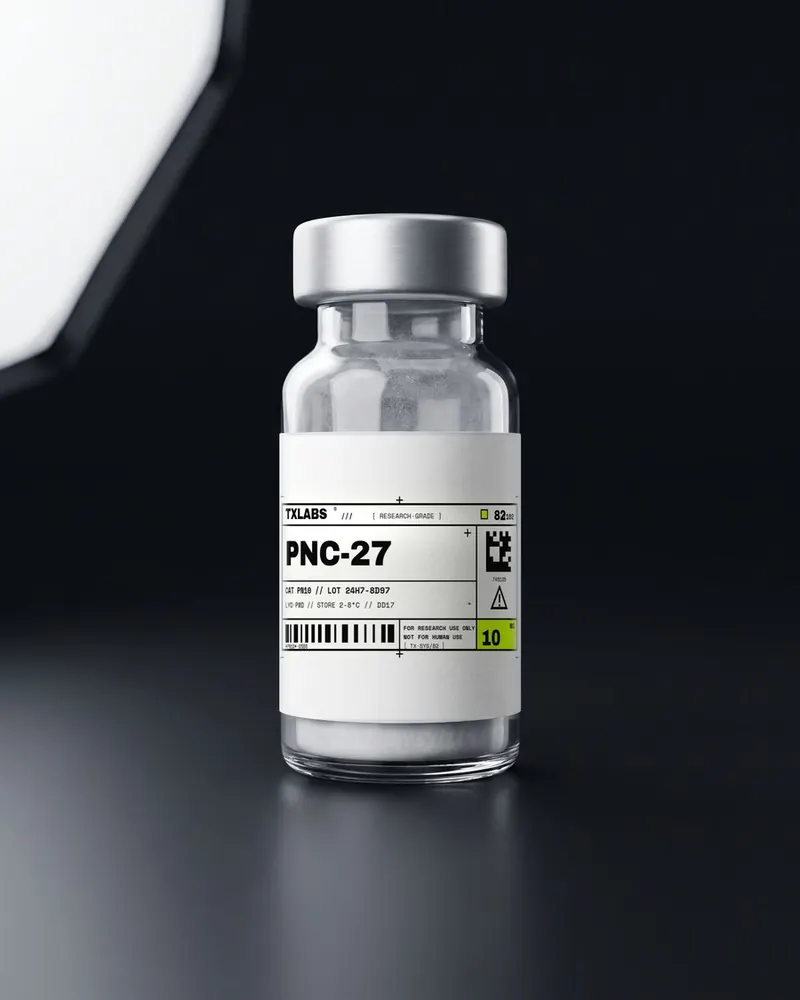
From $139 AUD · ≥98% HPLC purity · third-party COA · ships Australia-wide
What is PNC 27?
PNC 27 is a chimeric p53-penetratin peptide studied for its selective binding to membrane HDM-2 in cancer cell research. Combining a p53-derived HDM-2-binding sequence with a membrane-residency segment, it is investigated in laboratory studies of transmembrane pore formation and p53-independent necrosis in transformed cell lines.
Specifications
- From: $139 AUD
- Category: Cognitive & Nootropic
- Form: Lyophilised powder
- Purity: ≥98% HPLC
- Testing: Third-party Certificate of Analysis
- Classification: Research reference material · For Research Use Only
What the research covers
PNC-27 is a chimeric peptide of 32 residues, built from two functional parts joined end to end. One part corresponds to a region of the p53 tumour suppressor protein around residues 12 to 26, the segment that contacts HDM-2, the human homologue of MDM2. The other is a cell-penetrating leader derived from penetratin, the Antennapedia homeodomain-derived sequence widely used to carry cargo across membranes. The construct is therefore a targeting element plus a delivery element, which is a common and well-understood design pattern in peptide chemistry.
The published mechanism is unusual and specific. Work from groups associated with Mount Sinai and collaborating institutions reports that PNC-27 binds HDM-2 that is present at the plasma membrane of transformed cells rather than in the nucleus, and that the resulting complexes assemble into transmembrane pore structures, causing membrane disruption and necrosis rather than apoptosis. A 2022 paper in Biomedicines reported immuno-scanning electron microscopy showing gold-labelled PNC-27 and HDM-2 particles in approximately one-to-one ratios arranged in ring-shaped structures at the cell surface, with no equivalent structures reported in untransformed fibroblast controls. Subsequent work has extended the account to mitochondrial membranes.
The evidence should be read with its provenance in view. The work is peer-reviewed and structurally detailed, which is more than can be said for several compounds in this part of the catalogue, but it is concentrated in a small network of affiliated investigators, independent replication by unaffiliated groups is limited, and it is entirely preclinical, in cultured cells and in animal models. The membrane-pore mechanism is a distinctive claim that has not been broadly taken up in the wider oncology literature. No human data exists.
TXLABS supplies PNC-27 as an analytical reference material for laboratory research only. It is not an approved therapeutic good in Australia and is not supplied for human or veterinary administration.
Reading the certificate
A 32-residue synthetic peptide is long enough that synthesis quality is a genuine variable rather than a formality. Deletion sequences, in which a single residue fails to couple, are the characteristic failure at this length, and they differ from the target by one amino acid, which on a peptide of this size is a small proportional mass change and co-elutes closely on reversed-phase HPLC. Ask for the observed mass as a number and for the chromatogram rather than only a headline percentage. Because the construct fuses two functional regions, ask that the certificate names the full sequence rather than the product name alone, since a truncated construct would still look plausible. Salt form and net peptide content matter disproportionately here given the high positive charge. TXLABS publishes third-party certificates for tested lots in the CoA library; no certificate is currently published for PNC-27. The lot certificate is available on request to support@txlabs.bio.
Storage and handling
Penetratin-derived sequences are strongly cationic, and that dominates the practical behaviour of this construct. Highly basic peptides adsorb readily to negatively charged surfaces, including glass and some plastics, and dilute working solutions lose a measurable fraction of their content to container walls; low-binding tubes and the addition of carrier protein are the usual responses. The same charge makes the peptide very water-soluble, so concentrated stocks are straightforward.
At 32 residues the sequence is long enough to carry several degradation liabilities at once. Depending on the exact composition it may include methionine or tryptophan, both readily oxidised, and asparagine or glutamine subject to deamidation, and the peptide is long enough that a single deletion during synthesis produces only a small proportional mass change. The construct is also amphipathic by design, since it is intended to interact with membranes, and amphipathic peptides aggregate at high concentration and at interfaces.
Store the lyophilised powder at -20 C, desiccated and protected from light, and equilibrate before opening. Add diluent gently and avoid agitation, which promotes aggregation of membrane-active sequences. Hold solutions at 2-8 C and aliquot rather than freeze-thaw. Australian transit above 40 C is a real risk, so refrigerate promptly.
Working out concentration
The TXLABS PNC-27 vial is 10 mg. Ten milligrams into 2 mL of bacteriostatic water gives 5 mg/mL; into 1 mL, 10 mg/mL; into 5 mL, 2 mg/mL. Because the peptide is strongly cationic it dissolves readily and all three are achievable. Molar conversion should use the mass reported on the certificate for the lot supplied rather than a catalogue figure: at 32 residues the mass depends on the exact sequence and on the salt form, and counterion content on a highly basic peptide can be a substantial fraction of gross vial weight. Published cell work with peptides of this class is typically specified in micromolar terms, well below stock concentration. The reconstitution calculator handles the pairing. Concentration examples only, not a protocol.
How it relates to adjacent compounds
PNC-27's most useful comparison in this catalogue is FOXO4-DRI. Both are designed peptide-based disruptors of a specific protein-protein interaction involving p53, both rest on a small preclinical literature from a limited set of groups, and both illustrate how much design ingenuity can sit on top of how little independent replication. PTD-DBM is the other compound here built as a cell-penetrating domain fused to an interaction-blocking motif, which makes it the closest structural analogue in construction if not in target. KPV is a further neighbour among the short peptides with proposed intracellular targets. These are design and structural adjacencies only, and imply nothing about comparable activity or interchangeable use.