PE 22-28 Australia — Spadin-Derived TREK-1 Research Peptide
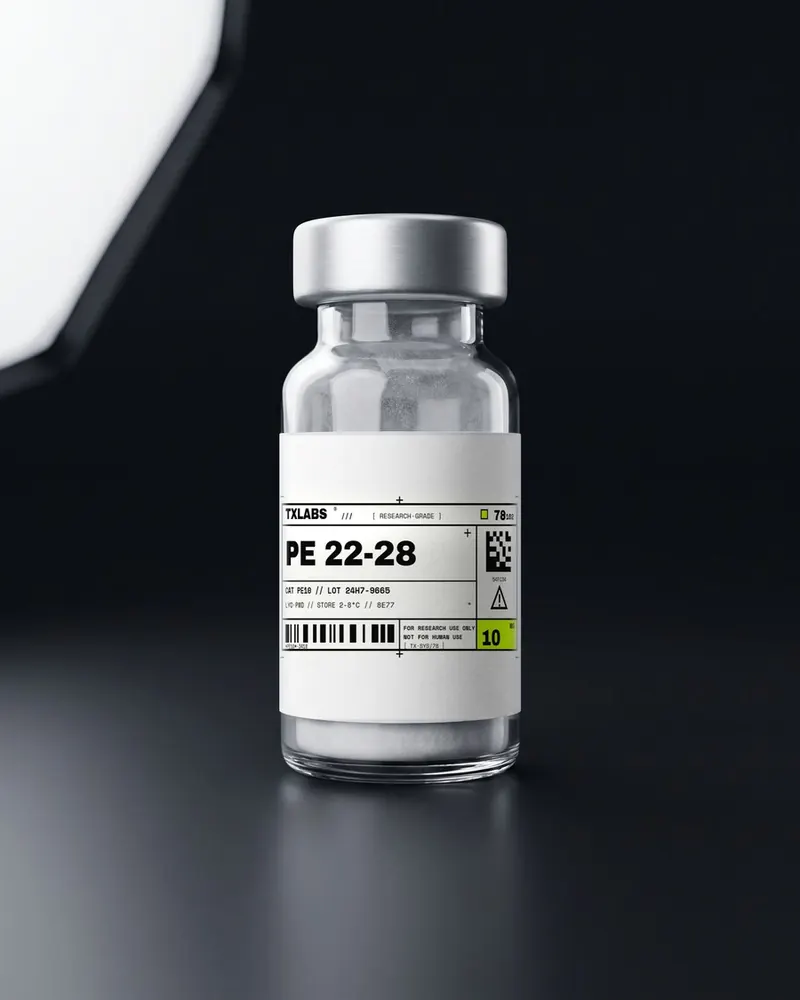
From $219 AUD · ≥98% HPLC purity · third-party COA · ships Australia-wide
What is PE 22-28?
PE 22-28 (spadin-derived peptide) is a TREK-1 potassium channel inhibitor studied in research on mood and neurogenesis. A seven-amino-acid fragment of the spadin sequence with greater TREK-1 affinity than the parent molecule, it is used as a research reference in preclinical models of antidepressant-like activity and hippocampal neurogenesis.
Specifications
- From: $219 AUD
- Category: Cognitive & Nootropic
- Form: Lyophilised powder
- Purity: ≥98% HPLC
- Testing: Third-party Certificate of Analysis
- Classification: Research reference material · For Research Use Only
What the research covers
PE 22-28 is a shortened analogue of spadin. Spadin is a peptide released from the propeptide region of sortilin and was described in 2010 by Mazella and colleagues as a selective blocker of the TREK-1 two-pore-domain potassium channel. PE 22-28 corresponds to residues 22 to 28 of that propeptide numbering, a seven-residue fragment identified as retaining the channel-blocking activity of the longer parent while being shorter and, as reported, more stable.
The primary source for the shortened analogues is a 2017 paper in Frontiers in Pharmacology by Djillani and colleagues from the originating group, which reported that shortened spadin analogues displayed greater TREK-1 inhibition than spadin itself, longer duration of action in vivo, and effects in standard rodent behavioural paradigms including forced swim, novelty-suppressed feeding and learned helplessness, together with markers of neurogenesis and of synaptogenesis in cortical neuron culture. TREK-1 itself is a well-characterised channel with an independent literature, including work on knockout mice, and that background is considerably more robust than the peptide-specific work.
The honest position on the evidence is that it is thin and concentrated. Almost all of the published work on spadin and its shortened analogues originates from a single research group in France, independent replication by unaffiliated laboratories is limited, and no human data of any kind exists. In addition, no authoritative primary source consistently fixes a molecular weight or a definitive sequence for the commercial material sold under the name PE 22-28, and figures circulating in supplier listings should not be relied on. This page therefore describes the design lineage and declines to assert a mass; the certificate for the lot supplied is the reference to work from.
TXLABS supplies PE 22-28 as an analytical reference material for laboratory research only. It is not an approved therapeutic good in Australia and is not supplied for human or veterinary administration.
Reading the certificate
The awkwardness with this compound is that there is no published reference specification to check a certificate against, so the certificate is doing more work than usual. Ask for the observed mass as a number and for the sequence as the manufacturer states it, rather than accepting the name alone, because the name describes a residue range in a propeptide numbering scheme rather than a defined commercial product. Confirm the salt form and net peptide content, since for a seven-residue peptide counterion and residual water can be a large proportion of gross vial weight. Confirm that reversed-phase purity was determined with a gradient appropriate to a short peptide, where closely related deletion sequences elute near the parent. TXLABS publishes third-party certificates for tested lots in the CoA library; no certificate is currently published for PE 22-28. The lot certificate is available on request to support@txlabs.bio.
Storage and handling
Without a confirmed sequence, handling for this peptide has to be set from what is known about short synthetic peptides generally, and the conservative course is to assume the ordinary liabilities apply. Backbone hydrolysis proceeds slowly in solution and accelerates with warmth and with pH extremes. If the sequence carries methionine or cysteine, oxidation and disulfide chemistry become concerns; if it carries asparagine, aspartate or glutamine, deamidation and isomerisation do. The certificate and any sequence information supplied with the lot are what allow those questions to be narrowed.
What can be said generally is that a seven-residue peptide has few degradation routes but little margin: a single modification represents a large proportion of the molecule, and short peptides give high molar concentrations for a given mass.
Store the lyophilised powder at -20 C, desiccated and protected from light, and equilibrate the sealed vial before opening so moisture does not condense onto a hygroscopic cake. Add diluent down the vial wall and swirl gently. Hold solution at 2-8 C in the dark and aliquot rather than freeze-thaw cycling. Australian summer freight above 40 C is a real risk for any short peptide, so collect promptly and refrigerate.
Working out concentration
The TXLABS PE 22-28 vial is 10 mg. Ten milligrams into 2 mL of bacteriostatic water gives 5 mg/mL; into 1 mL, 10 mg/mL; into 5 mL, 2 mg/mL. A molar figure is deliberately not given here, because no authoritative primary source fixes a molecular weight for the commercial material and using a supplier-listed number would embed an unverified value in every subsequent calculation. The mass reported on the certificate for the lot supplied is the figure to work from. Since published channel work with peptides of this class is specified at nanomolar concentrations, the stock will sit many orders of magnitude above the working range. The reconstitution calculator handles the arithmetic. Concentration examples only, not a protocol.
How it relates to adjacent compounds
PE 22-28 sits in the cognitive and nootropic group of this catalogue, where its closest relatives are other short peptides derived from larger parent proteins by fragment identification. Semax and Selank follow the same general design logic, taking a short active region of a parent protein and stabilising it, though from entirely different parents and with a much larger, if similarly provenance-limited, literature behind them. DSIP is a further neighbour: another short peptide with a contested mechanism and a literature that has not consolidated. The common thread across all four is that a well-defined chemical structure does not by itself imply a well-established biology. These are design and category adjacencies only, and imply nothing about comparable activity.