P21 non-Adamantane Australia — Unmodified Parent Peptide
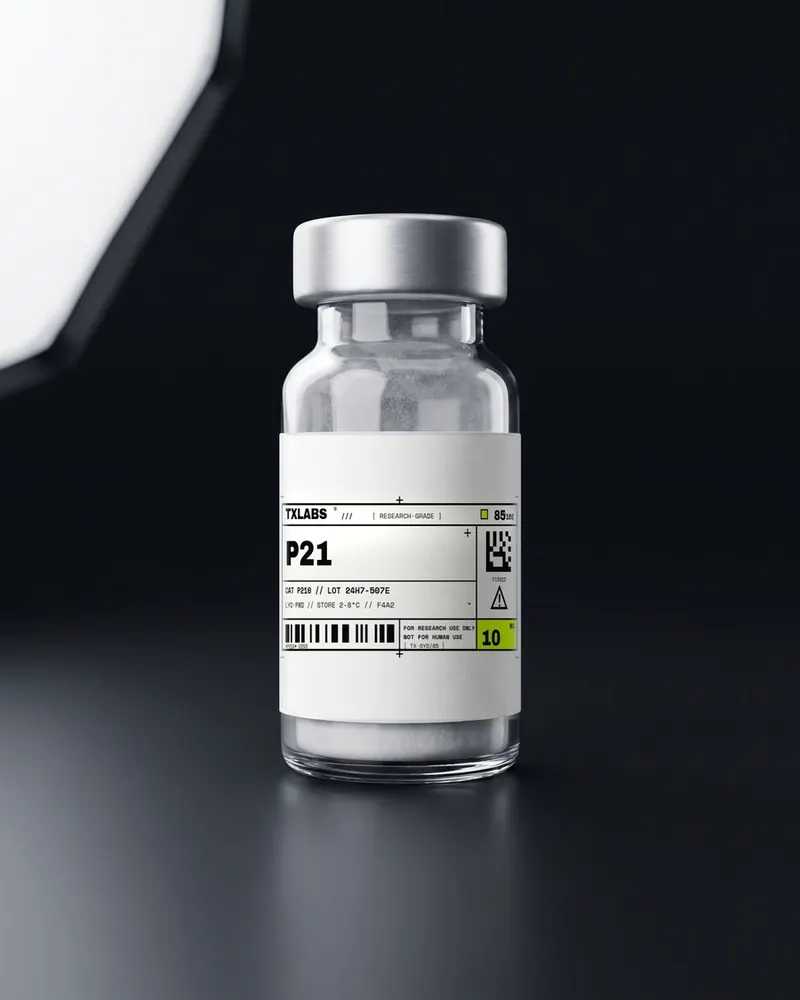
From $129 AUD · ≥98% HPLC purity · third-party COA · ships Australia-wide
What is P21 (non-Adamantane)?
P21 (P021, CNTF-derived peptide) is a synthetic neurotrophic peptide studied in research on memory and neurogenesis. This non-adamantane form is an unmodified CNTF-mimetic peptide, originally reverse-engineered from Cerebrolysin, investigated in preclinical models of hippocampal neurogenesis, synaptic plasticity and learning.
Specifications
- From: $129 AUD
- Category: Cognitive & Nootropic
- Form: Lyophilised powder
- Purity: ≥98% HPLC
- Testing: Third-party Certificate of Analysis
- Classification: Research reference material · For Research Use Only
What the research covers
P21 non-adamantane denotes the peptide core of P021 without the adamantyl conjugation, corresponding to the CNTF-derived tetrapeptide reported in the primary literature as peptide 6c, Ac-Asp-Gly-Gly-Leu-NH2, with both termini capped. It is the parent from which the adamantylated compound was built, and it is a distinct molecule with its own literature and its own properties.
That literature is worth separating out. Work from the laboratory of Khalid Iqbal at the New York State Institute for Basic Research identified an eleven-residue active region of ciliary neurotrophic factor, designated peptide 6, and reported that a shorter subsequence, peptide 6c, retained activity in rodent studies of hippocampal neurogenesis, learning and memory endpoints and synaptic plasticity markers. The adamantylated derivative was developed subsequently and explicitly to address the limitations of the unconjugated peptide, principally its lipophilicity and its central availability. In other words, the existence of the modified compound is itself a statement by the originating group about what the unmodified peptide does not do well.
Two honest qualifications belong here. First, the same provenance limitation applies as to the adamantylated form: the work is concentrated in the originating laboratory and its collaborators, independent replication by unaffiliated groups is limited, and all of it is preclinical. Second, the naming in the supply chain is loose. Material sold as P21 non-adamantane is being described by what it is not, and the precise sequence and terminal modifications supplied under that name are not fixed by any published specification. The mass reported on the certificate for the lot supplied is the reliable statement of what is in the vial.
TXLABS supplies P21 non-adamantane as an analytical reference material for laboratory research only. It is not an approved therapeutic good in Australia and is not supplied for human or veterinary administration.
Reading the certificate
The identity question here runs in the opposite direction from its conjugated counterpart. There, the risk was that the adamantyl group is absent; here the material is defined by the absence of that group, so the certificate needs to establish positively what the peptide actually is. Ask for the observed mass as a number and for the analyte name as the laboratory recorded it, since a four-residue peptide described only as P21 non-adamantane is not specified by any published standard. Ask whether the terminal acetyl and amide caps were confirmed, since they change the mass by about 42 and minus 1 daltons respectively and their absence would give a different compound. Because of the Asp-Gly motif, ask whether the chromatography resolves the isoaspartate isomer, which mass spectrometry cannot exclude. TXLABS publishes third-party certificates for tested lots in the CoA library; no certificate is currently published for P21 non-adamantane. The lot certificate is available on request to support@txlabs.bio.
Storage and handling
Without the adamantyl cage this is a small, polar, doubly capped tetrapeptide, and it behaves accordingly. It dissolves readily in water, unlike its conjugated counterpart, and does not aggregate or adsorb appreciably to plastic at ordinary working concentrations. Of the two forms, this is much the easier to work with.
The chemistry to watch is the aspartyl-glycine motif at the start of the sequence. Asp-Gly is the classic substrate for aspartimide formation, a cyclisation that proceeds in aqueous solution and resolves to a mixture of aspartate and isoaspartate forms. It accelerates with warmth and with pH away from neutral, and because the tetrapeptide is so short, that single motif represents a large proportion of the molecule rather than a minor site. The resulting isomer is isobaric with the parent. There is no cysteine, no methionine and no tryptophan, so oxidation is not a concern, and both termini are capped, so exopeptidase attack is not either.
Store the lyophilised powder at -20 C, desiccated and protected from light, and equilibrate before opening. Hold solutions at 2-8 C near neutral pH and aliquot rather than freeze-thaw. Australian summer transit above 40 C drives aspartimide chemistry, so prompt cold storage matters.
Working out concentration
The TXLABS P21 non-adamantane vial is 10 mg. Ten milligrams into 2 mL of bacteriostatic water gives 5 mg/mL; into 1 mL, 10 mg/mL; into 5 mL, 2 mg/mL. Unlike the adamantylated form, all three are readily achievable as true aqueous solutions, since the unconjugated peptide is small and polar. Molar conversion should use the mass on the certificate for the lot supplied rather than an assumed figure, because the compound is defined in the supply chain by what it lacks rather than by a published specification. As a very short peptide it will give high molar concentrations for a given mass. The reconstitution calculator handles the arithmetic. Concentration examples only, not a protocol.
How it relates to adjacent compounds
The obvious companion is P21 adamantane, and the pair is genuinely informative: the adamantylated form was developed to address limitations of this one, so holding both allows the contribution of the lipophilic conjugation to be examined directly rather than assumed. Cerebrolysin sits in the same neurotrophic research area while being a heterogeneous porcine hydrolysate rather than a defined molecule, which is a useful contrast in what a certificate can establish. Epithalon is a further neighbour by structure alone, being another very short synthetic peptide containing an Asp-Gly motif and sharing exactly the same aspartimide chemistry and the same analytical blind spot. These are structural adjacencies only, and imply nothing about comparable activity or interchangeable use.