P21 Adamantane Australia — CNTF-Derived Research Peptide
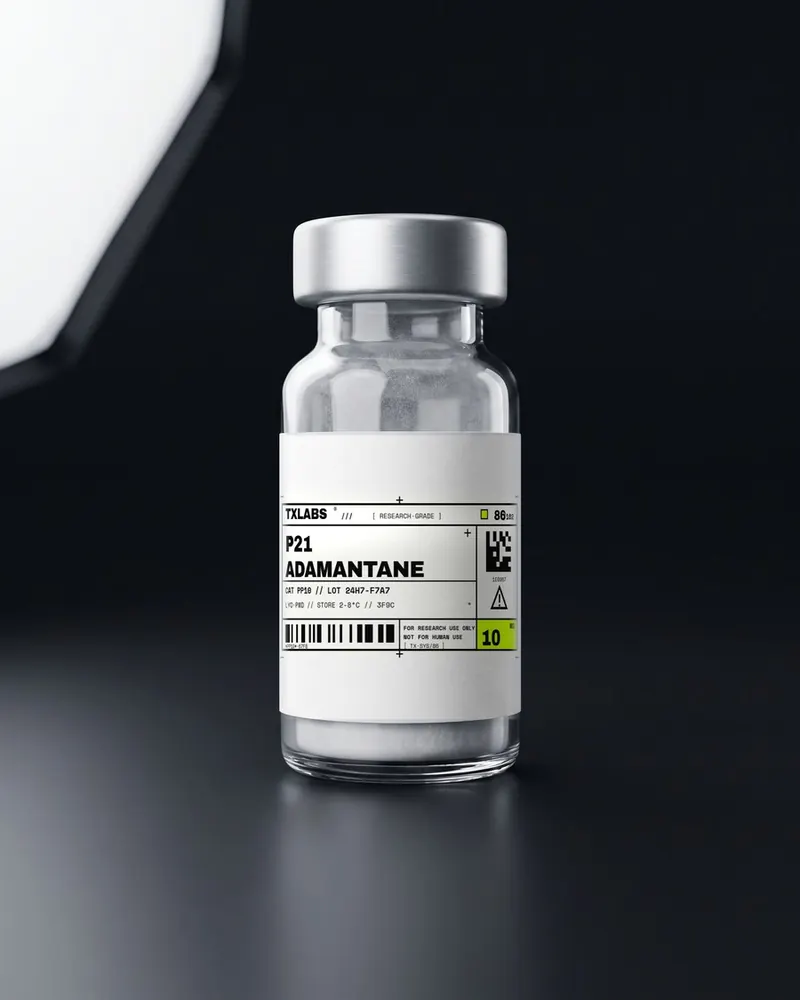
From $129 AUD · ≥98% HPLC purity · third-party COA · ships Australia-wide
What is P21 (Adamantane)?
P21 (P021, adamantane-modified CNTF peptide) is a synthetic neurotrophic peptide studied in research on memory and neurogenesis. The adamantane group (Ac-DGGL-adamantane) is added to improve stability and blood-brain barrier penetration; it is investigated in preclinical models of neurogenesis, synaptic plasticity and cognition.
Specifications
- From: $129 AUD
- Category: Cognitive & Nootropic
- Form: Lyophilised powder
- Purity: ≥98% HPLC
- Testing: Third-party Certificate of Analysis
- Classification: Research reference material · For Research Use Only
What the research covers
P21, also written P021 in the primary literature, is a short synthetic peptide derived from ciliary neurotrophic factor. Its lineage is unusually well documented for a compound of this kind. Work from the laboratory of Khalid Iqbal at the New York State Institute for Basic Research in Developmental Disabilities identified an eleven-residue active region of CNTF, designated peptide 6, and then a shorter subsequence of it, peptide 6c, reported as Ac-Asp-Gly-Gly-Leu-NH2 and corresponding to CNTF residues in the region of 148 to 151. P021 is that tetrapeptide core with an adamantylated glycine appended, the adamantyl cage added specifically to raise lipophilicity and blood-brain barrier permeability and to add steric resistance to exopeptidase attack.
The proposed mechanism reported in that literature is competitive interference with leukaemia inhibitory factor signalling. LIF signalling is described as suppressing neurogenesis, and the published account is that disinhibiting it permits neural progenitor proliferation in the dentate gyrus, with associated increases in brain-derived neurotrophic factor expression. Rodent work from the originating group and collaborators has examined learning and memory endpoints, hippocampal neurogenesis and synaptic plasticity markers in normal adult mice and in transgenic mouse lines used in Alzheimer's disease and tauopathy research.
The evidence base has a specific shape that should be stated. It is substantial in volume, it is peer-reviewed, and it is backed by granted patents, which puts it well ahead of most compounds in this part of the catalogue. But it is heavily concentrated in the originating laboratory and its collaborators, independent replication by unaffiliated groups is limited, and all of it is preclinical. The compound has been reported as being taken forward in commercial development, which is a fact about a development programme rather than about demonstrated effects in people. No human efficacy has been established.
TXLABS supplies P21 adamantane as an analytical reference material for laboratory research only. It is not an approved therapeutic good in Australia and is not supplied for human or veterinary administration.
Reading the certificate
For an adamantylated peptide the certificate has to establish that the conjugation is present, complete and in the right place, and mass alone answers only the first two of those. An observed mass consistent with the adamantylated conjugate distinguishes it from the unmodified tetrapeptide, which is a far cheaper material and which TXLABS lists separately; the difference is large and unambiguous. Where mass cannot help is regiochemistry, since an adamantyl group attached at the wrong position gives the same mass. Ask what structural evidence beyond mass was obtained. Because the sequence contains an Asp-Gly motif, ask also whether the chromatography resolves the isoaspartate isomer, which is isobaric with the parent and invisible to mass spectrometry. Reversed-phase retention will be long. TXLABS publishes third-party certificates for tested lots in the CoA library; no certificate is currently published for P21 adamantane. The lot certificate is available on request to support@txlabs.bio.
Storage and handling
The adamantyl group dominates the physical behaviour. Adamantane is an extremely lipophilic rigid hydrocarbon cage, and attaching one to a four-residue peptide produces a molecule that is far less water-soluble than its size would suggest. Expect slow dissolution, a tendency to aggregate above a critical concentration, and appreciable adsorption to plastic labware. Material that appears undissolved has usually aggregated rather than remained solid, and a water-miscible co-solvent is often required for a genuine stock.
Chemically the peptide portion is comparatively benign. There is no cysteine, no methionine and no tryptophan, so the common oxidation routes are absent, and both termini are capped, removing exopeptidase susceptibility. The sequence does contain an aspartate followed by glycine, which is the classic substrate for aspartimide formation and subsequent isomerisation to isoaspartate in aqueous solution. That reaction accelerates with warmth and with pH away from neutral, and it produces a species with the same nominal mass as the parent.
Store the lyophilised solid at -20 C, desiccated and protected from light, and equilibrate before opening. Hold solutions at 2-8 C and aliquot rather than freeze-thaw. Australian summer transit above 40 C is a genuine concern because of the Asp-Gly chemistry, so prompt cold storage matters.
Working out concentration
The TXLABS P21 adamantane vial is 10 mg. Ten milligrams into 2 mL gives 5 mg/mL; into 1 mL, 10 mg/mL; into 5 mL, 2 mg/mL. Molar conversion should be done from the mass reported on the certificate for the lot supplied rather than from a catalogue figure, since published sources describe the compound structurally without consistently fixing a molecular weight for the commercial material, and an adamantylated peptide's mass depends on exactly how the conjugation was made. The practical caveat is solubility rather than arithmetic: an aqueous stock at 10 mg/mL is unlikely to be a true solution for a compound this lipophilic. The reconstitution calculator handles the pairing. Concentration examples only, not a protocol.
How it relates to adjacent compounds
The direct counterpart is P21 non-adamantane, the same peptide core without the adamantyl conjugation, and the pair exists precisely so that the contribution of the lipophilic cage can be examined rather than assumed. Cerebrolysin is a relevant neighbour for a different reason: it is a heterogeneous neurotrophic preparation studied in overlapping research areas, and the contrast between a single defined synthetic tetrapeptide and an undefined biological hydrolysate is instructive about what a certificate can and cannot establish. Adamax shares the adamantane conjugation strategy but, unlike this compound, has no identifiable published characterisation behind it. These are structural and strategy adjacencies only, and imply nothing about comparable activity or interchangeable use.