VIP Australia — Vasoactive Intestinal Peptide, 10 mg
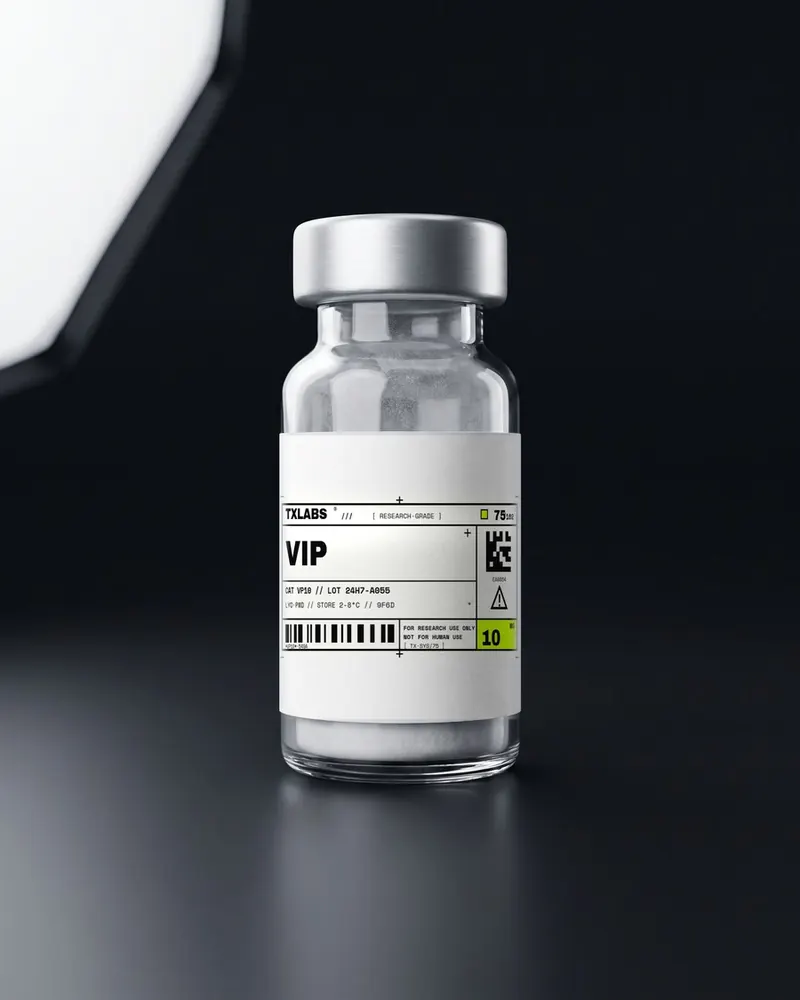
From $139 AUD · ≥98% HPLC purity · third-party COA · ships Australia-wide
What is VIP?
VIP (vasoactive intestinal peptide) is a 28-amino-acid neuropeptide that acts on VPAC receptors as a vasodilator and immunomodulator. It is studied in research on smooth muscle relaxation, circadian signalling, neuroprotection and inflammatory pathways.
Specifications
- From: $139 AUD
- Category: Recovery & Repair
- Form: Lyophilised powder
- Purity: ≥98% HPLC
- Testing: Third-party Certificate of Analysis
- Classification: Research reference material · For Research Use Only
What the research covers
VIP, vasoactive intestinal peptide, is a 28-residue neuropeptide catalogued in UniProt as P01282, with the sequence His-Ser-Asp-Ala-Val-Phe-Thr-Asp-Asn-Tyr-Thr-Arg-Leu-Arg-Lys-Gln-Met-Ala-Val-Lys-Lys-Tyr-Leu-Asn-Ser-Ile-Leu-Asn-NH2. It carries a C-terminal amide, which is not a stabilising modification added by a manufacturer but part of the native structure, generated in vivo by enzymatic amidation of a glycine-extended precursor.
VIP belongs to the secretin and glucagon peptide superfamily, which makes it structurally related to PACAP, secretin, glucagon and by extension to the incretin peptides stocked elsewhere in this catalogue. It acts at two class B1 G protein-coupled receptors, VPAC1 and VPAC2, encoded by VIPR1 and VIPR2. Published work has examined VIP in a wide range of physiological contexts including smooth muscle relaxation, vasodilation, secretory regulation in the gastrointestinal tract, circadian signalling in the suprachiasmatic nucleus, and immunomodulatory functions; it is a well-characterised endogenous peptide with a large and long-established literature, which distinguishes it from most of the compounds around it here.
Three residues determine how the molecule degrades, and knowing which they are makes stability planning straightforward rather than guesswork. The methionine at position 17 is the single most oxidation-sensitive site. The asparagine and glutamine residues, of which there are several including two asparagines near the C-terminus, are deamidation-prone. And the C-terminal amide itself can hydrolyse to the free acid, a change of about one dalton that matters because the published structure-activity literature indicates the amide is required for receptor activity.
TXLABS supplies VIP as an analytical reference material for laboratory research only. It is not an approved therapeutic good in Australia and is not supplied for human or veterinary administration.
Reading the certificate
Three specific species should be excluded on a certificate for VIP, and they are all predictable from the sequence. Methionine sulfoxide adds sixteen daltons and is the classic degradation product; it is the first thing to look for on a mass spectrum and it usually elutes slightly earlier than the parent on reversed-phase. Deamidated species add about one dalton and arise at the asparagine and glutamine positions, requiring reasonable mass accuracy to see. And the des-amido C-terminal form, also about one dalton heavier, matters more than its size suggests because the published structure-activity work indicates the amide is required for receptor activity, so a des-amido impurity is not a minor variant. Ask which of the three the certificate actually addressed. TXLABS publishes third-party certificates for tested lots in the CoA library; none is published for VIP, and the lot certificate is supplied on request to support@txlabs.bio.
Storage and handling
The methionine sets the storage priorities. Methionine oxidises to the sulfoxide readily in the presence of dissolved oxygen, peroxide traces in solvents, and metal ion catalysis, so minimising headspace, avoiding aged solvent stocks and keeping solutions cold and dark are substantive controls for this peptide rather than general precautions. Deamidation of the asparagine and glutamine residues is the second route and accelerates at elevated pH and temperature, which argues against holding VIP in alkaline buffers. The dry cake is held at -20 °C under desiccant and away from light, and a chilled vial should reach ambient temperature still sealed before the closure is broken. Reconstituted solution goes to 2-8 °C in single-use aliquots. At 28 residues VIP has enough amphipathic character to adsorb to surfaces at low concentration, so low-binding plasticware is worth using. Australian summer transit above 40 °C accelerates both oxidation and deamidation simultaneously; a parcel collected promptly and refrigerated avoids a degradation profile that no later handling can undo.
Working out concentration
VIP is stocked in a 10 mg vial. Reconstituted with 1 mL of bacteriostatic water it gives 10 mg/mL; with 2 mL, 5 mg/mL; with 5 mL, 2 mg/mL; with 10 mL, 1 mg/mL. Two tyrosine residues and a phenylalanine give VIP a usable absorbance near 280 nm, so a spectrophotometric estimate against a calculated extinction coefficient offers an independent check on the arithmetic, which is worth doing for a peptide where surface adsorption can reduce the actual concentration below the calculated one. Any large discrepancy points to incomplete dissolution or loss to container walls. The calculator handles the division. Concentration examples only, not a protocol.
How it relates to adjacent compounds
VIP's superfamily relationship is the useful one here: it belongs to the secretin and glucagon peptide family, which makes it a structural relative of the incretin analogues stocked in this catalogue including semaglutide and retatrutide, both of which act at class B1 receptors of the same broad architecture. That relationship is one of shared ancestry and receptor class, not of interchangeability. SS-31 is a useful comparison of a different kind, as another peptide whose stability profile is dominated by a single oxidation-sensitive residue, which makes the two similar in what their storage conditions have to protect against. These are structural and analytical relationships, described because they bear on handling and certification, and they imply nothing about comparative activity.