5-Amino-1MQ Australia — NNMT Inhibitor, Not a Peptide
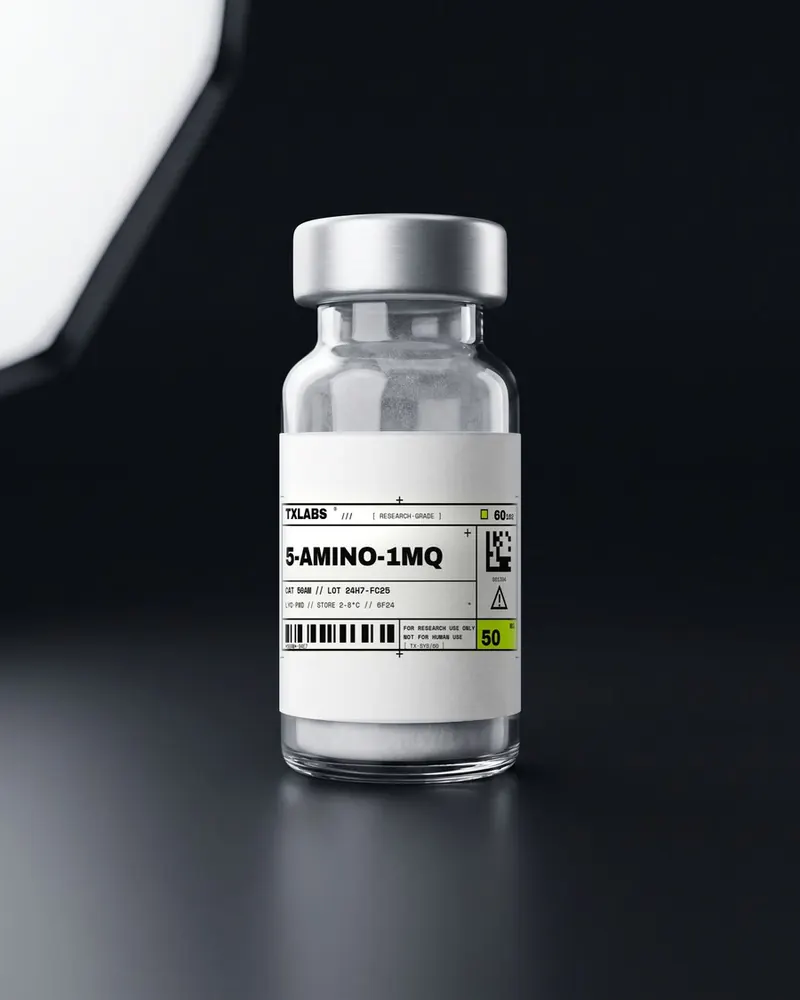
From $89 AUD · ≥98% HPLC purity · third-party COA · ships Australia-wide
What is 5-Amino-1MQ?
5-Amino-1MQ — a research-grade peptide reference supplied lyophilized for laboratory use only.
Specifications
- From: $89 AUD
- Category: Metabolic & GLP-1
- Form: Lyophilised powder
- Purity: ≥98% HPLC
- Testing: Third-party Certificate of Analysis
- Classification: Research reference material · For Research Use Only
What the research covers
5-Amino-1MQ is 5-amino-1-methylquinolinium, and the first thing to establish about it is that it is not a peptide. It is a small organic molecule built on a quinolinium ring system, catalogued in PubChem as CID 950107 for the cation, with the formula C10H11N2 for the free cation and a molecular weight near 159.2. It is most commonly supplied as the iodide salt, C10H11IN2, molecular weight approximately 286.1. It appears in peptide catalogues because of the research context it sits in, not because it shares any chemistry with the peptides around it, and nearly every instinct developed handling lyophilised peptides is the wrong instinct here.
Its pharmacological interest is as an inhibitor of nicotinamide N-methyltransferase, usually written NNMT. That enzyme transfers a methyl group from S-adenosylmethionine to nicotinamide, producing 1-methylnicotinamide and consuming a molecule of the cell's principal methyl donor in the process. Inhibiting the enzyme therefore has consequences on two fronts at once: it spares S-adenosylmethionine, and it leaves nicotinamide available to other routes, including the salvage pathway that supplies NAD. Published rodent and cell-culture work has examined NNMT inhibition in the context of adipocyte metabolism and of methyl-donor and NAD pool dynamics.
Structurally, the quaternary nitrogen at position 1 carries a permanent positive charge that no change of pH removes. That single feature accounts for most of its practical behaviour: it is freely water-soluble, it does not aggregate, it has no conformational state to preserve, and it is supplied as a salt whose counterion is part of what you weigh.
TXLABS supplies 5-amino-1MQ as an analytical reference material for laboratory research only. It is not an approved therapeutic good in Australia and is not supplied for human or veterinary administration.
Reading the certificate
A certificate for this material should look like a small-molecule certificate, and one that looks like a peptide assay is a signal that the wrong template was used. The elements that belong on it are HPLC purity with ultraviolet detection at a wavelength appropriate to the quinolinium chromophore, identity confirmed by nuclear magnetic resonance and by mass spectrometry, an explicit statement of the salt form and counterion, residual solvent content from the synthesis, and water content. What does not belong is an assay reported as milligrams of peptide, or a purity figure obtained by a peptide method. The salt form declaration matters more than anything else on the document, because without it molar concentration cannot be calculated at all. TXLABS publishes third-party certificates for tested lots in the CoA library; no certificate is currently published for 5-amino-1MQ, and the certificate for the lot supplied is available on request to support@txlabs.bio.
Storage and handling
A small aromatic salt is considerably more robust than a peptide and asks for different care. There is no cold chain imperative: material is normally held at room temperature or refrigerated, dry and protected from light, with a desiccant. Light protection is the one genuine control, because substituted quinolinium compounds absorb visibly and aromatic amines are prone to photochemical and oxidative discolouration. Appearance is diagnostic in a way it is not for peptides: 5-amino-1MQ is typically a yellow to orange solid rather than a white lyophilised cake, so anyone judging the material by expecting a white powder will conclude something is wrong when it is not, and equally will miss a genuine colour change that indicates degradation. Dissolution in water is immediate and needs no technique at all. In Australian conditions this is one of the few items in the catalogue where a hot letterbox is a minor issue rather than a serious one, though prolonged exposure to direct sunlight is still worth avoiding.
Working out concentration
The arithmetic is unchanged: mass over volume. A 10 mg vial with 1 mL of diluent gives 10 mg/mL, with 2 mL gives 5 mg/mL. The 50 mg vial with 5 mL gives 10 mg/mL and with 10 mL gives 5 mg/mL. Converting to molarity is where this compound differs from a peptide, and the difference is large: dividing by 159.2 for the free cation and by 286.1 for the iodide salt gives figures nearly a factor of two apart from the same weighed powder. Which figure is correct depends on the salt form, so read it from the certificate rather than assuming. The calculator handles the mass arithmetic. Concentration examples only, not a protocol.
How it relates to adjacent compounds
The nearest catalogue neighbour by subject matter rather than chemistry is NAD, since NNMT activity sits upstream of nicotinamide availability and therefore of the salvage route that supplies the dinucleotide. AICAR is the other non-peptide small molecule in this batch and raises the same point from a different direction, being a nucleoside whose characterisation requirements are equally unlike a peptide's. Glutathione is a useful third comparison as a genuine peptide that nonetheless behaves like a small molecule in most respects. What all three share with 5-amino-1MQ is that a certificate written on a peptide template describes them badly, and that the salt or counterion form has to be stated before any molar figure can be calculated. These are subject-matter and analytical-category adjacencies only, and they imply nothing whatever about comparative activity.