Cagrilintide Australia — Amylin Analogue Reference Material
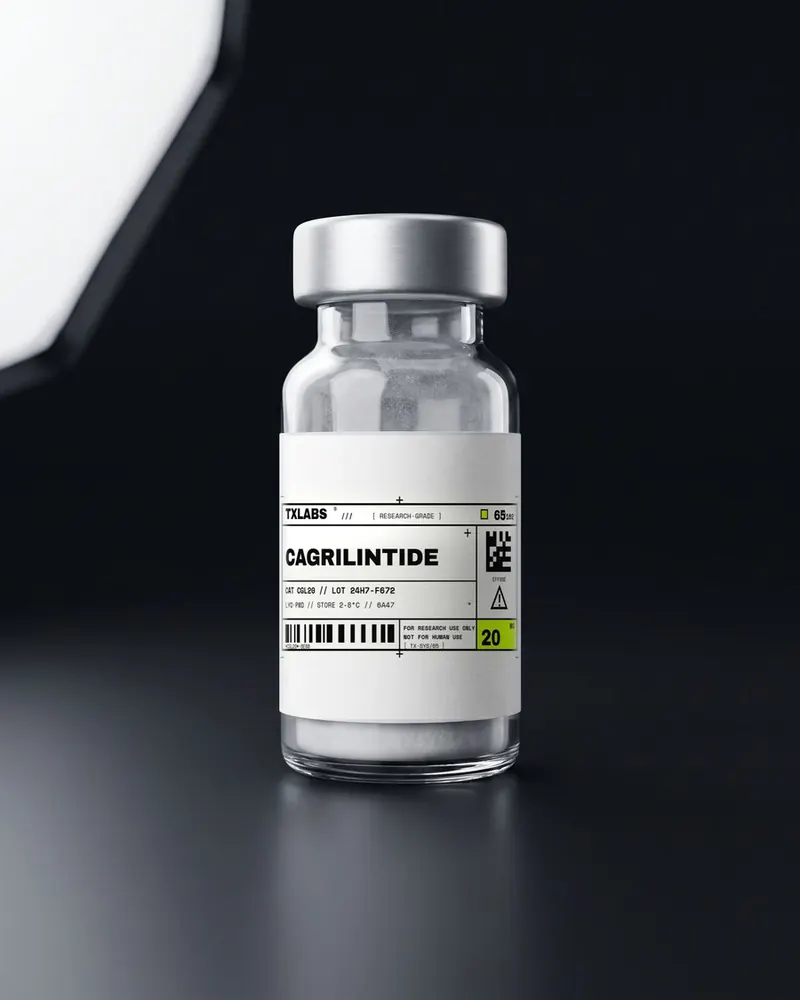
From $169 AUD · ≥98% HPLC purity · third-party COA · ships Australia-wide
What is Cagrilintide?
Cagrilintide — a research-grade peptide reference supplied lyophilized for laboratory use only.
Specifications
- From: $169 AUD
- Category: Metabolic & GLP-1
- Form: Lyophilised powder
- Purity: ≥98% HPLC
- Testing: Third-party Certificate of Analysis
- Classification: Research reference material · For Research Use Only
What the research covers
Cagrilintide is a synthetic long-acting analogue of human amylin, and it is worth stating plainly that it is not an incretin analogue. Amylin, also called islet amyloid polypeptide, is a 37-residue hormone co-secreted with insulin from pancreatic beta cells, and it signals through amylin receptors, which are complexes of the calcitonin receptor with receptor activity-modifying proteins rather than through the GLP-1 or GIP receptors. Cagrilintide is grouped with incretin analogues in supplier catalogues because of shared research context, not shared pharmacology, and confusing the two is a common error.
PubChem lists cagrilintide with the molecular formula C194H312N54O59S2 and a molecular weight near 4409 Da. The two sulfur atoms reflect a retained intramolecular disulfide bond, a feature inherited from amylin and calcitonin, and the C-terminus is amidated. The molecule also carries a fatty diacid acylation that promotes reversible albumin binding, which is the design feature responsible for its reported extended half-life relative to native amylin. Native human amylin is notoriously aggregation-prone and forms amyloid fibrils, and sequence modification to suppress that behaviour, an approach previously taken with pramlintide, is part of what an analogue of this class has to solve.
Published research on cagrilintide has examined amylin and calcitonin receptor pharmacology, receptor selectivity across the calcitonin receptor family, and food-intake and metabolic endpoints in animal models. Clinical trial programmes have been reported, including work studying cagrilintide together with a GLP-1 receptor agonist. The independent mechanistic literature is thinner than for the incretin analogues, and a good deal of what exists derives from a single development programme, which is worth keeping in view when reading it.
TXLABS supplies cagrilintide as an analytical reference material for laboratory research only. It is not an approved therapeutic good in Australia and is not supplied for human or veterinary administration.
Reading the certificate
Three checks are specific to an acylated, disulfide-containing peptide of this size. Confirm the observed mass against the expected value near 4409 Da, since a des-acyl species will differ by the mass of the fatty chain while eluting nearby on reversed-phase HPLC. Confirm the disulfide is intact, because the reduced form differs by about two daltons and behaves differently in solution. Check for high-molecular-weight species, since aggregates in an amylin-family analogue are a stability finding rather than a curiosity, and size-exclusion chromatography is the method that reveals them. TXLABS publishes third-party certificates for its tested lots in the CoA library. No certificate is currently published for cagrilintide. The certificate for the specific lot supplied will be provided on request to support@txlabs.bio.
Storage and handling
Cagrilintide combines two liabilities that its handling has to respect. It is acylated, so it is amphiphilic and aggregates under shear at air-liquid interfaces, and it descends from a peptide family with a documented tendency to form fibrils, which makes mechanical stress a more serious matter here than for an inert short peptide. Add diluent gently down the vial wall, swirl rather than shake, and never vortex. It also carries an intramolecular disulfide, so avoid reducing agents such as dithiothreitol or beta-mercaptoethanol in any diluent, since reduction opens the ring and changes the molecule. Store the lyophilised cake at -20 °C, desiccated and dark, and equilibrate to room temperature before opening. Hold reconstituted solution at 2-8 °C, protected from light, and aliquot before freezing. Under Australian summer conditions, a parcel left in a hot vehicle or letterbox above 40 °C is exactly the thermal insult that promotes aggregation in this class. Collect promptly and refrigerate.
Working out concentration
Cagrilintide is stocked in 10 mg and 20 mg vials. A 10 mg vial reconstituted with 2 mL of bacteriostatic water gives 5 mg/mL; with 1 mL, 10 mg/mL. A 20 mg vial with 2 mL gives 10 mg/mL, and with 4 mL, 5 mg/mL, so the same volume produces double the concentration in the larger vial. At roughly 4409 Da, a 5 mg/mL solution is approximately 1.1 mM, which is the conversion needed when receptor pharmacology work is specified in molar rather than mass terms. The reconstitution calculator handles vial mass against diluent volume. These are worked concentration examples for record-keeping, not a protocol of any kind.
How it relates to adjacent compounds
Cagrilintide is the only amylin-family compound in this catalogue, so its relationships to neighbours are mostly relationships of contrast. Semaglutide and tirzepatide share the fatty-diacid half-life-extension strategy but act at incretin receptors, whereas cagrilintide acts at calcitonin receptor complexes, a different receptor family with different signalling. The catalogue also lists co-formulated vials pairing cagrilintide with an incretin analogue, which exist because those two receptor systems are studied together, not because the molecules are related. Structurally, cagrilintide's closest kin outside this catalogue are calcitonin and pramlintide rather than anything shelved beside it. It is also the only compound in the catalogue whose parent hormone is itself a well-studied amyloid former, which shapes its handling as much as its pharmacology. These are receptor and structural relationships only.