Botulinum Toxin Australia — Restricted Reference Standard
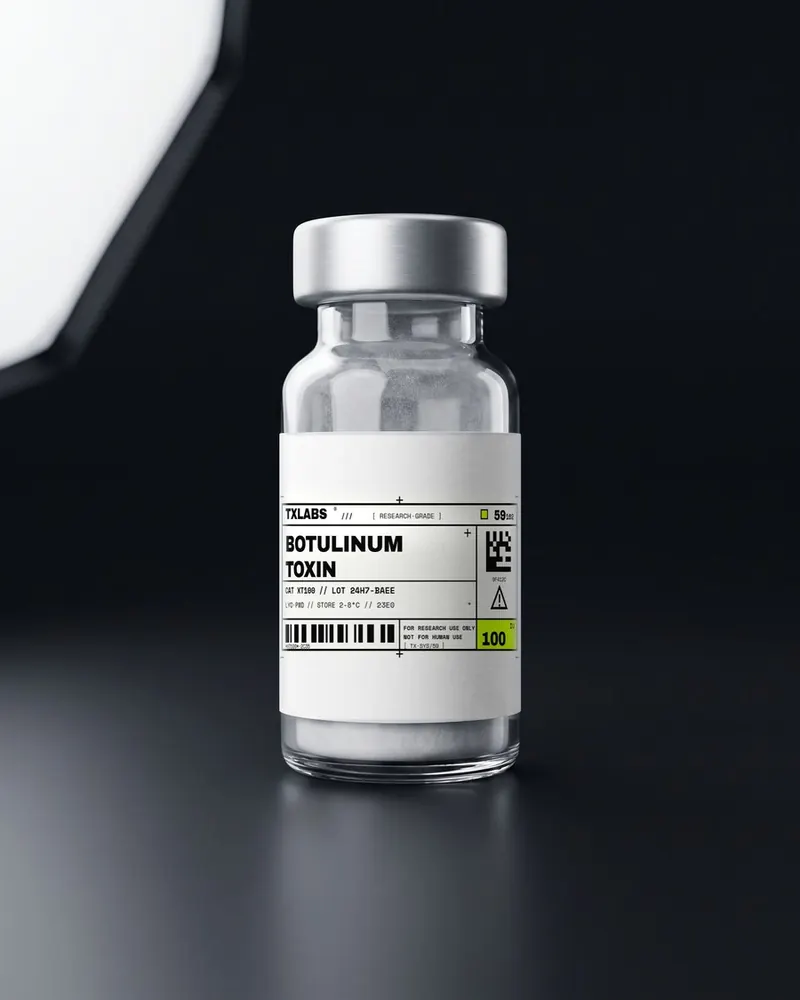
From $299 AUD · ≥98% HPLC purity · third-party COA · ships Australia-wide
What is Botulinum toxin?
Botulinum toxin is a Clostridium botulinum neurotoxin that cleaves the SNARE protein SNAP-25 to inhibit acetylcholine release. It is supplied strictly as a research reference for neuromuscular and SNARE-mediated exocytosis studies.
Specifications
- From: $299 AUD
- Category: Aesthetic & Skin
- Form: Lyophilised powder
- Purity: ≥98% HPLC
- Testing: Third-party Certificate of Analysis
- Classification: Research reference material · For Research Use Only
What the research covers
Botulinum toxin is a prescription-only medicine in Australia and a substance controlled under the Poisons Standard. TXLABS supplies it strictly as an analytical reference standard. It is not supplied for human or veterinary administration, and this page does not describe any clinical or cosmetic use.
The material is a bacterial protein toxin produced by Clostridium botulinum and related clostridia. It is synthesised as a single polypeptide chain of approximately 150 kDa which is subsequently cleaved into a two chain form: a light chain of roughly 50 kDa and a heavy chain of roughly 100 kDa, held together by a single interchain disulfide bond together with non-covalent contacts. The light chain is a zinc-dependent endopeptidase carrying the canonical HEXXH zinc binding motif. The heavy chain carries two functional domains, a C-terminal region responsible for binding at the target cell surface and an N-terminal region responsible for translocation across the endosomal membrane. Several antigenically distinct serotypes are recognised, conventionally designated A through G, differing in sequence, in the SNARE protein they cleave and in the peptide bond at which they cut. In laboratory work the protein is normally encountered as part of a larger non-covalent complex with associated non-toxic proteins rather than as the isolated neurotoxin.
Because its activity is enzymatic and its potency is expressed in units of biological activity rather than in mass, botulinum toxin is not ordinary laboratory material and is not comparable to the synthetic peptides that make up most of this catalogue. It requires specialist containment, institutional biosafety committee approval, documented chain of custody, defined inactivation and waste procedures, and personnel trained specifically for it. Facilities without those arrangements in place should not hold it.
TXLABS supplies botulinum toxin as an analytical reference standard for appropriately approved and equipped laboratories only. It is a prescription medicine in Australia, it is not supplied for human or veterinary administration, and it is not offered for any therapeutic or cosmetic purpose.
Reading the certificate
The defining feature of a certificate for this material is that the number that matters cannot be obtained by the methods used for peptides. Potency is established by a biological activity assay, and neither reversed-phase HPLC purity nor an observed mass by mass spectrometry establishes it: a protein can be intact by mass and inactive, or degraded and still assay above specification. Ask what assay defined the unit, since unit definitions are not interchangeable between manufacturers. Ask which serotype is stated, since serotypes differ in substrate and in specificity. Ask what the material actually is, isolated neurotoxin or a complex with associated non-toxic proteins, since the two behave differently. Ask what the excipient composition is, because carrier protein and stabiliser dominate the mass. TXLABS publishes third-party certificates for tested lots in the CoA library; no certificate is currently published for botulinum toxin. The lot certificate is available on request to support@txlabs.bio.
Storage and handling
Handling requirements for this material are set by biosafety governance rather than by convenience. Possession, storage, transport and disposal should follow the conditions imposed by the holder's institutional biosafety committee and the applicable state and Commonwealth controls, and those conditions take precedence over any general guidance. Access should be restricted, holdings should be reconciled against a written inventory, and every transfer should be recorded.
The chemistry, considered narrowly, is that of a large multi-domain protein with an essential interchain disulfide. Proteins of this class are sensitive to surface adsorption at low concentration, to shear and interfacial stress from shaking or vigorous mixing, to repeated freezing and thawing, and to disulfide reduction or scrambling. Lyophilised material is held frozen, protected from light and from moisture, and equilibrated to room temperature in its sealed container before opening. Solutions are kept cold and are not agitated. Aliquoting in preference to repeated freeze and thaw applies here as it does to other proteins.
Australian transit conditions can exceed 40 C. For a controlled protein toxin the correct response to any temperature excursion, breach of packaging or inventory discrepancy is to escalate under the facility's incident procedure rather than judge it locally.
Working out concentration
Potency for this material is expressed in units of biological activity, not in mass, so the arithmetic is unit accounting rather than a mass to volume conversion. The TXLABS presentation is nominally 100 units per vial. On that basis 100 units taken into 1 mL corresponds to 100 units per mL, into 2 mL to 50 units per mL, and into 4 mL to 25 units per mL. Units cannot be converted to a mass figure without the manufacturer's specific activity for that lot, and a unit defined by one assay is not necessarily equivalent to a unit defined by another. The calculator covers ordinary mass and volume conversions. This is analytical unit accounting only. It is not preparation guidance and it is not a protocol.
How it relates to adjacent compounds
Nothing else in this catalogue is comparable to this material, and the useful comparisons are analytical rather than pharmacological. ACE-031 is the other large recombinant protein stocked here, and it shares the problems of aggregation, shear sensitivity and identity confirmation by size and gel methods rather than by HPLC purity. EPO and HMG are the other products whose potency is expressed in international units established by bioassay rather than in mass, which is the single most important thing to understand about all three. Beyond that structural and metrological adjacency there is no relationship: botulinum toxin is a controlled bacterial protein toxin with containment requirements that none of the other products carry, and it should not be reasoned about by analogy with them.