CJC-1295 with DAC Australia — Albumin-Binding GHRH Analogue
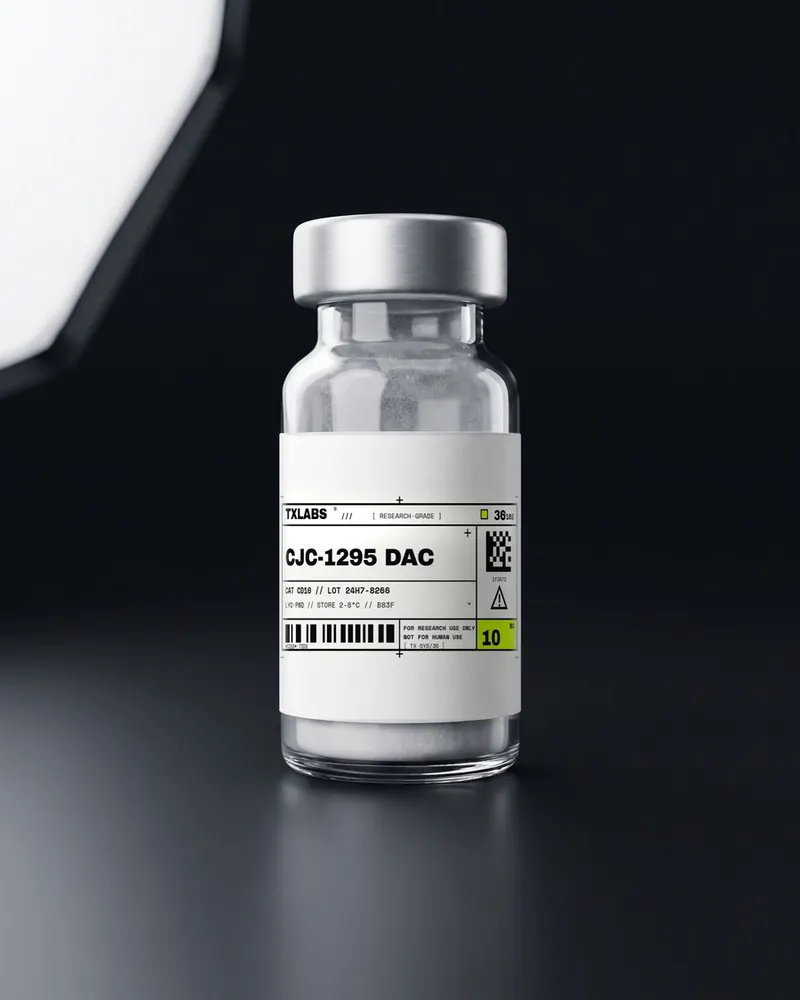
From $169 AUD · ≥98% HPLC purity · third-party COA · ships Australia-wide
What is CJC-1295 With DAC?
CJC-1295 with DAC (DAC:GRF) is a long-acting GHRH analogue whose Drug Affinity Complex binds albumin to prolong growth hormone release. It is investigated in preclinical research on sustained growth hormone-releasing hormone receptor stimulation and the GH/IGF-1 axis.
Specifications
- From: $169 AUD
- Category: GH & Secretagogues
- Form: Lyophilised powder
- Purity: ≥98% HPLC
- Testing: Third-party Certificate of Analysis
- Classification: Research reference material · For Research Use Only
What the research covers
CJC-1295 with DAC is a synthetic analogue of growth hormone-releasing hormone built on the GHRH(1-29) fragment and carrying a drug affinity complex, the modification the DAC designation refers to. PubChem lists the molecular formula C165H269N47O46 and a molecular weight of 3647.2 Da. The peptide portion is the tetrasubstituted GHRH(1-29) analogue also known as modified GRF(1-29), with reported substitutions of D-alanine at position 2, glutamine at 8, alanine at 15 and leucine at 27. The D-alanine at position 2 is the functionally decisive one, since it blocks dipeptidyl peptidase-4 cleavage at the N-terminus, the principal degradation route for native GHRH.
What separates this molecule from the version without DAC is a lysine-linked maleimidopropionamide group appended to the peptide. Maleimides react selectively with free thiols, and in circulation the available thiol is the unpaired cysteine on serum albumin. The result is a covalent peptide-albumin conjugate rather than the reversible, non-covalent albumin association used by acylated peptides such as semaglutide. That covalent strategy is why the reported circulating half-life for the DAC-bearing molecule is measured in days, whereas modified GRF(1-29) without the complex is reported in minutes. The two are not strength variants of one product; they are different molecules with a mass difference of roughly 280 Da.
The published literature has examined GHRH receptor binding and cAMP signalling, the chemistry of maleimide-albumin conjugation, and, in animal and early clinical studies from the 2000s, the pattern of growth hormone and IGF-1 responses produced by sustained rather than pulsatile GHRH receptor engagement. That distinction between pulsatile and sustained stimulation of a secretory axis is the main reason the DAC and non-DAC forms are studied as separate tools.
TXLABS supplies CJC-1295 with DAC as an analytical reference material for laboratory research only. It is not an approved therapeutic good in Australia and is not supplied for human or veterinary administration.
Reading the certificate
Two checks matter more than a purity percentage here. First, identity by mass: the DAC-bearing molecule sits at 3647.2 Da and modified GRF(1-29) without it near 3368 Da, a difference of roughly 280 Da that mass spectrometry resolves trivially. Material sold as with DAC that assays at the lower mass is simply the other product, and this substitution is a documented problem in the peptide supply chain. Second, the hydrolysed maleamic acid form, about 18 Da heavier than the intact maleimide, indicates material that has taken on water and lost its conjugating chemistry. TXLABS publishes third-party certificates for tested lots in the CoA library; no certificate is currently published for this compound. The certificate for the lot supplied is available on request to support@txlabs.bio.
Storage and handling
The maleimide group is what dictates handling here, and it is the most chemically reactive functional group of any compound in this catalogue. Maleimides hydrolyse to the unreactive maleamic acid in aqueous solution, and the rate rises sharply with pH and temperature, so alkaline diluents and warm solutions actively destroy the feature that defines the molecule. They also react with any free thiol present, which means reducing agents, thiol-containing buffers and cysteine-bearing proteins must be kept out of the diluent. Store the lyophilised cake at -20 °C, desiccated and protected from light, and equilibrate to room temperature before opening so that condensation does not wet a hygroscopic powder. Keep reconstituted solution cold at 2-8 °C, use it promptly rather than storing it for weeks, and aliquot before freezing. Australian summer transit above 40 °C is a particular concern for this compound, because heat accelerates maleimide hydrolysis silently and without any visible change to the solution.
Working out concentration
CJC-1295 with DAC is supplied as a 10 mg vial. Reconstituted with 1 mL of bacteriostatic water it gives 10 mg/mL; with 2 mL, 5 mg/mL; with 5 mL, 2 mg/mL. At 3647.2 Da, a 5 mg/mL solution is approximately 1.4 mM. One practical point specific to this molecule: because the maleimide hydrolyses over time in aqueous solution, the interval between reconstitution and use is a variable worth recording alongside the concentration, in a way that is not necessary for an inert peptide. The reconstitution calculator resolves vial mass against diluent volume. Worked concentration arithmetic only, not a protocol.
How it relates to adjacent compounds
The direct comparison is CJC-1295 without DAC, which is the same tetrasubstituted GHRH(1-29) peptide with the maleimide complex omitted; the two differ by roughly 280 Da and by their reported half-lives, and each page explains the distinction from its own side. Sermorelin is the unmodified GHRH(1-29) parent with no substitutions at all, and tesamorelin takes the opposite structural route, keeping the full 44-residue GHRH sequence and adding an N-terminal acyl group for protease resistance. All four act at the GHRH receptor and differ in how they resist degradation. Only the DAC-bearing molecule carries reactive maleimide chemistry, which is why its storage requirements sit apart from the rest of this group despite the shared peptide backbone. Structural relationships only.