CJC-1295 + Ipamorelin 10mg Australia — Co-Lyophilised
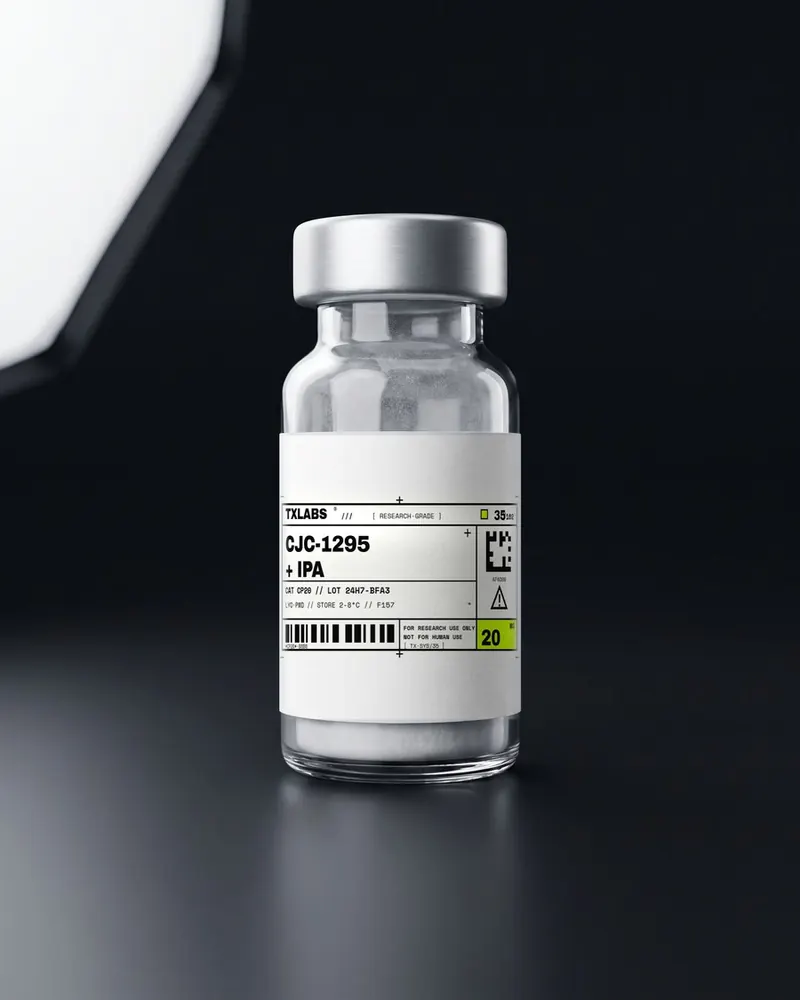
From $129 AUD · ≥98% HPLC purity · third-party COA · ships Australia-wide
What is CJC-1295 without DAC 10mg + IPA 10mg?
CJC-1295 without DAC + Ipamorelin (IPA) is a research blend pairing a short-acting GHRH analogue with a selective ghrelin receptor agonist. This 10mg + 10mg combination is studied for complementary growth hormone release, as Mod GRF 1-29 acts on the GHRH receptor and Ipamorelin on the ghrelin/GHS-R pathway.
Specifications
- From: $129 AUD
- Category: GH & Secretagogues
- Form: Lyophilised powder
- Purity: ≥98% HPLC
- Testing: Third-party Certificate of Analysis
- Classification: Research reference material · For Research Use Only
What the research covers
This vial contains two distinct research peptides co-lyophilised into a single cake, nominally 10 mg of CJC-1295 without DAC and 10 mg of ipamorelin, 20 mg of peptide in total. It is the double-strength form of the 5 mg plus 5 mg blend also stocked here. The two are separate molecules acting at separate receptors and a certificate should treat them separately.
CJC-1295 without DAC is more precisely described as modified GRF(1-29), a truncated analogue of growth hormone-releasing hormone. It uses the first 29 residues of GHRH, the shortest fragment reported to retain full agonist activity, with four amino acid substitutions reported as D-Ala at position 2, Gln at 8, Ala at 15 and Leu at 27. The D-Ala substitution is the functionally important one, blocking dipeptidyl peptidase-4 cleavage at the N-terminus, which is the principal degradation route for native GHRH. Its molecular weight is in the region of 3.4 kDa. The without DAC designation denotes the absence of the drug affinity complex, the maleimide group that allows the DAC-modified version to bind covalently to serum albumin.
Ipamorelin is a pentapeptide of 711.9 Da acting at the growth hormone secretagogue receptor GHS-R1a, the ghrelin receptor. It is a synthetic molecule with no sequence relationship to GHRH or to ghrelin. Research literature pairs GHRH analogues with GHS-R1a agonists because they represent two independent inputs converging on the same pituitary somatotroph population, and published work in cell and animal models has examined whether combined receptor engagement produces additive or synergistic secretory responses.
TXLABS supplies this blend as an analytical reference material for laboratory research only. It is not an approved therapeutic good in Australia and is not supplied for human or veterinary administration.
Reading the certificate
Per-component assay is the whole question for a blend, and here the components are easy to separate, so there is no technical excuse for a combined figure. At roughly 3.4 kDa and 711.9 Da the two masses are far apart and unambiguous by mass spectrometry, and their reversed-phase retention differs markedly. Ask for two purity figures, two observed masses and two content values, and confirm the ratio matches the label rather than assuming it. For the GHRH analogue specifically, ask whether the method resolves the methionine sulfoxide, and whether the substitution pattern was confirmed, since modified GRF(1-29) differs from plain sermorelin at four positions and the two are close in mass. Salt form and net peptide content should be stated for each. TXLABS publishes third-party certificates for tested lots in the CoA library; no certificate is currently published for this blend. The lot certificate is available on request to support@txlabs.bio.
Storage and handling
A blend is stored on the terms of its least stable component, and here that is the 29-residue GHRH analogue rather than the pentapeptide. Modified GRF(1-29) carries several liabilities at once: methionine, which oxidises to the sulfoxide with a sixteen dalton shift, asparagine and aspartate residues subject to deamidation and isomerisation, and a tendency to aggregate at high concentration. Ipamorelin at five residues is chemically far more robust, containing no cysteine and no methionine, and it is not the component that sets the storage terms.
The consequence for a blend is that differential degradation shifts the ratio with no visible sign. A vial can look correct, assay correctly for total peptide, and contain a different ratio than the label states.
Store the cake at -20 C, desiccated and protected from light, and equilibrate the sealed vial before opening so moisture does not condense onto a hygroscopic powder. Once reconstituted the two peptides share one solution and every decision applies to both: hold at 2-8 C in the dark, add diluent gently down the vial wall, swirl rather than shake, and aliquot before freezing. Australian summer transit above 40 C produces exactly that silent shift.
Working out concentration
For a blend, concentration has to be tracked per component or the record is meaningless. This vial holds nominally 10 mg of CJC-1295 without DAC and 10 mg of ipamorelin, 20 mg of peptide in total. Reconstituted with 2 mL of bacteriostatic water it gives 5 mg/mL of each and 10 mg/mL of total peptide; with 4 mL, 2.5 mg/mL of each and 5 mg/mL total; with 1 mL, 10 mg/mL of each and 20 mg/mL total. Recording only the total is the common error, since it doubles the apparent concentration of either component. Note also that the 5 mg plus 5 mg blend at the same diluent volume gives exactly half these figures. The reconstitution calculator handles the arithmetic. Concentration examples only, not a protocol.
How it relates to adjacent compounds
Both components are stocked individually as CJC-1295 without DAC and ipamorelin, and those pages carry the detail on each molecule. The same pairing is stocked at half strength as CJC-1295 without DAC 5 mg with ipamorelin 5 mg, which is chemically identical and differs only in mass. CJC-1295 with DAC is the albumin-binding variant and is a materially different molecule, not an alternative presentation of the same one. The tesamorelin and ipamorelin blend listed separately pairs a different GHRH analogue with the same secretagogue at an unequal ratio, so it is a different product rather than a variant of this one. These are structural and design adjacencies only, and imply nothing about comparable activity.