SNAP-8 Australia — Acetyl Octapeptide-3 Research Peptide
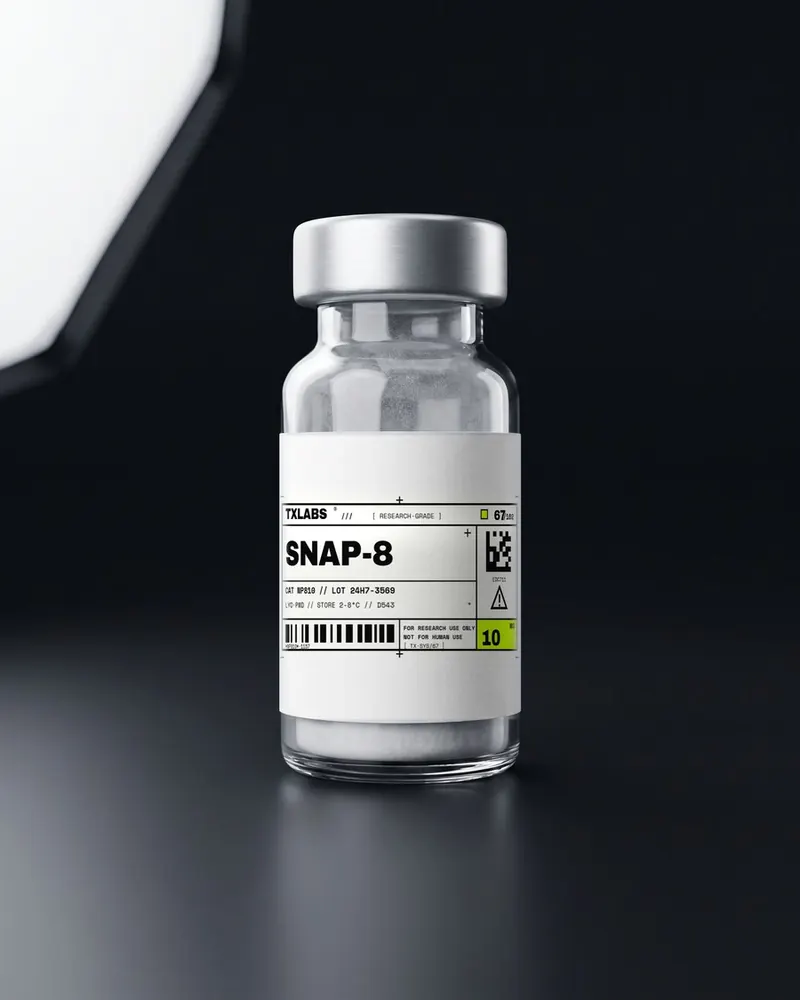
From $39 AUD · ≥98% HPLC purity · third-party COA · ships Australia-wide
What is SNAP-8?
SNAP-8 — a research-grade peptide reference supplied lyophilized for laboratory use only.
Specifications
- From: $39 AUD
- Category: Cognitive & Nootropic
- Form: Lyophilised powder
- Purity: ≥98% HPLC
- Testing: Third-party Certificate of Analysis
- Classification: Research reference material · For Research Use Only
What the research covers
SNAP-8 is the common name for acetyl octapeptide-3, a synthetic eight-residue peptide carrying an N-terminal acetyl group, CAS number 868844-74-0. The sequence is conventionally given as Ac-Glu-Glu-Met-Gln-Arg-Arg-Ala-Asp, and the reported molecular weight sits near 1075 Da, although quoted figures differ slightly between sources depending on whether the C-terminus is described as the free acid or the amide. That inconsistency is itself worth noting: the certificate for the lot supplied is the reference to work from rather than a number taken from a catalogue listing.
The design lineage is specific. SNAP-8 is an elongated version of acetyl hexapeptide-8, better known as Argireline, sharing its first six residues and adding two more. Both were modelled on the N-terminal region of SNAP-25, one of the SNARE proteins that mediate vesicle fusion, and the proposed rationale is competitive interference with SNARE complex assembly in vitro. The concept is straightforward to state and considerably harder to demonstrate.
The evidence base should be read carefully. The mechanistic rationale is largely inferred from the sequence relationship to SNAP-25 rather than established by direct structural or biophysical work on the peptide itself. The published literature is thin and heavily weighted towards cosmetic ingredient industry sources, the in vitro SNARE competition model is not well corroborated by independent groups, and the concentrations at which any competitive effect has been reported in cell-free systems are not obviously relevant to other settings. A page that presented this as a well-established mechanism would be overstating the record.
TXLABS supplies SNAP-8 as an analytical reference material for laboratory research only. It is not an approved therapeutic good in Australia and is not supplied for human or veterinary administration.
Reading the certificate
For a short synthetic acetylated peptide the certificate should settle three things. First, that the N-terminal acetylation is present and complete: the acetyl group adds forty-two daltons, and unacetylated peptide is a distinct species with distinct properties, so an observed mass forty-two daltons low indicates incomplete capping. Second, whether the C-terminus is the free acid or the amide, since sources disagree and the two differ by about one dalton, which is resolvable by accurate mass but only if the question is asked. Third, whether the chromatography resolves the methionine sulfoxide, which elutes near the parent and carries a plus-sixteen shift. Salt form and net peptide content complete it. TXLABS publishes third-party certificates for tested lots in the CoA library; no certificate is currently published for SNAP-8. The lot certificate is available on request to support@txlabs.bio.
Storage and handling
Two features of the sequence set the handling requirements. The peptide contains a methionine residue, and the thioether side chain oxidises readily to the sulfoxide in air or in the presence of trace metals and peroxides, adding sixteen daltons and shifting reversed-phase retention. It also contains glutamine and asparagine-adjacent chemistry, with the C-terminal aspartate and the glutamine residues susceptible to deamidation and to related rearrangement in aqueous solution, both of which accelerate with warmth and with pH away from mildly acidic. The two arginine residues make the peptide strongly basic overall despite the glutamates, so its solubility and its chromatographic behaviour are pH-dependent.
Store the lyophilised powder at -20 C, desiccated and protected from light, and equilibrate the sealed vial to room temperature before opening so that moisture does not condense onto cold material. Add diluent down the vial wall and swirl gently. Hold reconstituted solution at 2-8 C in the dark, aliquot into single-use volumes rather than freeze-thaw cycling, and prepare working dilutions fresh. Australian summer freight above 40 C accelerates methionine oxidation in particular, since the reaction proceeds even in the dry state given trace oxidants, so prompt collection and cold, dark storage on arrival are worthwhile.
Working out concentration
The TXLABS SNAP-8 vial is 10 mg. Ten milligrams taken into 2 mL of bacteriostatic water gives 5 mg/mL; into 1 mL, 10 mg/mL; into 5 mL, 2 mg/mL. Using an approximate molecular weight of 1075 Da, 5 mg/mL corresponds to roughly 4.7 millimolar. Because published figures for the molecular weight differ slightly between sources, a molar calculation should use the mass reported on the certificate for the lot supplied rather than a catalogue value, and the difference is large enough to matter at the precision most assay work requires. The reconstitution calculator resolves any vial and volume pairing. Concentration arithmetic only, not a protocol.
How it relates to adjacent compounds
SNAP-8 belongs to the group of cosmetic-science peptides in this catalogue rather than to any neurological group, despite its name deriving from a neuronal protein. Matrixyl is its nearest sibling: another short synthetic peptide with a commercial rather than academic origin, a comparably industry-weighted literature and the same requirement to confirm a terminal modification on the certificate. GHK-Cu shares the skin research context but has a much longer and more independent published record, which makes it a useful point of comparison when weighing how much a body of literature actually supports. Hyaluronic acid is a further neighbour by category only. These are category and provenance adjacencies, and imply nothing about comparable activity or interchangeable use.