Melatonin Australia — Indoleamine Reference Standard
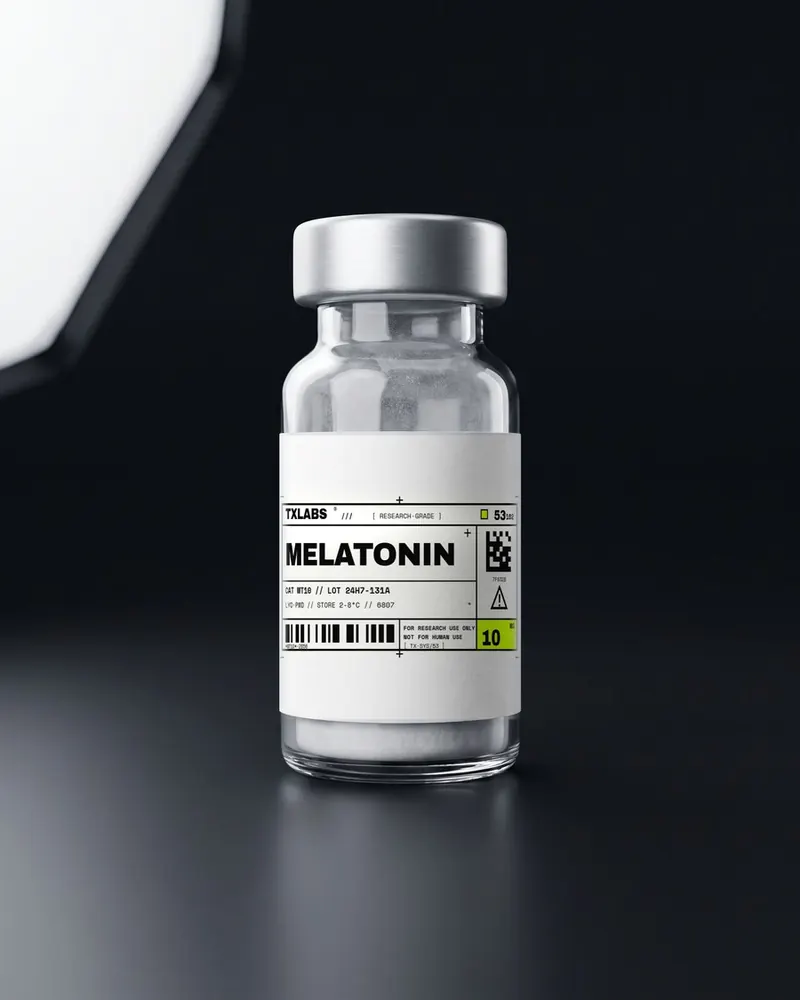
From $199 AUD · ≥98% HPLC purity · third-party COA · ships Australia-wide
What is Melatonin?
Melatonin — a research-grade peptide reference supplied lyophilized for laboratory use only.
Specifications
- From: $199 AUD
- Category: Cognitive & Nootropic
- Form: Lyophilised powder
- Purity: ≥98% HPLC
- Testing: Third-party Certificate of Analysis
- Classification: Research reference material · For Research Use Only
What the research covers
Melatonin is a small molecule, not a peptide. Its chemical name is N-acetyl-5-methoxytryptamine, molecular formula C13H16N2O2, molecular weight approximately 232.3 Da. Structurally it is an indole bearing a methoxy group at the 5-position and an N-acetylated ethylamine side chain, biosynthesised from serotonin by two enzymatic steps. It is an endogenous indoleamine produced principally by the pineal gland, and it is one of the most widely used reference standards in circadian biology.
Melatonin is regulated as a therapeutic good in Australia and its position is genuinely nuanced. Registered prescription medicines containing melatonin exist on the Australian Register of Therapeutic Goods, and the Poisons Standard carries entries that have changed over time, including a prescription entry for melatonin for human use together with a narrower entry covering specific modified release presentations supplied under pharmacist control. The boundaries between those entries are defined by strength, formulation and indication, and further amendments have been proposed. A bulk research powder does not fall within any narrower exemption. The current Poisons Standard at tga.gov.au is the authoritative source and should be consulted directly rather than inferred from a general description.
The published research literature is very large and spans several distinct fields. Melatonin is an analyte in circadian phase assessment, where the timing of its rise in plasma or saliva is a standard laboratory marker; it is a reference ligand in receptor pharmacology at the MT1 and MT2 G protein-coupled receptors; and it is a subject of an extensive antioxidant and free radical chemistry literature examining its behaviour and that of its oxidation products in cell-free and cellular systems. Across all three, well characterised reference material is a routine requirement.
TXLABS supplies melatonin as an analytical reference material for laboratory research only. It is a regulated therapeutic substance in Australia, it is not supplied for human or veterinary administration, and no use of any kind is described here.
Reading the certificate
A melatonin certificate is a small-molecule document and shares almost nothing with a peptide certificate. There is no sequence, no salt form question in the usual sense and no deletion sequences. What is expected instead is chromatographic purity by HPLC with ultraviolet detection, a related substances profile that specifically addresses the oxidation and photodegradation products, an identity test by infrared or nuclear magnetic resonance spectroscopy or by comparison of the ultraviolet spectrum against a reference, a melting range, water content by Karl Fischer titration and residual solvents from the final crystallisation. Because melatonin is a pharmacopoeial substance, monograph specifications exist and a certificate that references one is more informative than a bare percentage. TXLABS publishes third-party certificates for tested lots in the CoA library; no certificate is currently published for melatonin. The lot certificate is available on request to support@txlabs.bio.
Storage and handling
The defining property of melatonin in the laboratory is photolability. The indole chromophore absorbs strongly in the ultraviolet and the molecule degrades measurably under ambient light, which is why melatonin standards are conventionally handled in amber glass or under foil and why solutions left on an open bench are unreliable. This is not a marginal effect and it accounts for a large share of the variability seen in careless quantitative work.
Oxidation is the second route. The indole ring is readily oxidised, and melatonin's oxidation products, including the kynuramine derivatives, are themselves studied compounds, so their appearance is a real chemical change rather than an inert impurity.
Solubility is the third practical issue. Melatonin is poorly soluble in water, on the order of a milligram or two per millilitre, so concentrated aqueous stocks are not achievable and stocks are conventionally prepared in ethanol or dimethyl sulfoxide. That is a solubility fact, not a recommendation.
Store the solid at -20 C, desiccated, sealed and protected from light, and equilibrate before opening. Keep solutions cold, dark and freshly made. Australian summer transit above 40 C combined with light exposure is the worst case here, so opaque packaging and prompt storage matter.
Working out concentration
The TXLABS melatonin vial is 10 mg. Because aqueous solubility is limited, the arithmetic has a real ceiling: 10 mg taken into 10 mL of water approaches 1 mg/mL and is near the practical limit, while 10 mg into 1 mL of ethanol or dimethyl sulfoxide gives a 10 mg/mL stock comfortably. Using a molecular weight of approximately 232.3 Da, 1 mg/mL corresponds to roughly 4.3 millimolar and 10 mg/mL to roughly 43 millimolar. Because the molecule is small, molar concentrations for a given mass are high relative to the peptides in this catalogue, which matters when published work specifies micromolar or nanomolar figures. The reconstitution calculator handles the arithmetic. Concentration examples only, not a protocol.
How it relates to adjacent compounds
Melatonin is catalogued with the cognitive and nootropic group, where almost all its neighbours are peptides and it is not. The most informative relationship in this catalogue is with epithalon, the synthetic tetrapeptide designed as an analogue of a fragment of a bovine pineal extract: the two are connected by pineal biology and by a shared research literature on circadian and ageing questions, while being entirely unrelated chemically. Pinealon comes from the same Russian bioregulator tradition and the same pineal framing. DSIP is a further neighbour by subject matter, being a peptide with a long and contested sleep-research literature. These are subject-matter adjacencies only, and imply nothing about comparable activity, mechanism or interchangeable use.