Cerebrolysin Australia — Porcine Brain Peptide Preparation
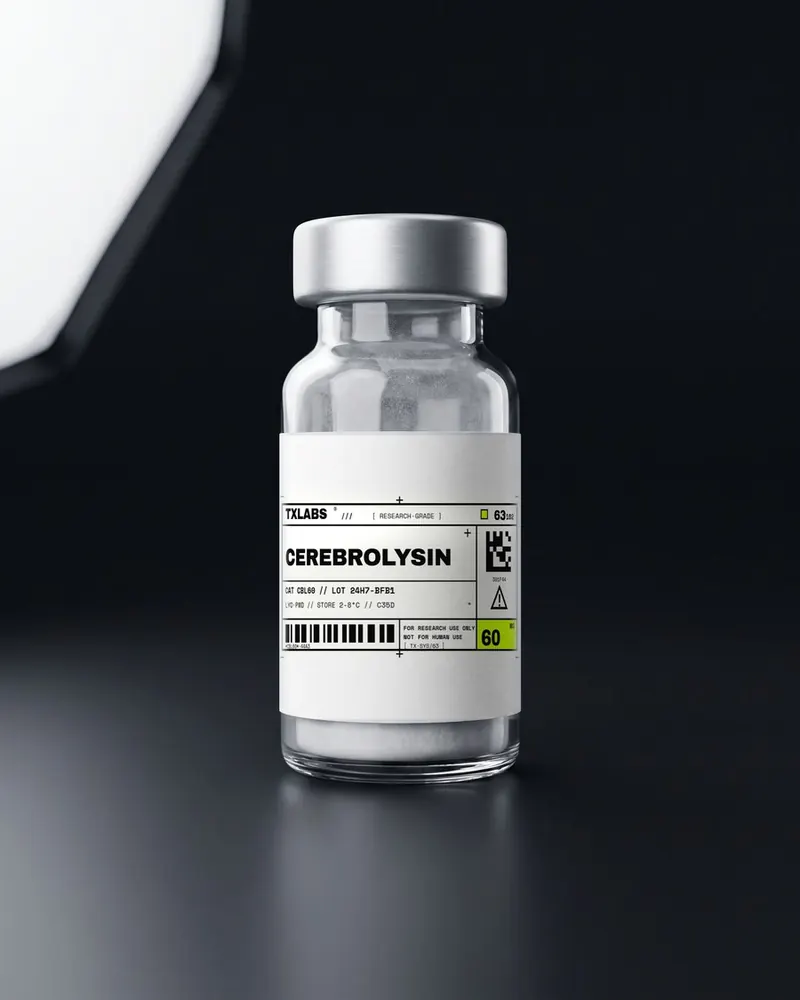
From $69 AUD · ≥98% HPLC purity · third-party COA · ships Australia-wide
What is Cerebrolysin?
Cerebrolysin — a research-grade peptide reference supplied lyophilized for laboratory use only.
Specifications
- From: $69 AUD
- Category: Cognitive & Nootropic
- Form: Lyophilised powder
- Purity: ≥98% HPLC
- Testing: Third-party Certificate of Analysis
- Classification: Research reference material · For Research Use Only
What the research covers
Cerebrolysin is not a molecule. It is a preparation: a heterogeneous mixture produced by controlled enzymatic hydrolysis of porcine brain protein, containing low molecular weight peptides together with a large proportion of free amino acids. Published descriptions of the pharmaceutical product characterise it as roughly fifteen percent low molecular weight peptides, generally below ten kilodaltons, and roughly eighty-five percent free amino acids, standardised batch to batch against manufacturing specifications rather than defined by a structure. The originator product is manufactured by EVER Neuro Pharma in Austria and is supplied as an aqueous concentrate at 215.2 mg of peptide preparation per millilitre.
That last point matters for anyone reading this page. The material TXLABS lists is a 60 mg research presentation, which is not the pharmaceutical concentrate and should not be assumed to be equivalent to it in composition, standardisation or provenance. Preparations of this type are defined by their manufacturing process, so two hydrolysates described by the same name are not necessarily the same material.
The published research literature is large and spans several decades, principally from central and eastern Europe and Asia, and includes both preclinical work and clinical trials in jurisdictions where the product is registered. Preclinical work has examined neurotrophic signalling, neuronal survival in culture and endpoints in rodent injury models. The interpretation of that literature is contested, and systematic reviews have raised questions about trial quality and about publication and sponsorship patterns. The deeper methodological problem is intrinsic: because the active substance is the mixture itself and no single component carries the described activity, mechanism cannot be pinned to a molecule and results cannot be reproduced from a defined chemical entity.
TXLABS supplies Cerebrolysin as a research-grade preparation for laboratory use only. It is not an approved therapeutic good in Australia and is not supplied for human or veterinary administration.
Reading the certificate
There is no purity percentage that means anything for a deliberately heterogeneous preparation, and a certificate offering one has misunderstood the material. What a useful certificate provides instead is compositional characterisation: total nitrogen or total protein content, free amino acid content and profile, and a peptide molecular weight distribution showing what proportion of the material sits below ten kilodaltons. Ask about the source species and tissue and about the process controls applied, since a hydrolysate is defined by its process. Ask about microbiological and endotoxin testing, which matter more for a biologically derived mixture than for a synthetic compound. Batch-to-batch consistency data, comparing a lot's profile against a reference profile, is the closest thing to an identity test available. TXLABS publishes third-party certificates for tested lots in the CoA library; no certificate is currently published for Cerebrolysin. The lot certificate is available on request to support@txlabs.bio.
Storage and handling
A hydrolysate is stored on the terms of its most fragile constituents, and since the composition is not fully defined, that means conservative handling throughout. The mixture contains peptides with free termini and unprotected side chains, so every ordinary degradation route is potentially present at once: oxidation of methionine, cysteine and tryptophan residues, deamidation of asparagine and glutamine, aspartimide formation at Asp-Gly motifs, and continued slow hydrolysis of peptide bonds. Free amino acids in solution are also susceptible to oxidation, and the mixture is an excellent microbial growth medium, so aseptic handling is not optional.
The specific hazard is that none of this is detectable without a compositional method. A hydrolysate that has degraded still looks like a hydrolysate and still assays as protein or as amino acid content. Only a peptide profile, typically by size exclusion or reversed-phase chromatography, reveals a shift in the distribution.
Store the lyophilised material at -20 C, desiccated and protected from light, and equilibrate the sealed vial before opening. Hold solutions cold, use them promptly, and aliquot rather than freeze-thaw. Australian summer transit above 40 C accelerates every one of the routes above simultaneously, so prompt collection and refrigeration matter.
Working out concentration
The TXLABS Cerebrolysin vial is 60 mg, and the arithmetic is straightforward mass per volume because there is no molecular weight to convert to. Sixty milligrams into 6 mL gives 10 mg/mL; into 3 mL, 20 mg/mL; into 12 mL, 5 mg/mL. Molar concentration is not a meaningful concept for a hydrolysate, since the material is a distribution of many species rather than one, and any figure expressed in millimolar terms for this product would be an error. For the same reason, comparing concentrations against the 215.2 mg/mL pharmaceutical concentrate is not a like-for-like comparison. The reconstitution calculator handles the mass and volume arithmetic. Concentration examples only, not a protocol.
How it relates to adjacent compounds
Cerebrolysin's nearest relative in this catalogue by kind rather than by subject is thymalin, which is likewise a tissue-derived peptide preparation rather than a defined molecule and raises the same certification problem: the material is its process, and no structure can be confirmed. Within the neurotrophic research area, P21 adamantane and P21 non-adamantane make the informative contrast, being single defined synthetic peptides addressing overlapping research questions with certificates that can state a sequence and a mass. Reading a hydrolysate and a defined tetrapeptide side by side is the clearest illustration in this catalogue of what analytical characterisation can and cannot deliver. These are category adjacencies only, and imply nothing about comparable activity.