PTD-DBM Australia — CXXC5-Targeting Research Peptide
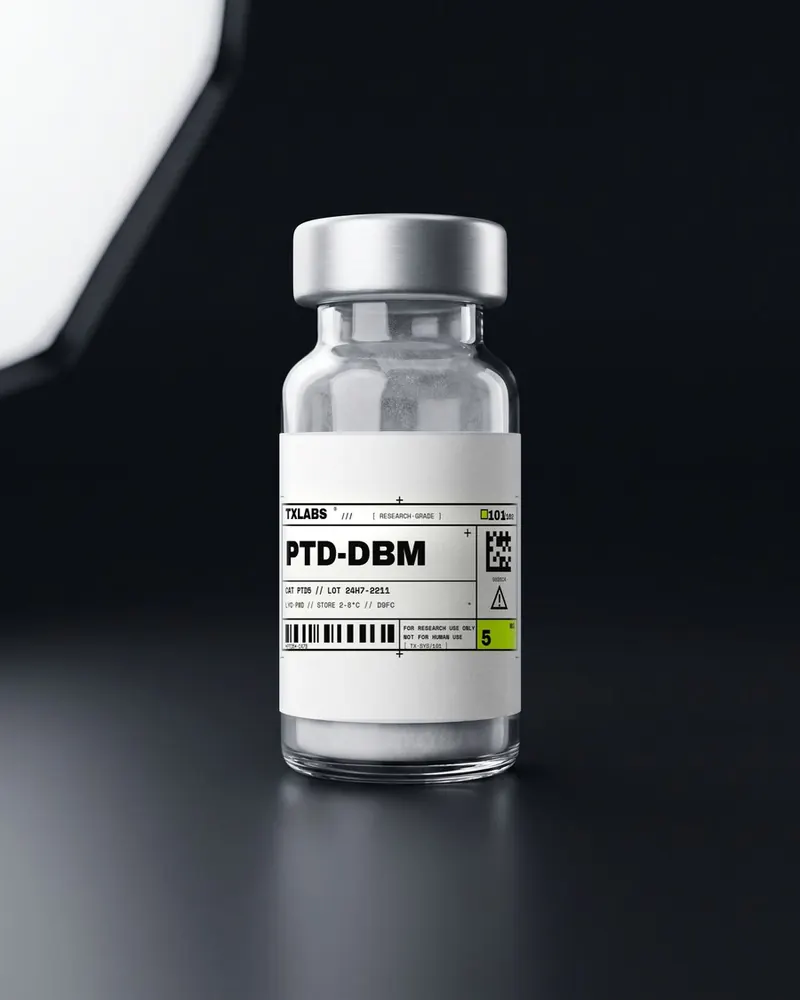
From $529 AUD · ≥98% HPLC purity · third-party COA · ships Australia-wide
What is PTD-DBM?
PTD-DBM is a synthetic cell-penetrating peptide that disrupts CXXC5-Dishevelled binding to activate the Wnt/beta-catenin pathway. It combines a protein transduction domain with a Dishevelled-binding motif and is investigated in preclinical hair-follicle and wound-healing research. PTD-DBM is used as a reference compound in Wnt signalling studies.
Specifications
- From: $529 AUD
- Category: Cognitive & Nootropic
- Form: Lyophilised powder
- Purity: ≥98% HPLC
- Testing: Third-party Certificate of Analysis
- Classification: Research reference material · For Research Use Only
What the research covers
PTD-DBM is a fusion construct whose name states its architecture: a protein transduction domain, meaning a cell-penetrating peptide sequence, joined to a Dishevelled-binding motif. The DBM portion is derived from CXXC5, a protein identified as a negative feedback regulator of Wnt/beta-catenin signalling. The published account is that CXXC5 binds directly to Dishevelled, a scaffolding protein central to canonical Wnt signal transduction, and that this interaction suppresses downstream pathway activity. A peptide reproducing the binding motif is intended to compete for that interaction and relieve the suppression.
The work originates from the laboratory of Kang-Yell Choi at Yonsei University in South Korea. The relevant publications include a 2015 report characterising CXXC5 as a Dishevelled-binding negative regulator, and a 2017 paper in the Journal of Investigative Dermatology reporting that topical application of PTD-DBM to mouse dorsal skin produced hair regrowth and follicle neogenesis in wound-induced assays, with CXXC5 knockout mice used as a genetic control.
The evidence position should be stated plainly. The underlying Wnt and Dishevelled biology is mainstream and extensively independently characterised. The specific claim about CXXC5 as a negative regulator, and the peptide built on it, come almost entirely from the originating laboratory and its collaborators, with limited independent replication by unaffiliated groups. All published work is preclinical, in cultured cells and in mice. In addition, the exact sequence, the choice of protein transduction domain and the molecular weight of the material sold commercially under this name are not fixed by any published specification, and figures in supplier listings should not be relied on. This page therefore describes the construct's design and declines to assert a mass.
TXLABS supplies PTD-DBM as an analytical reference material for laboratory research only. It is not an approved therapeutic good in Australia and is not supplied for human or veterinary administration.
Reading the certificate
For a fusion construct with no published reference specification, the certificate has to define the material rather than confirm it. Ask for the full sequence as the manufacturer states it, including which protein transduction domain was used, since different laboratories use different cell-penetrating sequences and the choice changes the molecule entirely. Ask for the observed mass as a number. Ask for the chromatogram, because at fusion-construct length deletion sequences differ by one residue, a small proportional mass change that co-elutes near the parent and is not excluded by a purity percentage alone. Salt form and net peptide content matter disproportionately for an arginine-rich peptide, where counterion can be a large share of gross weight. TXLABS publishes third-party certificates for tested lots in the CoA library; no certificate is currently published for PTD-DBM. The lot certificate is available on request to support@txlabs.bio.
Storage and handling
Protein transduction domains in common use are strongly cationic, typically arginine-rich, and that sets most of the practical behaviour of a construct built around one. Expect high aqueous solubility, strong adsorption to negatively charged surfaces, and appreciable loss of dilute working solutions to container walls. Low-binding labware and the addition of carrier protein are the conventional mitigations. Arginine-rich sequences also bind nucleic acids and anionic polymers non-specifically, which matters in any cell lysate work.
Because the exact sequence is not published, the internal chemistry has to be assumed conservatively. Any of the usual routes may apply: oxidation if methionine, cysteine or tryptophan are present, deamidation if asparagine or glutamine are, and hydrolysis of the backbone in solution. A fusion construct is also long enough that a single deletion during synthesis is a plausible failure with only a small proportional effect on mass.
Store the lyophilised powder at -20 C, desiccated and protected from light, and equilibrate the sealed vial to room temperature before opening. Add diluent gently and avoid vigorous agitation. Hold solutions at 2-8 C, aliquot rather than freeze-thaw, and prepare dilutions fresh. Australian summer transit above 40 C is a real risk, so refrigerate on arrival.
Working out concentration
The TXLABS PTD-DBM vial is 5 mg. Five milligrams into 1 mL gives 5 mg/mL; into 2 mL, 2.5 mg/mL; into 5 mL, 1 mg/mL. A molar figure is not given here, because no published specification fixes the sequence or the molecular weight of the commercial material and any molarity derived from a supplier-listed number would be unverified. The mass reported on the certificate for the lot supplied is the figure to work from. A further point specific to cationic constructs: because these peptides adsorb strongly to surfaces, the concentration actually delivered from a dilute working solution can be materially lower than the calculated one. The reconstitution calculator handles the arithmetic. Concentration examples only, not a protocol.
How it relates to adjacent compounds
PTD-DBM's closest structural relative in this catalogue is PNC-27: both are fusion constructs pairing a cell-penetrating leader with a motif designed to block a specific protein-protein interaction, and both raise the same certification problem, that the product name describes an architecture rather than a defined sequence. FOXO4-DRI belongs to the same design family as another engineered interaction disruptor, though it achieves protease resistance through retro-inversion rather than through a delivery domain. GHK-Cu is a distant neighbour by research area only, appearing in overlapping dermal and follicular literature while being an entirely different kind of molecule. These are design adjacencies only, and imply nothing about comparable activity or interchangeable use.