Humanin Australia — Mitochondrial-Derived Peptide Standard
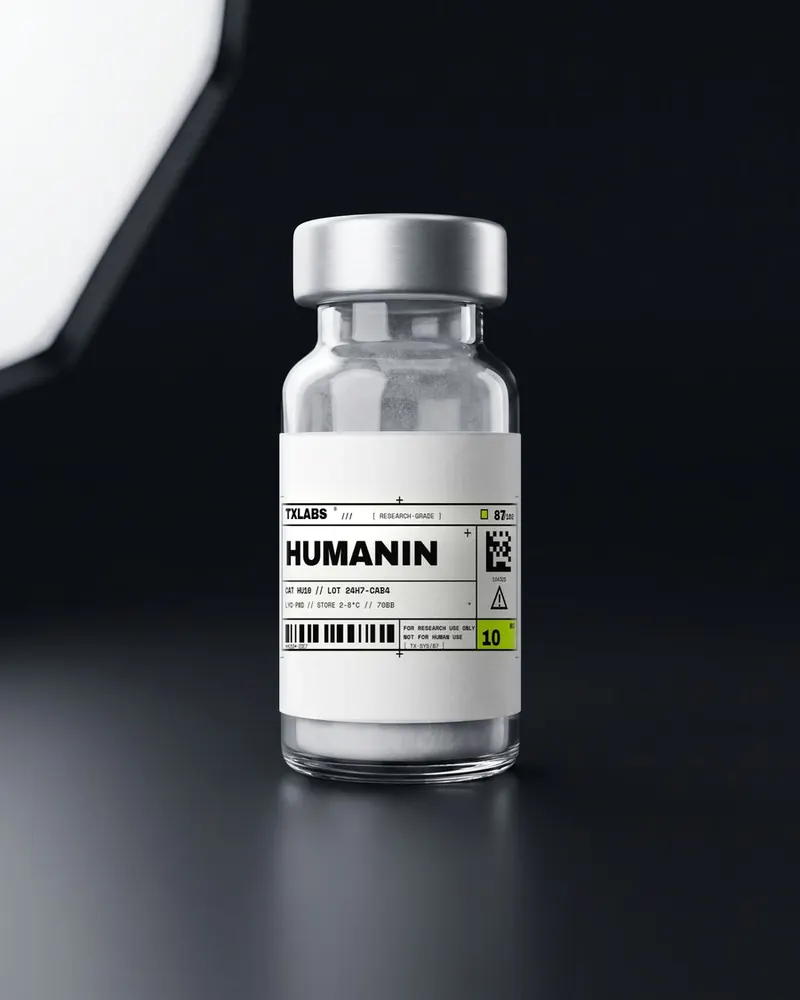
From $139 AUD · ≥98% HPLC purity · third-party COA · ships Australia-wide
What is Humanin?
Humanin is a 24-amino-acid mitochondrial-derived peptide studied for its cytoprotective, anti-apoptotic activity. Encoded within the mitochondrial genome, it is investigated in laboratory research on cellular stress resistance, amyloid-beta toxicity, metabolic regulation and JAK/STAT signalling.
Specifications
- From: $139 AUD
- Category: Cognitive & Nootropic
- Form: Lyophilised powder
- Purity: ≥98% HPLC
- Testing: Third-party Certificate of Analysis
- Classification: Research reference material · For Research Use Only
What the research covers
Humanin is a 24-residue peptide and one of the founding members of the mitochondrial-derived peptide class. It is encoded not in nuclear DNA but within an open reading frame in the 16S ribosomal RNA region of the mitochondrial genome, the same unusual genomic arrangement that later produced MOTS-c. The sequence most commonly cited is MAPRGFSCLLLLTSEIDLPVKRRA, and PubChem lists a corresponding molecular weight of 2687.2 Da, a figure that agrees with the mass calculated from that sequence.
Humanin was identified in the late 1990s in work screening for factors that protected neuronal cells from amyloid-beta toxicity, and the cytoprotective, anti-apoptotic phenotype described in that original context has anchored the field since. Published research has examined interaction with pro-apoptotic proteins of the Bcl-2 family, signalling through a receptor complex involving gp130 and associated components with consequent JAK/STAT activation, and effects in cellular stress models. Separate lines of work have examined metabolic parameters and circulating humanin concentrations in relation to age in observational human studies.
One point deserves emphasis for anyone buying material. Several humanin analogues exist, and the most widely used in published research is the S14G variant, usually written HNG, in which the serine at position 14 is replaced by glycine; that substitution lowers the mass by about 30 Da. A great deal of the potency described in the literature relates to HNG rather than to wild-type humanin, and material sold simply as humanin in the research supply chain may be either. The observed mass on a certificate is what distinguishes them, and no purity figure will.
TXLABS supplies humanin as an analytical reference material for laboratory research only. It is not an approved therapeutic good in Australia and is not supplied for human or veterinary administration.
Reading the certificate
Identity is the sharp issue. Confirm the observed mass against 2687.2 Da for the wild-type sequence, and note that the widely used S14G analogue HNG sits roughly 30 Da lower; material sold as humanin can be either, and only the mass on the certificate distinguishes them. Beyond identity, the expected impurities follow the sequence: methionine sulfoxide sixteen daltons above the parent, and cysteine-linked dimers at roughly double the parent mass, both of which reflect oxidative exposure rather than synthesis error. Deletion sequences from solid-phase synthesis across 24 residues are the third population. TXLABS publishes third-party certificates for tested lots in the CoA library; no certificate is currently published for humanin. The lot certificate is available on request to support@txlabs.bio.
Storage and handling
Humanin's sequence carries two specific chemical liabilities: a methionine at the N-terminus and a cysteine at position 8. The methionine oxidises to the sulfoxide, sixteen daltons heavier, and the free cysteine thiol can oxidise to form intermolecular disulfides, which produces dimers and higher aggregates rather than a simple mass shift. Both are accelerated by air exposure, warmth and light. Handling should therefore keep the vial open for as short a time as possible, minimise headspace, and hold solutions cold and dark. The central stretch of four consecutive leucines also gives the peptide a hydrophobic character that can limit aqueous solubility and encourage aggregation. Store the lyophilised cake at -20 °C, desiccated and light-protected, equilibrate before opening, hold reconstituted solution at 2-8 °C and aliquot before freezing. Australian summer transit above 40 °C accelerates both oxidation routes, so prompt collection and immediate refrigeration matter more here than for an inert sequence.
Working out concentration
The TXLABS humanin vial is 10 mg. Reconstituted with 2 mL of bacteriostatic water it gives 5 mg/mL; with 1 mL, 10 mg/mL; with 5 mL, 2 mg/mL. At 2687.2 Da a 5 mg/mL solution corresponds to roughly 1.9 mM, the conversion needed when published cell work specifies micromolar concentrations. The hydrophobic leucine-rich central region means aqueous solubility is not unlimited, so a solution that will not clear at high concentration is a property of the peptide rather than a fault in the vial; a lower working concentration is the usual response. The reconstitution calculator resolves vial mass against volume. Concentration arithmetic only, not a protocol.
How it relates to adjacent compounds
Humanin and MOTS-c are the two mitochondrial-derived peptides in this catalogue and are genuinely related in class: both are encoded in short open reading frames within mitochondrial ribosomal RNA regions, humanin in the 16S and MOTS-c in the 12S, and humanin's identification is what opened that field. They share no sequence homology and their proposed mechanisms differ entirely. SS-31 appears in the same mitochondrial research literature but is a synthetic tetrapeptide targeting a membrane lipid rather than a peptide of mitochondrial origin. NAD+ is subject-matter adjacent as a redox coenzyme. Being the first of the class to be identified, humanin is also the compound for which the term mitochondrial-derived peptide was originally coined. Class and subject relationships only.